Visualizzazione post con etichetta R TIGMANSHU DHULIA. Mostra tutti i post

01 luglio 2022

THE HINTERLAND STRIKES BACK

[Archivio]

The Hinterland strikes back, Parul Khanna Tewari, Brunch, 19 agosto 2012:

'The aspirations and imagery of small town India are being played out on celluloid like never before. While Mumbai continues to be the filmmakers’ muse, the action has shifted to Delhi over the last few years. But now, the industry’s lens has zoomed even further inward. Shyam Benegal’s Welcome To Sajjanpur (2008) was set in a fictitious village in central India. Anurag Kashyap’s Gangs Of Wasseypur I and II is rooted in Dhanbad, Jharkhand. Tigmanshu Dhulia’s Paan Singh Tomar (2012) finds its hero in Chambal, Madhya Pradesh. Abhishek Chaubey’s Ishqiya (2010) sees much of its action in Gorakhpur, Uttar Pradesh and Habib Faisal’s Ishaqzaade (2012) gives Almor (a fictitious village in UP), its three hours of fame. The films may be set in the hinterland, but are nothing like the stereotypical village stories of old Bollywood. (...) This time, the locations are real, the plots believable, the details authentic. (...) It’s changing the way the stories are being told, and larger cities appear to be lapping it up. "We are tired of living our cinematic dreams abroad," says author and film critic Anupama Chopra. "Filmmakers have explored the world, set stories and characters in New York and London and anywhere else fancy. This concept has done its time."

Small towns, big money
So movies, with a rural semi-realistic setting, are giving the urban viewer something different. We’re finally waking up to the fact that there are villages outside of Punjab. We are enjoying the stories even if what is depicted is far removed from what we have experienced in cities. And the box office proves this. "One of the first films we did that told the story of the hinterland India in a near-real setting was Welcome To Sajjanpur (2008)", says Rucha Pathak, senior creative director at Disney UTV Studios. "It was Shyam Benegal’s biggest grosser." Four years later, UTV, still cautious, released only limited prints of Paan Singh Tomar. It was only after the film started to pick up through word-of-mouth, that they released more prints, making the film a runaway hit. "Authenticity does appeal to people," Pathak admits, explaining how the bulk of the revenue came first from big cities and then from smaller ones. "The former contributed to the success of the movie." Pathak has an explanation: migration of people from little towns to the cities with whom these movies resonate. These are people who respond to a different kind of story. “They would not, even now, understand proms and live-ins. It’s a world they don’t know and a whole lot of it, they don’t even aspire for,” says Chopra. Adding, “Now, the film industry wants to cater to everyone. Everyone wants to get into the 100-crore club. They want to appeal to the person sitting in Dhanbad as well as Delhi. And reaching out to a wider audience is the key.” (...)


Agents of change
One reason for this shift in sensibilities is the new crop of directors, producers and scriptwriters that small town India is importing to Bollywood. (...) "Seventeen years ago, all the directors were over 50 years old and so were the assistant directors," explains Chopra. "Now, anyone who has a brilliant idea can crack it. The new breed of filmmakers is telling stories the only way it knows it, changing the language of cinema." It’s a departure from the blockbusters that filmmakers like Aditya Chopra have been putting out since Dilwale Dulhania Le Jayenge (1995). Those films told universal tales of romance and painted syrupy fantasies. “When I was making Kuch Kuch Hota Hai (1998), for me, the high point was having my actors wear brands like DKNY,” said Karan Johar on the NDTV show Picture This. “It was something I had aspired for while growing up and that is what reflected in my film,” added Johar. Dhulia agrees: “The ‘Bandra boys’ show what they’ve seen. The new filmmakers from smaller towns express what they’ve experienced.” He adds that Bollywood, like print and TV news, holds a mirror to society. “Smaller towns are making newspaper headlines. Corruption, scams, murders, political intrigue, even stories of caste and love, are emerging from smaller places. And that’s why the shift, even in movies,” he says. “So you have Shanghai (2012) telling a story of corruption in a small town, Gangs Of Wasseypur telling one of revenge, Ishqiya of a lust triangle and Ishaqzaade of caste politics and love”.

Devil is in the details
“You have to be real, there is no other way,” says Dhulia, explaining the secret to successful small-town storytelling. So important is authenticity for these directors, that at times, they defy urban logic. “Many people have asked me that even as everyone in the film is ageing, why doesn’t the person who sings in two voices also age?” says Kashyap about the Wasseypur films. “These small town singers care about their looks. They dye their hair regularly. If you look carefully below his eyes, you will see the wrinkles.” Also, the landscapes of these films would not feature a spiral staircase or a bungalow that would have cropped up in the older movies. Instead there are dilapidated houses on a busy street - recreated from childhood memories of the small town filmmaker himself. Of course, for every Gangs Of Wasseypur that strives to get a sense of realism, there is a Bol Bachchan that recreates a picture-perfect cosmetic village which could be anywhere in India. But we can’t ignore the shift.


Locale flavour emerges
It’s no fun recreating locations in studios, points out Dhulia. For this breed of filmmakers, everything should be as close to reality as possible. For Saheb Biwi Aur Gangster (2011), Dhulia could only find a haveli he liked in Gujarat. The problem was that the story was set in Uttar Pradesh. “I was worried about the local crowd that would be in the background,” he recalls. “But because Baria was close to Madhya Pradesh, we found people walking around in the typical UP kurta pyjama.” To make Paan Singh Tomar authentic as possible, the crew shot in the ravines of Chambal and filmed a few parts in the cantonment area of Roorkee, Uttarakhand. The shoot was tough. The crew had to park their vanity vans two hours away from the set, at the edge of the ravine, and use smaller cars to travel back and forth. There was no power or bathrooms. "Mahie Gill would go where the other village women were going. It would rain at inordinate times," recalls Pathak of UTV. Like any Prakash Jha film, which has been instrumental in putting Bihar on Bollywood’s map, Ishqiya was actually shot in Wai, Maharashtra. It is a small town located some 300 km from Mumbai that looks similar to a village in north India. For Ishqiya, cheaper, safer, more convenient Wai was passed off as Gorakhpur, UP. It looks more realistic than a set and "even the villagers have a close resemblance to those in north India," says Ishqiya director Abhishek Chaubey.

Characters get real
For your film to be convincing as a small town tale, you can’t have a good-looking, polished, Mumbai boy dancing to songs in the background or filling up the dramatis personae. Dhulia picked actors hailing from the northern India to play Paan Singh Tomar’s gang members. “One of the other characters, the leader of another gang, was picked up from Chambal itself. He is not a trained actor. In fact, he was helping us around the area and he proved brilliant in the film,” says Pathak. Then, there are the little flourishes that urban India might not recognise. (...) Launda nach, an obscene dance that the groom and his friends perform before a wedding, is as common in the hinterland as a bachelor party would be in Delhi or Mumbai. Loudspeaker announcements about a wedding, an approaching enemy or something as banal as a new soap brand are as common as Twitter is in urban India, points out Zeishan Quadri, actor and scriptwriter for Gangs Of Wasseypur.


Costumes cut to the chase
For Vidya Balan’s character in Ishqiya, Chaubey reportedly asked his costume designer to pick polyester sarees that looked pretty, yet were not something a girl in urban India would wear. To make the women characters of Wasseypur look true to character, Kashyap gave Richa Chadha worn-out sweaters torn in some places, and also gave Huma Qureshi salwar suits that indicated she was a Madhuri Dixit fan and had emulated her fashion sense in a way most fans copy actors’ clothes in small town India.

Lingo goes cool 
And if the look is so painstakingly authentic, why wouldn’t the lines be too? Directors have worked hard to recreate the mispronunciations, the dialect, the colloquialisms and the quirky turns of phrase that are dead giveaways to the towns they are set in. (...) Quadri, who has written the movie [Gangs of Wasseypur] along with Anurag Kashyap and two others, (...) is unapologetic about the profanities in the film. “Characters abuse each other all the time, even for fun. That’s the way friends there talk.”. (...) 

So will this change the way Bollywood depicts the other India? Not necessarily, points out trade analyst Komal Nahta. “A Cocktail is still bringing in more money. It’s a passing trend as films are about good-looking people, places and larger-than-life aspirations. There will be exceptions. These films are just the vision of a few directors.” Wonder if the Wasseypur gang has any choice words in response?


Directors from small towns
* Vishal Bharadwaj: The filmmaker, composer, singer was born in Bijnor, raised in Meerut.
* Anurag Kashyap: The filmmaker, born in Gorakhpur, grew up in Varanasi.
* Tigmanshu Dhulia: The writer, director, actor was brought up in Allahabad.
* Raj Kumar Gupta: The writer, director (...), comes from Hazaribagh in Bihar.
* Abhishek Chaubey: The Ishqiya director went to school in Faizabad, Uttar Pradesh.
* Kabeer Kaushik: Writer, director (Maximum) has grown up in Patna as well as Delhi.
* Rajesh Mapuskar: The director of Ferrari Ki Sawaari was raised in Shrivardhan village, Maharashtra.

A slice of reality
* Director Anurag Kashyap made sure that a few establishing scenes of Gangs of Wasseypur I and II were shot in Wasseypur and the rest in Benares (close to the real Wasseypur).
* Real incidents inspired the films’ scripts. The character on whom Faisal Khan (played by Nawazuddin Siddiqui) is based, is still alive and kicking in Wasseypur.

The other India
* Details in Gangs of Wasseypur II, such as Nawazuddin’s fascination with Amitabh Bachchan, Huma emulating Madhuri Dixit and Definite [personaggio del film] aping Salman Khan are typical of youngsters in (...) [small] cities.
* Dialogues and lyrics are kept as true to the local dialect as possible. Zeishan Quadri, born and brought up in Wasseypur, was responsible for bringing in most of the authentic flavour.

Carbine copy
* To make Paan Singh Tomar as close to reality as a movie can be, it was shot in the ravines of Chambal in Madhya Pradesh.
* Paan Singh’s gang’s costumes were picked from the Chippi Tola market in Agra that sells used NCC uniforms. The clothes were rubbed with sandpaper and crushed and made dirty to make them look the way they did. 


Blending in (...)
* Mahie Gill’s make-up in Paan Singh Tomar made her look like any other village woman. Even while the shooting was on, the locals thought Gill was one of them, says Rucha Pathak of UTV. (...)
* The film’s costume designer, picked up saris for Mahie Gill (...) from Dholpur, near Madhya Pradesh’s Chambal region.

Drawstrin Inc
* Peepli [Live] was shot in Badwai, Bihar, to demonstrate the plight of a poor farmer, according to director Anusha Rizvi. (...)

Desi is chic
* Vidya Balan made a statement, draped in sarees picked up from Meerut in Ishqiya.
* The movie was shot in Wai, a small town in Maharashtra, close to Mumbai. The villagers could pass off as North Indians.

Yuva speak
* Parts of Ishaqzaade, shot in Hardoi and Lucknow, were passed off as Almor, a fictitious town in Uttar Pradesh, where the movie is set.
* The protagonist couple speak in a mix of broken English and choicest Hindi abuses, which teenagers in small towns can relate to.

Learn the Hinterland lingo
Here are a few specimens of the new cool lingo - straight from the hinterland. It is fast becoming the fun language of the urban youth too. For more, you will have to watch the films.
1. Gaggle [Gaag-gal] = Goggles - These are my new Armani gaggles.
2. Sikari [See-car-ee] = Man on the prowl for a woman - He’s such a sikari. Always looking for a woman to hit on.
3. Kahe [Kaa-hey] = Why - Kahe are you being so excited?
4. Ishaqzaade [Eesh-aaq-zaa-dee] Aka lovers or a couple - Only Ishqzaades are seen in Lodhi gardens post 6.
5. Katta [Ka-tta] = Local made gun - The coolest weapon to own nowadays: America's laws on the katta makes people very vulnerable to gun violence.
6. Kamina/kaminey is the new ‘bastard’ - Does wonders to the cathartic process: That kamina has been troubling me for days. He just wouldn’t stop calling.
7. Premnisaniya [Prem-nee-sa-niya] = Love bite - My colleague came to office with a prem nisaniya. She seems to be getting a lot of action.
8. Womaniya [Woo-man-ee-ya] = Sexy woman - She’s such a womaniya. Makes my heart beat faster.
9. Baagi [Baa-gee], The ‘Paan Singh Tomar’ way to describe someone who stands up or revolts against the system - He doesn’t care about what his boss says. He’s a baagi yaar'.

09 dicembre 2014

IRRFAN KHAN OSPITE D'ONORE DEL RIVER TO RIVER


Come ogni anno per tutti gli amanti del Cinema Indiano, dicembre equivale ad un appuntamento fisso con il River to River Florence Indian Film Festival, l’unico festival italiano interamente dedicato all’India quest’anno alla sua 14a edizione.
Ospite d’onore del 2014 è  lo straordinario attore Irrfan Khan, un volto conosciuto anche da coloro che non si sono mai avvicinati al cinema indiano grazie alla sua partecipazione a produzioni internazionali di estremo successo, come Life of Pi , The Millionaire, The Amazing Spiderman e Jurassic World (il nuovo film di Spielberg in uscita nel 2015). Anche se tutti quelli che seguono l’attore con ammirazione e affetto, e che conoscono soprattutto i suoi titoli per il mercato indiano, avranno probabilmente nel cuore le sue performance strepitose in film come Maqbool, Paan Singh Tomar, Haasil, The Lunchbox (uscito fortunatamente anche in Italia) Life in a Metro e Mumbai meri Jaan, fino ad arrivare ad alcuni titoli più commerciali ma interessanti come New York, Knock Out, Yeh Saali Zindagi e Billu.
Selvaggia Velo, ideatrice e direttrice del festival , ha organizzato la prima retrospettiva europea dedicata ad Irrfan Khan, riuscendo anche a portare la star indiana a Firenze per la gioia dei suoi ammiratori. In programma non solo il bellissimo film Qissa  ma anche una delle pellicole migliori della sua filmografia, Paan Singh Tomar, oltre che The Namesake/Il Destino nel Nome e alcuni episodi della serie americana In Treatment

Irrfan Khan, Selvaggia Velo e Anup Singh

Irrfan ha partecipato al River to River per ben tre giorni, il 6 dicembre la conferenza stampa e l’apertura del festival, il 7 dicembre per la premiere italiana di Qissa seguita dall’incontro con il pubblico in presenza anche del regista Anup Singh, e l’8 dicembre per la prima proiezione in Italia di Paan Singh Tomar, capolavoro di Tigamanshu Dhulia.  L’attore, elegante e casual, fin dal primo giorno ha incantato tutti con l’intensità del suo sguardo e con la sua presenza, i numerosi fotografi ufficiali dell’evento l’hanno immortalato in una serie di bei scatti.
Sul palco del Cinema Odeon, il 7 dicembre, prima che venisse proiettata la prima pellicola della sua retrospettiva  il sindaco di Firenze Dario Nardella ha onorato Irrfan Khan consegnandogli le chiavi della città. Irrfan ha detto di sentirsi coccolato, quasi viziato, da tutte le attenzioni ricevute dal suo arrivo in Italia, Paese che visita per la prima volta e da lui definito come “culla di maestri del cinema internazionale”.  Nel ricevere le chiavi della città Irrfan ha commentato “spero che siano anche le chiavi per aprire i cuori dei suoi abitanti, cercherò la serratura”. 

Irrfan Khan riceve le chiavi della città di Firenze dal sindaco Dario Nardella

L’incontro con l’attore e Anup Singh, e il regista,  è proseguito per oltre un’ora dal termine della proiezione di Qissa, film in lingua punjabi che racconta la storia di un uomo ossessionato dal desiderio di avere un figlio maschio, tanto che decide di voler crescere la sua quarta figlia femmina esattamente come un ragazzo, nascondendo a tutti la sua vera identità.  Il film ha avuto un impatto molto positivo sul pubblico, scatenando non solo l’interesse e l’ammirazione degli spettatori ma anche una serie di interrogativi  dai quali si è avviata una lunga, piacevole e costruttiva conversazione che ha toccato temi diversi, tra cui la  lunga e travagliata genesi del lungometraggio, la partizione e i suoi effetti devastanti nella vita quotidiana e nella psicologia di tutti coloro che l’hanno vissuta, le fonti d’ispirazione del regista, la simbologia e le molteplici interpretazioni del finale.


Per ripercorrere tutte le tappe della partecipazione straordinaria di Irrfan Khan al festival fiorentino :  River to River pagina Facebook e Twitter ufficiale.


Le immagini in questo articolo sono foto amatoriali scattate da me durante la serata del 7 dicembre. Clicca qui invece per vedere le photogallery dei fotografi ufficiali del River to River, dalla conferenza stampa fino alla proiezione del giorno 8 dicembre. 

Vedi anche l'articolo della Breaking News : River to River Florence Indian Film Festival: I vincitori della 14a edizione.

21 marzo 2013

NATIONAL FILM AWARD PER L'ANNO 2012: I VINCITORI


Sono stati annunciati i vincitori dei prestigiosi National Film Award per la produzione dell'anno 2012. L'industria cinematografica hindi ha ottime ragioni per celebrare: il bottino è ricchissimo. Segnalo di seguito solo i premi più importanti, con qualche cenno anche alle altre cinematografie.
 
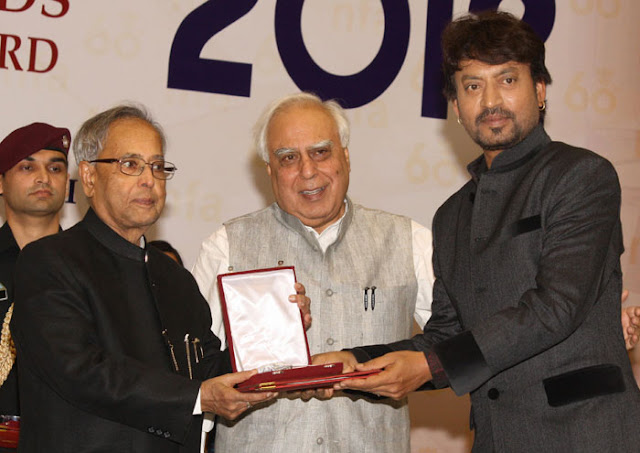
* Paan Singh Tomar: miglior film, miglior attore protagonista (Irrfan Khan - ex aequo con Vikram Gokhale per Anumati, in lingua marathi)
* Chittagong di Bedaprata Pain: miglior opera prima (ex aequo)
* Vicky Donor di Shoojit Sircar: miglior film d'intrattenimento (ex aequo), miglior attore non protagonista (Annu Kapur), miglior attrice non protagonista (Dolly Ahluwalia, ex aequo)
* Delhi safari di Nikkhil Advani: miglior film d'animazione
* Dekh Indian Circus di Mangesh Hadawale: miglior film per ragazzi, premio speciale della giuria (Nawazuddin Siddiqui), menzione speciale (Tannishtha Chatterjee) 
* Kahaani: migliore sceneggiatura originale (Sujoy Ghosh), premio speciale della giuria (Nawazuddin Siddiqui)
* OMG - Oh my God! di Umesh Shukla: migliore sceneggiatura non originale
* Gangs of Wasseypur di Anurag Kashyap: premio speciale della giuria (Nawazuddin Siddiqui)
* Talaash: premio speciale della giuria (Nawazuddin Siddiqui)
* Ishaqzaade di Habib Faisal: menzione speciale (Parineeti Chopra)
* Filmistaan di Nitin Kakkar: miglior film in lingua hindi.
 
Miglior regista: Shivaji Lotan Patil per il film in lingua marathi Dhag
Miglior attrice protagonista: Usha Jadhav per il film in lingua marathi Dhag
Miglior film in lingua telugu: Eega
Migliori effetti speciali: Eega
Premio speciale della giuria: Rituparno Ghosh per il film in lingua bengali Chitrangada

 
I feel more cautious now about what I'm making, Devanshi Seth, The Times of India, 20 marzo 2013. Dichiarazioni di Tigmanshu Dhulia: 'It's overwhelming. I wasn't expecting this. I did expect Irrfan to win, though. There were so many good films this year. So, it wasn't a walk-over for me. No one can say we won the award because there was no competition. And that's what's giving me added pleasure. That we won despite the competition. (...) It's true that off-beat films are now commercially successful. But it was an economic necessity. When some five years ago, multiplexes began to open in smaller cities, the middle class intellectuals in these cities started going back to theatres. Till before this, the cinema halls were in such bad shape that the educated elite did not want to step out of their homes to watch a film. This was also the time when there was this huge vomit of Hindi films by big banners, which were made essentially for the NRI audience, and that doctors, engineers, lawyers in these towns could not relate to. When multiplexes opened up, these people began to return to theatres, fuelling a demand for a cinema they could relate to, and the Indian box office returns began to make a difference, with revenues from small cities increasing. And they're increasing every year'.
 
Definition of 'hero' is changing in Hindi cinema, Aarushi Nigam, The Times of India, 20 marzo 2013. Dichiarazioni di Irrfan Khan: 'I'm very happy, I'm ecstatic for the film, for the subject, and for Paan Singh himself. For me, it's... the most interesting thing about this award is the kind of reaction I got from the people who are my well-wishers, who believe in me. They are reacting as if they themselves have got the award. You somehow feel that people connect with you and people put their hopes in you, and they somehow feel that we are representing them. So they are feeling that this is their victory. That Paan Singh was looking for its due, and it has got its due now. (...) And the definition of 'hero' is changing in Hindi cinema, and it will keep on changing, it's not a temporary change. Last year, you saw a few films which were trying to redefine commercial cinema, and this change will go on, because a whole new generation has come, in filmmakers and in the audience, so it's here to say'.
 
National Award is a shocker, Jyothi Prabhakar, The Times of India, 20 marzo 2013. Dichiarazioni di Shoojit Sircar: 'I'm very glad this worked, because it was a very difficult subject that I tried to present in a simple manner. But the shocker was that this subject, which is a taboo in society, which I thought would face problems on that angle, being adjudged the best entertainer - that's definitely a shout out for the Indian audience. Actually, I never thought... I mean, I thought of this as a socially relevant film. There was the topic of divorce, of infertility, sperm donation, and here we are, as the entertainers. Life's truths do entertain, isn't it?'.
  
Akshay Kumar in Twitter, 18 marzo 2013: 'Superb news, our first film Oh my God! won a National Award for Best Adapted Screenplay! Truly an OMG moment for us'.
S.S. Rajamouli in Twitter, 18 marzo 2013: 'But I would have been really happy had Sudeep received the recognition for his extraordinary efforts. Eega is not the same without him'.
 

24 gennaio 2013

STAR SCREEN AWARDS PER L'ANNO 2012 : I VINCITORI


La diciannovesima edizione degli Stars Screen Awards ha avuto luogo a Mumbai lo scorso 12 gennaio ma e' stata trasmessa dalla rete televisiva Colors una settimana dopo in prima serata. La live performance più attesa sicuramente quella di Ranbir Kapoor impegnato in uno scoppiettante duetto con la madre Neetu Singh. Tra gli altri numeri divertenti le esibizioni di Sonakshi Sinha e del trio di giovani attori di Student of The Year: Alia Bhatt, Siddharth Malhotra e Varun Dhawan. A guidare la serata Shahrukh Khan e Priyanka Chopra.


La lista dei vincitori delle categorie più importanti:

* Miglior Film: Paan Singh Tomar
* Miglior Regista : Anurag Basu (Barfi! )
* Miglior Attore Protagonista : Irrfan Khan (Paan Singh Tomar) in ex equo con Ranbir Kapoor (Barfi! )


* Miglior Attrice Protagonista : Vidya Balan (Kahaani)
* Miglior Attore Non Protagonista : Nawazuddin Siddiqui (Talaash)
* Miglior Attrice Non Protagonista : Dolly Ahluwalia (Vicky Donor)
* Miglior Attore Debuttante : Ashumman Khurrana (Vicky Donor)


* Miglior Attrice Debuttante : Ileana D'Cruz (Barfi!)
* Miglior debutto alla Regia : Gauri Shinde (English Vinglish)
* Miglior Colonna Sonora : Pritam (Barfi!)
* Migliori Coreografie : Prabhu Deva ("Go Govinda" da Oh My God)
Public Popular Awards : Salman Khan e Katrina Kaif (Ek Tha Tiger)

La pagina web dedicata all'evento. Clicca qui.

Vedi anche Zee Cine Awards per l'anno 2012: I Vincitori

27 luglio 2012

OSIAN'S CINEFAN FESTIVAL OF INDIAN ASIAN AND ARAB CINEMA 2012


La dodicesima edizione dell'Osian's Cinefan Festival of Indian, Asian and Arab Cinema si svolge a Delhi dal 27 luglio al 5 agosto 2012. Fra i titoli indiani in cartellone segnalo Gangs of Wasseypur (2012) di Anurag Kashyap e Local Kung Fu (2013, assamese) di Kenny Basumatary. Chitrangada (2012, bengali) di e con Rituparno Ghosh chiuderà la manifestazione. In programma alcuni dibattiti dedicati ai temi più disparati, come la sessualità e la censura; i film Paan Singh TomarDhobi Ghat e Vicky Donor; Delhi nuova capitale del cinema indiano. Prevista anche la vendita all'asta di oggetti da collezionismo per cinefili incalliti. La lista degli ospiti è chilometrica e include, fra gli altri, Rituparno Ghosh, Dibakar Banerjee, Tigmanshu Dhulia, Anurag Kahsyap, Rakeysh Omprakash Mehra, Imtiaz Ali, Kiran Rao, Irrfan Khan, Rajat Kapoor, Kalki Koechlin e John Abraham. Marco Müller è membro della giuria nella sezione asiatica e araba.


Rituparno Ghosh in Chitrangada

23 novembre 2011

INTERNATIONAL FILM FESTIVAL OF INDIA 2011


Un mese fa si sono spenti i riflettori sul goloso Mumbai Film Festival, ed ecco che si prospetta un'altra rassegna da sogno. La 42esima edizione dell'International Film Festival of India si svolge a Goa dal 23 novembre al 3 dicembre 2011. Il cartellone è ovviamente ricchissimo, e contempla pellicole rappresentative di varie industrie cinematografiche (assamese, bengali, hindi, inglese, malayalam, manipuri, marathi, tamil). Vi segnalo di seguito alcuni titoli: Adaminte Makan AbuDelhi safari (2012, animazione) di Nikkhil Advani, Sengadal (2011, tamil) di Leena Manimekalai, ShagirdUrumiZindagi Na Milegi Dobara. È in programma anche un tributo a Shammi Kapoor.
Fra le iniziative collaterali, segnalo il Film Bazaar India 2011, uno spazio che facilita i contatti fra produttori e distributori indiani e internazionali. Durante la scorsa edizione ben 453 delegati provenienti da 37 Paesi parteciparono ai lavori. È confermata la presenza di Shah Rukh Khan alla cerimonia di apertura della manifestazione. Fra le celebrità attese a Goa, cito Madhuri Dixit, Jackie Shroff, Atul Kulkarni, Abhay Deol, Zoya Akhtar, Anurag Kashyap, Kalki Koechlin, Dibakar Banerjee, Nana Patekar, Rahul Bose, Shekhar Kapur, Vidhu Vinod Chopra, Kangana Ranaut. Irrfan Khan e Suriya parteciperanno alla cerimonia di chiusura.
Aggiornamento del 24 novembre 2011: video Prudent Media del notiziario del 23 novembre 2011 che testimonia la partecipazione di Shah Rukh Khan e Bertrand Tavernier alla cerimonia di apertura del festival (Tavernier riceve un premio alla carriera).

Shah Rukh Khan e Bertrand Tavernier - Goa, 2011

Madhuri Dixit - Goa, 2011

17 ottobre 2010

SOUTH ASIAN INTERNATIONAL FILM FESTIVAL 2010


Dal 27 ottobre al 2 novembre 2010 si svolgerà a New York la settima edizione del South Asian International Film Festival. Fra i numerosi titoli indiani in cartellone, vi segnalo: That girl in yellow boots (pellicola d'apertura), Pappu can't dance saala (2011, prima mondiale) di Saurabh Shukla, I M 24 (2012, prima mondiale) di Saurabh Shukla, Paan Singh TomarPhas Gaye Re Obama (prima mondiale).

Anurag Kashyap - SAIFF 2010

Aggiornamento del 7 novembre 2010: Phas Gaye Re Obama ha conquistato il premio del pubblico.
Aggiornamenti del 18 novembre 2010:
Video della proiezione di TGIYB, con Anurag Kashyap
Video della proiezione di PCDS, con Saurabh Shukla
Video della proiezione di PST, con Irrfan Khan

Irrfan Khan - SAIFF 2010

15 ottobre 2010

ABU DHABI FILM FESTIVAL 2010


Dal 14 al 23 ottobre 2010 si svolge l'Abu Dhabi Film Festival. Vi segnalo i titoli indiani in cartellone: Laadli Laila (2011) di Murali Nair, Autograph (2010, bengali) di Srijit Mukherji, Paan Singh Tomar.

26 settembre 2010

BRITISH FILM INSTITUTE LONDON FILM FESTIVAL 2010


Dal 13 al 28 ottobre 2010 si svolgerà la 54esima edizione del British Film Institute London Film Festival. Vi segnalo le pellicole indiane in cartellone: Dhobi Ghat, Harud (2010, lingua kashmiri) di Aamir Bashir, I am KalamMee Sindhutai Sapkal (2010, marathi) di Anant Mahadevan, Arekti Premer Golpo (2010, bengali) di Kaushik Ganguly, Paan Singh TomarUdaan.