Visualizzazione post con etichetta V BOX OFFICE. Mostra tutti i post

26 giugno 2022

BOLLYWOOD BOX OFFICE UNPLUGGED

[Archivio]

Nell'agosto 2012 Moneylife pubblicò Bollywood Box Office Unplugged, tre articoli che illustravano l'importanza, in termini di incassi, assunta dalla prima settimana di distribuzione delle pellicole hindi, analizzando motivazioni e strategie. Di seguito ve li propongo integralmente, dal momento che l'argomento è tuttora attuale. (Cliccate sui grafici per renderli più leggibili).

WHY THE FIRST DAY AND FIRST WEEK IS MAKE OR BREAK, Sandeep Khurana, 6 agosto 2012:

'Once, the barometer of success for films was platinum, golden and silver jubilees. (...) Today, it's the first week that matters for box office success. Online bookings of new releases open Wednesday. But savvy marketers ensure that the excitement starts building weeks and months before ticketing action as the movie stars are in your face promoting the movie. They are at the mall next door, the pub downtown, gate-crashing weddings (yes, 3 idiots did it) - even the most uninitiated can predict whose movie is releasing next at the box-office. Then there is the music video launch, Page3 [terza pagina dei quotidiani, tradizionalmente dedicata alla cronaca mondana, anche a pagamento] plugs, YouTube clips, fun-bites on Facebook, Twitter teasers, online trailers, video games and more. The idiot box joins the frenzy with Amitabh Bachchan turning up as guest anchor, Akshay [Kumar] and Sonakshi [Sinha] getting face time at a cricket match, or reality shows of all hues being invaded by your favourite stars. (...) The idea is to get everybody caught up in the frenzy before cash registers start ringing on Friday.
A few discerning ones wait to read the reviews or sneak previews. Enter the analysts. Taran Adarsh, Rajeev Masand, Anupama Chopra, Raja Sen, and many more - the list is long. Reviews pouring in on Friday. Rajeev Masand’s review is Googled more than say, “home loans” in India. Taran Adarsh and Rajeev Masand have over 150,000 followers each including many opinion-makers themselves among their followers. Anupama is not far behind either. Since movies get booked well in advance, bookings for much-hyped movies happen before getting feedback from your trusted social circle. You bank on the stars promoting it and on analysts. An exhortation by Amitabh or SRK carries trust. Film reviewers, the pied pipers of cinemagoers in a star-crazy nation, carries credibility. Tragedy strikes when movie after movie, hyped by stars and reviewers turns out to be a disaster. Millions of hours wasted. Crores of rupees down the drain or into undeserving pockets! You wish the stars and reviewers had not lied and you had not trusted their hype.

Movie business for you - Reincarnated
Now for the dynamics of how it works. There was a time, when movies released in theatres could run for years, secure in the knowledge that nobody would steal the reels. That’s because you had to go to a theatre and couldn’t view it on your cable, notebook computer or smart phone. The barometer of success was platinum, golden and silver jubilees. (...) Today, movie releases need to beat the pirates by simultaneous release in as many theatres as possible. Only the rupee matters and this can also come from music rights, overseas distribution, satellite rights or video/web/YouTube releases, in-film advertising, etc. But this analysis will focus only on the box office for 33 recent releases.

Industry rides on blockbusters
In terms of budget of box-office (BO) collections, the film industry works due to blockbusters. (...)


This sets in motion a sequence of desirable and undesirable actions. A lavishly mounted movie also needs a lavish marketing budget in order to recover costs. Distributors demand item songs which make cash registers ring and every cog in the wheel from stars to cinema hall owners work at making it succeed; and the first week is make-or-break time. With stakes so high, it also needs friendly reviewers to tailor ratings to suit the industry rather than the cine-goer who forks out just Rs200 for a ticket. The mantra is simple - after the shoot, take what you can in the first week and scoot before word-of-mouth reality sinks in. (...)
Now look at performances in the first half of the current year.
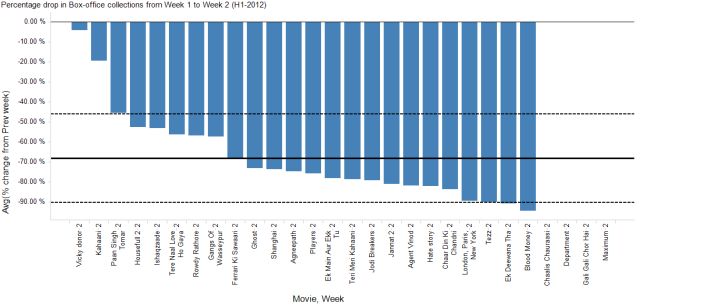

The high first weekend collection is projected as validation of film’s BO superiority. This happens occasionally, like with 3 idiots, but in most cases, the hype about the opening weekend is entirely fake or good marketing. On the way out of the theatre, many people realize they have been had, but since it is all about entertainment, the reaction is amusement rather than outrage. The following two charts, based on BO collections, show how much is at stake. (Only Hindi movies released in first half of the year, between Jan-Jun 2012 and surviving at least a week at box-office are considered. There is a whole alternate business revenue stream of music rights, satellite rights, merchandizing agreements, in-film advertising is not the subject of this analysis.)


A week is a long time in Hindi films. Especially, if it is the first week. It is analyzed down to each day by film trade analysts and watched for its trending collections. We notice some very interesting insights and trends.


On an average, two-third of a movie’s BO collection is done before business before the second week begins. On an average, a movie’s BO collection drops to one third of the previous week, every week, till it disappears into oblivion - this is the one-third rule. The graph above shows aggregate week-wise collections post-release. Movies that beat this rule are the winners. For instance, a dark horse like Vicky Donor could see collections drop just 5% less in week two. A movie whose BO collections drop 65%-70% in a week is primarily rejected by audience; that an Agneepath still earns Rs100 crore is due, in no small measure, to the inability to cancel bookings made before its Friday. They are still trade hits but not by popular choice.
Here is a plan that seems to work. If viewers are numbed by a blast of star power and publicity blitz to ensure that first week plans are full before reviews, social media feedback or word-of-mouth reach them, the producer can make a killing. This explains why they pull out all the stops and plan a release with such care. For a good movie, the progress path is altogether different - we will examine this in the next part'.


WINNERS AND LOSERS AMONG THE 2012 RELEASES, Sandeep Khurana, 7 agosto 2012:

'Who were the Survivors (the workhorses), Fakestars (work for the industry too but not so much for the audience), Rockstars, (as they are low-budget winners) and the duds for the fist half of 2012. In the first six months of 2012, 35 Hindi films were released, of which 33 reported their box office (BO) numbers and the remaining probably sank without a trace. As we pointed out in the first part, the frenzied hype that accompanies a movie’s release is purely commercial. Influencing reviews to get better ratings is a part of this. Let’s see how it works.
We analysed the movie ratings of as many as 33 reviewers for each movie. We then looked at the drop in BO business from the first week to the second as an indicator of public verdict. We then included a third dimension of total movie business to build a complete perspective on the movie in a single snapshot. (See graph: Jan-Jun 2012: Business, Reviews, People’s verdict). There is a whole alternate business revenue stream of music rights, satellite rights, merchandizing agreements, in-film advertising that is not the subject of this analysis.


We then classified the whole set. The Rockstars are those that were high on reviewers’ and peoples’ choice - they received high ratings and also sustained business in the second week (see graph). The Survivors are movies that received average ratings but survive to retain the audience interest and do not drop more than a third in the second week. The Duds are movies that simply fail to take off with both viewers and reviewers. And finally there are the Fakestars - which generate huge BO business in the first week, only to crash over 70% in the second week. These are over-hyped movies and, but a curious co-incidence, their names provide clues to this category. 

The viewers guide to the categories: Rockstars, Survivors, Fakestars and Duds


In terms of business for the entire industry, Survivors are the workhorses - they are not stars though, not high on critics list, but just good for an average laugh by the masses. Fakestars work for the industry too but not so much for the audience. Rockstars, especially as they are low-budget, are the ones we could do with more of. Duds - let us not waste time on them. 


Good, large production houses play safe with big movies to ensure they are Survivors - big bankable stars, tested formula, item songs, prime release dates, zero or low competition from other movies, secured by marketing, etc - all this often prevents them from being Duds by just a whisker. 

The distribution channels


Based on channel structure, ownership, market size, local issues and movie-related factors there is a full treatise possible on territory level insights. We restrict our focus to the BO (Pie chart: Collections: Jan-Jun 2012), but even a quick glance shows heavy dependence on just two key regions in terms of revenues. Corporate entry into Bollywood was expected to bring in such professionalism. It has indeed cured some ills but has also introduced others. We need introspection on how to connect the dots to create win-win movies. What good is a good Bollywood movie without a sequel?'. 


MOVIE REVIEWERS, REVIEWED, Sandeep Khurana, 8 agosto 2012:

'Like in every profession, movie reviewers come in all shades. There are trade analysts, willing to offer glowing reviews to help drive box office (BO) collections and there are others, who are courageous enough to stick their necks out and call a flop despite the producer’s clout. To be honest, a reviewer is only a chhota [piccolo] culprit, in the big faking game to ensure first week collections. Stars who promote Duds (movies that simply fail to take off with both viewers and reviewers) are bigger culprits. Interestingly, among the big names a dispassionate look at the numbers throws up only one reviewer as being disposed to hand out benevolent ratings to producers to drum up business, but being unfair to readers. As we said earlier, the first week collection, especially the all-important first weekend is often influenced by the marketing blitz and star promotions. The reviewers really influence only the second week. Since reviewers are after all human, we do understand occasional aberrations, mistakes or differences in perception; however, we have also come across a pattern of consistent, undeserved high ratings by a reviewer that stand out. 
We considered an exhaustive list of 38 analysts and all available ratings by them for movies included in the study. (Refer Graph: The dozen Pied Pipers of Hindi Cinema). Those with less than 10 reviews are excluded from detailed analysis of the reviewers themselves but ratings given by them retained for the movie analysis. It must be recognized that any positive or negative outcomes are purely data-driven and unintended. (Only Hindi movies released in first half of the year, between Jan-Jun 2012 and surviving at least a week at BO are considered. There is a whole alternate business revenue stream of music rights, satellite rights, merchandizing agreements, in-film advertising that is not the subject of this analysis.)


It flows from the analysis and the chart above that not all analysts do justice to the ratings. A good analyst must exploit the full range from 0 to 5 to rate movies, especially when viewers reject movies frequently. If a reviewer gives a 3 and 4 star rating for all movies reviewed by him/her, you are not getting a worthwhile opinion. A reviewer can be purely value-based and unconcerned by BO collections; or can be purely a trade-based critic. But the review must be qualified by a disclosure. (Reviewers whose ratings were included in the research are: Rajeev Masand, Taran Adarsh, Shubhra Gupta, Anupama Chopra, Blessy Chettiar, Omar Qureshi, Martin D'Souza, Komal Nahata, Raja Sen, Madhureeta Mukherjee, Kunal Guha, Avijit Ghosh, Srijana Mitra Das, Saibal Chatterjee, Sukanya Verma, Subhash K. Jha, Aniruddha Guha, Khalid Mohammed, Piyali Dasgupta, Mayank Shekhar, Kanika Sikka, Vivek Bhatia, Prashant NDTV, Shomini Sen, Mrigank Dhaniwala, Preeti Arora, Zinnia Ray Chaudhary, Resham Sengar, Priyanka Ketkar, Puja Banta, Nikhat Kazmi, Soumyadipta Banerjee, Shakti Salgaocar, Aseem Chhabra, Shaikh Ayaz, Ritu V. Singh, Anirudhha Guha, Gaurav Malani) 

Head to head


The top two analysts of the film world head-to-head for all movies they rated in the period of study make for interesting comparison. Note that barring two movies out of 33, Taran Adarsh always rates a movie higher than Rajeev Masand. Rajeev Masand has an average ranking of 2.2 and the third horse in the race, Anupama Chopra has ranking of 2.3 as against Taran whose average is way higher at 3. For the statistically inclined - there is a significant difference in all parameters. Take away the exception - Bittoo Boss, and you know the rule. It is cognitively difficult to dissociate ratings by linking them with names; a high rating is a high rating and it fools us into an inflated opinion about movie’s worth. 
The difference is more pronounced when it comes to big-budget movies. For the 10 costliest movies in the period, the average rating by Rajeev Masand is 2.15 and that by Taran Adarsh it is whopping 3.45, on same scale of 5. That Taran’s ratings are influenced by a movie’s budget, more than popular choice, is too obvious to require further explanation. It is no coincidence either, that he is trade analyst and the bias shows. Week 2 continuation/drop of business and thereby the public verdict, supports possibly Rajeev and Anupama’s review ratings as also those of most other analysts. Even last year, the costliest movie ever made, Ra.One was given the highest rating of 4.5 by Taran, when most analysts could not even tolerate the movie till interval. On other hand, after the same movie, Anupama Chopra wrote a very honest article - Box Office Followers - blasting the obsession of box office with moneybags. To quote her, “The multi-crore grosses that eventually follow are then bandied about as proof of quality. The art becomes irrelevant.” 
The Fakestars - the film industry helps create them because of what rides on them and not because of intrinsic merit of the movie reviewers can help build them up with an extra star. Check our film reviewer rating comparator for all movies in the Fakestar category for the top three reviewers. (See graph: Aggressive promotion, inflated ratings and reality strikes in week 2). For seven out of eight movies, Taran Adarsh has more generous ratings than the other two. The eight movies listed below accounted for 50% production cost of the industry’s cost of making 33 movies in the period under study'.


02 gennaio 2022

HOW BOLLYWOOD IS REWRITING HISTORY


Da qualche tempo riporto quasi integralmente articoli pubblicati da varie testate perché, aggiornando questa sezione del blog, ho purtroppo appurato come molti pezzi interessanti, segnalati in passato, non siano più consultabili a causa della chiusura di quotidiani (ad esempio il Mumbai Mirror, nel cui archivio storico, acquisito da The Times of India, la ricerca per argomenti è lunga e laboriosa), riviste (ad esempio Box Office India o The Film Street Journal, i cui archivi non sono disponibili) o siti (ad esempio DearCinema, nel cui archivio, acquisito da una biblioteca digitale, ad oggi è impossibile effettuare una ricerca per argomenti). 

[Archivio] 

In questi giorni Uday Bhatia, critico cinematografico di Mint e autore del volume Bullets over Bombay, ha conquistato il Ramnath Goenka Excellence in Journalism Award per l'anno 2019, nella categoria Reporting on Arts, Culture and Entertainment, grazie al magnifico articolo How Bollywood is rewriting history, pubblicato da Mint il primo dicembre 2019. Il pezzo mi era sfuggito, e ve lo propongo ora. 

'There has been an explosion of Hindi historical films in the last couple of years. Some are set in the distant past, others in relatively recent times of turmoil. Most of them place on the nation’s screens, and in the public’s imagination, a version of the past that’s obscured by legend and skewed towards certain narratives.
The blockbuster success of Baahubali (2015), a lavish Telugu action film set in unspecified ancient times, sent the Hindi film industry scurrying for similar epic material. Though the film was not a historical, it would, along with its 2017 sequel (...), have a huge influence on the genre, which adopted its grandiose production values and overtly Hindu iconography. However, instead of inventing its own legends, Hindi cinema turned to history.
Bajirao Mastani arrived at the end of 2015, Raag Desh in 2017. In 2018, Padmaavat brought controversy - and box-office credibility - to the genre; it was followed later that year by Gold and Manto. This year, there’s been Manikarnika and Kesari. Two films about the Marathas are coming up: Ashutosh Gowariker’s Panipat releases next weekend, and Om Raut’s Tanhaji: The Unsung Warrior in January. There have also been several works of historical fiction in the last couple of years, with invented characters but based on real events: Begum Jaan, Rangoon and Firangi in 2017, Thugs Of Hindostan in 2018, and Kalank and Laal Kaptaan in 2019. (For the purposes of this piece, 1947 is the broad cut-off point for what qualifies as historical.)

WHEN PAST IS PRESENT

Why is the historical - a genre out of favour for years - suddenly back in Hindi cinema? It may have something to do with the box-office success of Sanjay Leela Bhansali’s Padmaavat, a flamboyant look at the 13th century Delhi Sultunate ruler Alauddin Khilji and his obsession with (the possibly fictional) Rani Padmavati, wife of the Rajput king of Mewar. With Hollywood making alarming inroads into the Indian market and streaming platforms drawing audiences away from theatres, Hindi cinema now needs its own big-budget offerings - and history is a ready source. Despite the controversies before its release - or because of them - Padmaavat earned ₹572 crore worldwide, making it one of the highest-grossing Indian films ever. Kesari, about an 1897 battle between Sikhs in the British Indian army and Pashtun tribesmen, also earned an impressive ₹207 crore.
There’s another reason. Historical films allow directors to play up present-day beliefs while evoking past legends. On email, Katherine Schofield, senior lecturer in South Asian music and history at King’s College London, says these films are useful for understanding modern values. “Film scholars talk about the historical film as providing a ‘heterotopia’ - literally ‘another place’ - in which to play out the political and social issues of the present day. We should be reading these films not for what they tell us about the past - even the most factually accurate films have to make enormous concessions to telling an entertaining story - but what they tell us about us, now, in the present day."

Take Panipat, a reimagining of the storied 1761 battle - regarded as one the biggest clashes of two armies in the 18th century - between Afghan ruler Ahmad Shah Abdali (Sanjay Dutt) and the Marathas under Sadashiv Rao (Arjun Kapoor). The trailer, released on 4 November, comes with an intriguing tag line: “The great betrayal". A clue might lie in historian T.S. Shejwalkar’s 1946 monograph on the battle, which Gowariker has confirmed is the source material for his film. His study says that although the Marathas lost, “on the moral side their record is very clean", and that the “ultimate result of Panipat was to make the way smooth and clear for the English". It seems likely that the “betrayal" will be of India itself - possibly the decision by ex-Mughal serviceman Najib-ud-Daulah to side with Abdali. It’s also a good bet that the Marathas will come out looking saintly, defeat conferring martyrdom on them as it did on the Rajputs in Padmaavat, the Sikhs in Kesari and the rebels in Manikarnika.
What does a battle fought over 250 years ago have to do with the present day? More than you might expect. In January, Amit Shah, Union home minister and president of the Bharatiya Janata Party (BJP), declared that the forthcoming general election would be “a decisive contest, like the third battle of Panipat". “The Marathas had won 131 battles," he said, “but lost one decisive battle, which led to 200 years of colonial slavery." While referencing one of the greatest “Hindu" defeats, Shah also spoke of the BJP’s commitment to building a Ram temple in Ayodhya. Less than a year later, with the road to the temple’s construction now clear after the Supreme Court verdict, Panipat is set to release on 6 December, the day of the Babri Masjid’s destruction in 1992.

Every generation makes historical films in its own image. In the years before independence, stories about Indian kings (mostly Hindu) fighting foreign powers (mostly Muslim) were seen as an allegory for protest against British rule. Today, in a time of similarly heightened nationalism but no occupying force or officially declared wars, the same stories take on a more troubling patina. Earlier this month, The Caravan quoted Rashtriya Swayamsevak Sangh joint general secretary Krishna Gopal as telling an audience of Muslim professionals a day before the Ayodhya verdict: “There came a phase in our history when outsiders destroyed this country’s temples." Fuelling the idea of Muslims as historic outsiders on the big screen may just strengthen this narrative.

NATIONALISM SELLS

Padmaavat and Kesari are set several centuries apart, but in each the protagonists are brave patriots, and the antagonists barbaric Muslims. It remains to be seen how Abdali and his people are portrayed in Panipat but the Afghanistan embassy to India has already expressed concerns about “insensitive/distorted depiction of (Abdali’s) character". The trailer shows the Afghan king with a blood-streaked face, ranting about conquering Hindustan, while Arjun Kapoor’s smooth-cheeked Maratha general talks about defending his land - a juxtaposition reminiscent of Padmaavat, in which Ranveer Singh’s psychotic sultan faced off against Shahid Kapoor’s bland patriot.
Panipat director Gowariker has suggested that the “Indian" army in the film would be an inclusive force. “By the time (the Maratha army) reached Panipat, there were 50,000 soldiers," he said at a press conference earlier this month. “There were Hindus and Muslims. It was a cooperative kind of army, I felt it was important to bring that to the screen." It should be intriguing to see how the Lagaan director’s pet theme of different clans and creeds coming together in the service of the nation plays out.

“Movies are made for the market," says Rana Safvi, an author and historian documenting India’s syncretic culture. “You are catering to what you think is going to sell." What is being sold, by nearly every Hindi film in 2019, is national pride. So much so that patriotism has become just another ingredient, to be inserted at regular intervals like one would a fight sequence or a comic track.
Patriotism is especially prominent in recent historical films. From Padmaavat to Tanhaji, nothing is more important than protecting the motherland. In Manikarnika, the queen’s all-consuming love for her country gives rise to a slur that’s common today, points out historian and Lounge columnist Manu S. Pillai. “There’s a scene where she calls Scindia deshdrohi (traitor to the nation). This is not the kind of vocabulary that existed in that time."

The weight of nation-love has hobbled otherwise sensible films, like Reema Kagti’s Gold, about the building of independent India’s first hockey team. It stars, as the team’s architect, Akshay Kumar, Hindi cinema’s patriot-in-chief in the last couple of years (Hum India ko dekhega - I will look out for India - he says at one point). If you ignore the flag-waving and anthem-playing and assertions that winning the 1948 Olympic hockey final against England would be “revenge for 200 years of slavery", Gold is a good test case for debating what bits of history can and cannot be altered. Is it all right, for instance, to show the score in the final as 4-3 in India’s favour, when in reality it was a one-sided, cinematically unappetizing 4-0?
I ask Rajesh Devraj, credited with the film’s story, about the rules he set for historical invention. Devraj, who stresses he isn’t responsible for the final screenplay, says he wouldn’t have changed the final scoreline. As an example of the sort of thing he would change, he pointed to the scene where the Indian players take off their shoes to counter wet conditions. This might well have taken place; 1948 star Balbir Singh recalls it happening, though other accounts are silent. Even if it didn’t, Devraj says, there’s enough historical precedent for barefoot Indian athletes for this to work as a narrative device. “It’s really a metaphor. When they take off the shoes, they are rejecting colonialism. It’s them saying, this is how I played back in my village, I need to feel that contact with the soil."
Gold offers up a soft vision of Indian glory, achieved by a mix of classes and creeds. Other historical films, however, are dialling up patriotism into a clash-of-civilizations rhetoric.

DEEPENING DIVIDE

In the trailer for Om Raut’s Tanhaji, Ajay Devgan’s titular Maratha general tells a young boy they will defeat the Mughals just as the Pandavas won against the Kauravas (a similar comparison is made in Padmaavat). It goes on to describe the 1670 Battle of Sinhagad as “the surgical strike that shook the Mughal empire". The term “surgical strike" entered the public lexicon after Indian military action against Pakistan in 2016, and was cemented by the success of the film Uri this January (several BJP leaders adopted its famous line, “How’s the josh?"). That a film promo would associate the Mughals with the uber-villains of Indian mythology and then with Pakistan tells you a lot about the nation and its cinema in 2019.
“You can see a change," Safvi says about the Panipat and Tanhaji trailers. “It’s becoming slightly more Islamophobic. It’s a more aggressive tone."
In recent historical films, Hindus are more visibly Hindu. The Tanhaji trailer shows Devgan sitting beside a fluttering bhagwa dhwaja - the saffron standard of the Marathas. But there’s an addition: the Om symbol. This is almost certainly a leap of imagination; the Maratha flag had nothing printed on it. Muslims have also seemed more Muslim on screens in 2019: Kohl-lined eyes followed viewers from Gully Boy to Uri to Kalank to Panipat.

The most partisan contrast was in Anurag Singh’s Kesari, a violent war film in which Akshay Kumar plays the leader of 21 Sikh soldiers who died fighting an army of thousands of Afridi and Orakzai Pashtun tribesmen. The battle took place in 1897 in Sarhagarhi, in the North-West Frontier Province, then part of India. As soldiers in the British Indian army, the Sikhs were fighting other Indians for the British. The film, though, deliberately paints the tribesmen as marauders and the Sikhs as patriots fighting only in name for the British. In one particularly insidious scene, the film’s chief antagonist, a fanatical religious leader named Khan Masud, orders the beheading of a woman who tries to run from her abusive husband. As the execution is about to be carried out, he recites surah Al-Fatiha - a common prayer in praise of Allah. At the last moment, Kumar saves her.
Singh isn’t done labouring the point. He has Masud call for jihad (holy war) and repeatedly take Allah’s name while discussing battle plans. Then he restages the beheading with the same woman, and again the prayer is recited - only this time she’s killed. One of the last scenes, as the last of the Sikhs are dying, is of the tribesmen looting their supplies.

Throughout Padmaavat, we are told of the amazing things Rajputs can do, from walking on burning embers to sacrificing their life to uphold truth and freedom. There are no songs of praise for the Khiljis, even though Amir Khusro, the pre-eminent poet of his age, is in their ranks. They have a reputation for pillaging and raping; they are wild and dusty and dressed in dirty robes, while the Rajputs are perfectly attired. It’s unfortunate that Ranveer Singh’s turn as Khilji is the one spark in a dull film, for his unhinged performance only draws attention to a characterization that leans far too heavily on Muslim invader tropes. The real Alauddin was certainly a tyrant, but the Alauddin of Padmaavat is a sadist, a psychopath and a rapist who stages an eight-month-long siege so he can enslave one woman. The image that seems to have stuck with everyone most is of him biting into hunks of meat (“It seemed very barbaric," Safvi says).
The one thing that Bhansali doesn’t do is link Khilji with any personal religiosity - though in the world of this film, a person who doesn’t believe in God is to be suspected. Alauddin’s object of desire, though, is compared to a goddess several times in the film. By the end, she’s a literal deity; “Today, she’s worshipped as a goddess, destroyer of evil," read the credits. This is similar to Manikarnika, which also elevates its Hindu queen to divine status. As she slashes through British soldiers on the battlefield, her face smeared with blood, she is Durga’s wrath incarnate - which is why we hear a few lines from Aigiri Nandini, a Sanskrit song in praise of Durga, being chanted.

TIED TO TRADITION

Padmaavat’s fraught production is an extreme example of the kind of problems that can accompany the making of historical films in India today. During the film’s shooting in 2017, the Karni Sena, a fringe group in Rajasthan, alleged that the director was shooting a dream sequence with Khilji and Padmavati. They vandalized the sets and later threatened to cut off actor Deepika Padukone’s nose. Release dates were announced and deferred. The Central Board of Film Certification showed the film to a panel of historians, who passed it. The final film was as deferential to Rajput pride as the Karni Sena could have hoped for, but the threat lingered on. Every historical film since has inspired claims of “hurt sentiments".
One can only speculate if the attacks had a role in moving Bhansali towards safe, “respectful" ground, and whether the film might have ended up differently if there weren’t any threats. Between 2015’s Bajirao Mastani and 2018’s Padmaavat, you can feel the genre ossify. The earlier Bhansali film seemed open to possibilities - of poetry; of a certain syncretic tradition of cinema; of love between a Hindu king and a Muslim queen; even the idea that king, queen and new queen might coexist in a respectful, impossibly good-looking triangular relationship. Padmaavat, on the other hand, seems stifled by tradition, dulled by duty, with nothing more to offer than centuries-old ideas of honour and sacrifice.

If service of the nation is the top priority of the modern Hindi historical, upholding traditional values comes a close second. The Tanhaji trailer has an unusually specific shout-out, with actor Kajol saying, “When Shivaji wields his sword, the honour of women and janeu (sacred thread) of Brahmins remain intact." It’s curious that a film about Shivaji’s general (of Koli caste) would make this pointed a reference to Brahmin dignity - and deem it important enough to include in the trailer.
An earlier evocation of the caste system was in Baahubali 2 (2017) - not a historical, but a template in many ways for the genre - when prince Amarendra Baahubali says: “God creates life, the Vaidya (physician) saves it, and the Kshatriya (warrior) protects it." “Kshatriya" turns up twice in Manikarnika, both times to specify that the future Rani of Jhansi, though not herself of the warrior caste, possesses its best qualities. Padmaavat treated jauhar - ritual self-immolation by women so they wouldn’t be captured by the enemy - with reverence. The climactic scenes, with hundreds of stoic women led by Padmavati running towards the fire, are drawn-out and disturbingly triumphant.

Conservative ideas of sexuality hold sway. In both Padmaavat and Kesari, the top soldier in the Muslim army is gay. The sniper in Kesari has long nails with red polish and rouge on his cheeks. In Padmaavat, the character is a historical figure - Malik Kafur, a eunuch presented to Alauddin as a slave, who, incredibly, rose from there to attain the rank of general. Several accounts of the time suggest that Alauddin and Kafur were lovers. In the film, Kafur dresses his king (as Padmavati dresses hers), rubs his feet in a bathtub. The Binte Dil song sequence, where Kafur serenades Alauddin and his female companion for the night, might be the first openly bisexual love ballad in Hindi cinema.
Normally, queer texts turning up in historical dramas would be welcome. But by ascribing feminine traits to the deadliest solider in the enemy camp, the films seem to be inviting a contrast to the manly Rajputs and Sikhs on the opposing side. Moreover, the three queer characters (if you include Alauddin) are shown as sadists and betrayers - a worrying conflation of deviation from the sexual majority with moral deviance. The sniper gleefully shoots a fallen Sikh soldier in the leg. Alauddin stabs his king in the back; Kafur shoots Ratan Singh in the back. “Alauddin’s implied relationship with Kafur is portrayed as yet another sign of his untrustworthiness - a stigma many bisexual men have to contend with in modern life," Schofield says. “In their own time, close romantic, erotic, and even sexual relationships between men of different social statuses were not only commonplace, but often held up as the ideal, as in the beautiful poetry written about the relationship between Mahmud of Ghazni and his slave Ayaz."

FUTURE HISTORIES

Though it’s beyond the ambit of this piece, Hindi cinema has also been scanning recent history for source material. The subjects chosen are, unsurprisingly, either concerned with national pride (Mission Mangal, Pad Man - both with Akshay Kumar) or focused on events that show the present administration in a good light (PM Narendra Modi) or the opposition in a bad one (Indu Sarkar, about the Emergency; The Accidental Prime Minister, about the UPA government) [UPA = United Progressive Alliance, coalizione di centro-sinistra]. Or the military: After Uri’s success, two period war films are in the works - Bhuj: The Pride Of India, about the 1971 war with Pakistan, and a Sam Manekshaw biopic starring Vicky Kaushal as the Field Marshal.

History is amended all the time. This is a necessary churn, allowing suppressed voices to enter the conversation, but it can also give rise to exclusionary narratives. If Karnataka chief minister B.S. Yediyurappa has his way, a key figure like Tipu Sultan might not appear at all in school textbooks. In October, speaking at a seminar at Banaras Hindu University, Amit Shah said: “There is a need to rewrite the Indian history from India’s point of view, but without blaming anyone." His 30-minute talk presents India’s ancient history as a long string of Hindu achievements, with a stray mention of Sikh gurus and mentions of “hundreds of years of slavery".
This particular vision of history may well match what we see on our screens in the immediate future. Next year there’s Tanhaji, and a Marathi film about Tanaji Malusare’s king, Chhatrapati Shivaji, starring Riteish Deshmukh. There’s a biopic on Prithviraj Chauhan, another Hindu king who fought Muslim invaders, with Akshay Kumar in the lead. Few of these are likely to treat their subjects like flesh-and-blood humans. “Deification clouds a mature historical understanding of these real figures," Pillai says, “but there’s this trend in India that promotes them to divine status because otherwise our confidence will suffer."

There’s a scene in Padmaavat where Ratan Singh tells Khilji: “History isn’t just written on paper which you can burn." For a film whose titular character might be drawn from a poem written two centuries after the events in it took place, this is a bold statement. It seems to suggest that what we think of as history could also include legends passed down from generation to generation, not just words on paper. This gives the film-maker a wide range of crowd-pleasing material to draw on, but what of the impressionable viewer who ends up believing that Manikarnika rode a horse off the edge of a fortress and survived what appears to be a 30ft fall? Perhaps future films could carry, in the style of tobacco warnings, little fact-checks in a corner of the screen, informing us when history is being rewritten'.

Vedi anche: 

17 luglio 2011

ZOMBIE E VAMPIRI ALLA CONQUISTA DI BOLLYWOOD


Il genere horror non è fra i più amati dal pubblico indiano, e di conseguenza la produzione di pellicole è scarsa, sia in termini qualitativi che quantitativi. Non mancano però cineasti appassionati del soprannaturale: cito, fra gli altri, i leggendari fratelli Shyam e Tulsi Ramsay, che hanno firmato titoli ormai di culto (Veerana, Purana Mandir); Ram Gopal Varma, che ha diretto (Bhoot, Darling, Phoonk) e prodotto (Darna Zaroori Hai) diversi classici del genere; Vikram Bhatt (Raaz, Haunted).


Scorrendo rapidamente l'offerta cinematografica hindi degli ultimi anni, segnalo nel 2006 Darna Zaroori Hai (prodotto e codiretto da Varma); nel 2007 Darling (di Varma) e Gauri; nel 2008 Phoonk (di Varma) e 1920 (di Bhatt); nel 2009 Raaz - The mystery continues (di Mohit Suri), 13B (versione hindi di Yavarum Nalam, tamil) Agyaat (di Varma). Nel 2010 la produzione aumenta di numero a scapito però della qualità: escludendo il secondo dignitoso tempo di Click, Rokkk, Shaapit (di Bhatt), Phoonk 2 (prodotto da Varma) e Hisss (coproduzione indo-americana di Jennifer Lynch) deludono le aspettative.


Nel primo semestre del 2011 assistiamo ad una decisa - e per certi versi stupefacente - inversione di tendenza. Nel mese di maggio, in sole tre settimane, vengono distribuiti tre horror hindi che conquistano pubblico e critica: Haunted (di Bhatt), Ragini MMS (di Pavan Kirpalani) e 404 (di Prawaal Raman). Nella settimana 13/19 maggio, forse per la prima volta nella storia del box office indiano, due film horror guidano la classifica degli incassi hindi pubblicata da Bollywood Hungama (Ragini MMS e Haunted), e la settimana successiva sono ben tre le pellicole horror che si posizionano fra i primi cinque titoli (Haunted è secondo, Ragini MMS è terzo e 404 è quinto). Una vera rivoluzione. (Successivamente viene distribuito A strange love story, che però passa inosservato).


Inevitabile dunque il crescente interesse verso il genere soprannaturale dimostrato di recente da grossi nomi dell'industria cinematografica di Mumbai. Pare siano già in cantiere due commedie horror che avranno per protagonisti degli zombie molto speciali. La prima, Go Goa Gone, è diretta dal duo Raj & DK. Mentre Navdeep Singh tornerebbe finalmente alla macchina da presa con Rock The Shaadi, interpretato da Abhay Deol. Satish Kaushik ha dichiarato di aver acquistato i diritti per la trasposizione sullo schermo del romanzo indiano The Company Red, di Shantanu Dhar, che narra una storia di vampiri, romanzo in distribuzione nelle librerie in agosto. Sembra che The Company Red sia il primo volume di una futura trilogia. Non finisce qui: Bhatt starebbe già lavorando al progetto di Raaz 3 (in 3D), dopo aver accantonato l'idea di Bhoot 2, sequel su cui Varma ha reclamato, forse per burla, il diritto di prelazione. Ci aspettano dunque sorprese da brivido.

Vedi anche The new brand of Bollywood horror films, 4 maggio 2013

27 agosto 2010

MY NAME IS KHAN: DISTRIBUZIONE EUROPEA


Taran Adarsh oggi pubblica nel sito di Bollywood Hungama un interessante articolo relativo alla distribuzione nel mondo di My name is Khan. In Europa, MNIK è stato distribuito in 325 copie e ha incassato 5.600.000 dollari. La sola distribuzione in Europa è superiore a qualunque altra distribuzione mondiale di pellicole bollywoodiane. MNIK, inoltre, è il primo film popolare hindi ad essere doppiato e distribuito nelle sale in Spagna, Germania, Russia e Italia (Adarsh dimentica che diverse pellicole bollywoodiane vengono regolarmente doppiate e distribuite nelle sale in Germania, e che Lagaan era stato doppiato e distribuito anche nelle sale italiane). In Germania MNIK è già in distribuzione. In settembre toccherà alla Russia e in novembre all'Italia. In tutto si prevedono altre cento copie del film.
Adarsh analizza il successo di MNIK al di fuori dell'India, e cita diversi fattori: un nuovo montaggio realizzato da Alan Edward Bell appositamente per i mercati internazionali (strategia inaugurata per la prima volta nella storia del cinema indiano); una campagna pubblicitaria specifica per ciascun Paese; iniziative promozionali organizzate in occasione di eventi internazionali di grande rilevanza; la proiezione di MNIK al festival di Berlino alla presenza del cast. Lo scopo è di conquistare nuovi mercati: Porto Rico, Siria, Libano, Giordania, Egitto, Taiwan, Italia, Spagna, Russia.

Vedi anche: