Visualizzazione post con etichetta V COPERTINE 2010-2014. Mostra tutti i post

21 agosto 2022

ANURAG KASHYAP, THE GODFATHER


[Archivio]

Due giorni fa è stato distribuito Dobaaraa, l'ultimo film diretto da Anurag Kashyap. Quale migliore occasione per riproporvi un lungo articolo del 2013 dedicato al talentuoso regista. Anurag Kashyap, the Godfather, Parul Khanna, Brunch, 7 luglio 2013:

'Anurag Kashyap, godfather to aspiring filmmakers, a writer-producer-director whose stature has reached almost mythic proportions among his fanatic fans. Kashyap has scripted a success story fit for a Bollywood blockbuster. (...)
He was the youngest in his class, (...) didn't have enough facial hair to prove his machismo, wasn't confident enough to talk in English and was often at the receiving end of severe ragging. He would run and hide in the school library. Sexually abused and bullied as a child, he brooded over his anguish - for years. Kashyap created a whole parallel world inside himself. He wrote stories with unexpected twists and surprises, stories that would one day come to define his style of filmmaking. All of this has shaped him into the man that he is now. "My survival instincts were always very strong. To avoid the bullies, I would go to places no one would go to. I would read. And till a student fell ill for an inter-house race and I stepped in and won, nobody knew I could run, too. That's about all my achievements in school," he says, grinning. For his father, he was always the prodigal son. He was brilliant (he could remember the entire contents of his Biology textbook without trying too hard), but he never studied much. He could have done so much, but he drifted. Till he found himself. (...)


A troubled childhood
All of 41, with a life studded with enough twists, turns and struggles, (...) Kashyap is nonchalant about all that fate has thrown his way. "Sexual abuse is common in schools, especially residential ones. It's not the children's fault, it's the system that's faulty, but that I realise today. Then, I was deeply affected by it," he says, sipping French coffee in his Versova home. (...) The walls of his no-fuss home are littered with posters of films he has loved all his life, (...) along with snapshots of iconic New Wave French-Swiss filmmaker Jean-Luc Godard. Photographs of Kashyap with wife Kalki Koechlin, and daughter Aaliyah, sit on a side table, adding the finishing touch to his living room. The only hint of indulgence (something he has been accused of in his films by critics) is a small cushion with a caricature of his face on it.
Originally from Varanasi, (...) Kashyap spent a lot of time in places like Anpara and did a few years of schooling in Obra, Faizabad, Dehradun, Gwalior's residential Scindia School and Delhi. After school, he decided to go to college in Delhi in the late '80s, because that's what everyone around him was doing. "As a direct effect [of the abuse in school], I built muscle in college, started playing sports, and would often be seen with a hockey stick in hand. I would get out of the oppressive college cliques, and form my own parallel world, all the while protecting those who weren't strong enough," he says. In 1992, after finishing a BSc in Zoology from Hansraj College, Delhi University, he was lost for a while. He cleared the National Institute of Fashion Technology (NIFT) exam in Delhi - because the college girl he loved (but who didn't love him back) had got admission there. He decided to back off, got through the Short Service Commission of the Army, but didn't join. In the midst of these existential dilemmas, Kashyap discovered international cinema. A new world opened up to him, with stories he couldn't relate to but stories which affected him. And even now, he searches the Internet for some of the films he saw back then. That's when he decided - he would go to Mumbai!  With dreams of becoming an actor, Kashyap came to Mumbai in 1993 with just Rs. 6,000 that he took from his father. Because that's all that he thought he would need! But he ran out of the cash quickly.


Struggler in Maximum City
A friend (...) offered to let Kashyap stay with him at his cousin's place. But the cousin turned him out. (...) Some days were spent on the streets of Mumbai, at forgotten nooks of Andheri where cars were less likely to run him over. On other days, the same friend ('a predator in a good way') would hook up with a girl who had a place to stay and often, would ask Kashyap to stay over, or invite him for breakfast. "The days she would refuse to let me in, he would be with her, and I would just sleep on the roof (...) in her building," he recalls. On better days, when he had Rs. 30, he would sleep in a lodging house right outside Dadar station in a room that already had several people in it. Belongings were to be kept in the pocket, as even underwear would get stolen. But Kashyap loved these experiences, "These experiences are now a part of my filmmaking. In Murabba (his story in Bombay Talkies) (...) I recreated that world. So many people had slept on the mattress that it would stick to your back when you woke up in the morning," he laughs, oblivious to the grossness potential of his statement.
Back in his Delhi University days, he fell in love with a girl, would stare at her in class, and tell everyone she was his. (...) These are the little moments he recreates in his films. Dev's alcohol-induced trips in Dev. D, his walking around the city, his sudden realisation he didn't love Paro are all things Kashyap has been through himself. "People say you don't realise something suddenly, it's a gradual process. But believe me, it happens in a snap," he says. (...)
Kashyap was a natural at writing scripts. "Soon after I arrived in Mumbai, in the '90s, cable TV had just come in, and there were these shows - Superhit Muqabla etc - for which votes were counted a day before, and the script had to be turned in fast. I became known for churning out scripts for two episodes in a night. So writing started to sustain me," he says. Kashyap would write for everyone, sometimes without remuneration and often even without credit. This irked his brother, director Abhinav Kashyap, known to be better with money dealings. By the time Kashyap was able to sustain himself with writing, Abhinav too had come to Mumbai to prepare for the IIM [Indian Institutes of Management] exam. The brothers took up a flat on rent and Kashyap realised there was a lot of money in writing. "Though I would often refuse people whose script ideas didn't excite me. But Abhinav figured it was Rs. 10,000 a night's work for me. He would accept it on my behalf, write it himself. Slowly we got a fridge, then something else in the house, and I'd be wondering where the money came from," says Kashyap. Abhinav bought a house in Mumbai 15 years ago, but Kashyap did so only recently. His father often worries about his finances. Kashyap's business partners put a salary in his bank account, enough for his expenses every month. "They know any extra money I get, I'll give it to someone to make a film," he says laughing.


The making of brand Anurag
Today, Anurag Kashyap has arrived. He completes 20 years in Mumbai, and finally Mumbai is giving him his due. He is now a filmmaker who is expected to give viewers something edgy, something different, something cerebral in his films. Even people who don't like his films, watch them. Strong in content, casting, music and visuals, he's known for breaking the myth that audiences only like films with big stars. Credited with making unknown faces - Nawazuddin Siddiqui, Huma Qureshi, Richa Chadha - overnight stars, and rebuilding flailing careers, Kashyap is 'The Man' to go to. During the four hours I was at his place, he was inundated with calls from people who wanted something or the other from him. (...)
Gangs of Wasseypur is a huge commercial and critical hit. Legendary Hollywood filmmaker Martin Scorsese wrote to Kashyap, saying how much he loved Gangs... and Dev. D. The two will be spending 15 days together at the end of the year. Kashyap's first big-budget film, Bombay Velvet, being co-produced by Fox Studios, went on the floors this month. He's getting to direct Amitabh Bachchan, whose movies of the '70s greatly influenced him, for a fiction TV show. Megastars such as Shah Rukh Khan are keen to work with him. "An Amitabh and a Ranbir working with me means they are coming midway, they want to do something different and don't want to be slaves of their image. That says a lot. We both are meeting midway. A Ranbir is as good or an even better actor than a lot of those on the fringes," says Kashyap.
The production houses Kashyap floated with the intent of maintaining creative freedom, (...) run like well-oiled machines. "I have spent many years trying to get other people's films out. Now, I want to only focus on directing. Even in the production houses, I focus on the creative aspects, my strengths - casting, reading scripts, and deciding the music. My weaknesses are taken care of by everyone else. They don't even take me for the money meetings because I am a liability there," he says.


Breaking the jinx (...)
Mention his tales of epic struggle and he says, "Who doesn't struggle? People just love these stories. Those were the fun days. And those are the experiences that I borrow from now. If Paanch (the first movie he made in 2000, but which didn't get any backers and still remains unreleased) had been released, I wouldn't have been half of what I am today." He then started work on Gulaal, completed the script in 2002 and the film in 2008, but nobody wanted to distribute it. He finally got it released only after the success of Dev. D in 2009. For seven years, he struggled to get his 'stuck' films released. Alongside Gulaal, Kashyap worked on Black Friday, which too got mired in legal hassles and released only in 2007, after being blocked for two years. It was his first release, but the third film he had directed. "People believed I was jinxed," (...) he recalls without a trace of residual hurt. When Black Friday released, it got tremendous critical acclaim. That was when people in the industry started warming up to him. Dev. D became a critical and commercial success. It still remains a cult classic for the Kashyap fan club. This was the film that made India sit up and take notice of this director who could give an old tale of love and loss a gritty touch. (...) Then there was the over-indulgent No Smoking, which left most people wondering what they'd just seen, and the not-so-great That Girl in Yellow Boots. Eventually he released Gulaal in 2009. The film earned rave reviews. Critics called it 'compelling.' 'Trust Anurag to give something different' and 'courageous,' they said. He'd had his revenge.


Poster boy to mentor
It was time to break the pattern, again. Kashyap noticed many others like him who were new to Bollywood. Creative, brilliant freethinkers who were fighting to get their films out to an audience that existed, but faced rejection by distributors and producers. He came across debutant director Vikramaditya Motwane's Udaan. "No one was willing to touch it. It got picked up by UTV only after it went to the Cannes International Film Festival. I wasn't a producer but I backed it," he says. [Guneet] Monga [produttrice, partner di Kashyap] came onboard and helped him raise funds for That Girl in Yellow Boots, through Facebook, the Internet and even internationally. Soon everyone - his assistant directors and crew members - started giving him scripts. From then to now, he's become a talent-churning factory. There's Michael, Peddlers, Monsoon Shootout, Shahid, Haraamkhor, The lunchbox. (...)
Kashyap became the poster boy for the indie film movement, breaking through the stranglehold of big-budget, star-studded films and family-run productions. Anyone and everyone who had a story had Kashyap in mind. Though that's coming to bite him now. Kashyap groupies are crying foul that he's sold himself out by agreeing to do the big budget Bombay Velvet. Kashyap, a little irked, says, "I didn't ask anyone to make me a poster boy. Because poster boys always end up on dart boards," he says. "Once people see the film, they will calm down. Fans are your greatest enemies because they tend to bracket you. And the moment someone expects I should do something, I break out. I often tell fans who say, 'make a Gulaal 2 or Gangs 3,' that I am living my dream, not theirs." Being from a small town himself, Kashyap has also become the face for a movement that is encouraging people from India's small towns to get their individual, interesting voices on the big screen. (...)
Kashyap lets first-time filmmakers be. He believes they make the most unadulterated and honest films before they are corrupted by the demands of the audience or commerce. (...) He has an almost abnormal sense of justice and fair play. He cast Tejaswini Kolhapure in Ugly because she'd worked for him in Paanch, which never released. Music composer Amit Trivedi gave music in Dev. D and Udaan for a pittance, but Kashyap promised to work with him next when he could pay him well. Trivedi is now doing the music for the big-budget Bombay Velvet. Democratic, a visionary and a mentor, he empowers everyone around him. "Anurag stands by silently, collaborates and lets you make your mistakes, and helps you get up," says Monga. He is the most unalloyed form of movie lover. His only agenda is movies - to watch them, make them and let others create them too. A familiar joke Kalki cracks about Kashyap goes like this: "If you want to see him head over heels, turn the TV upside down with a movie playing on it."


Inside the aesthete's den
Thousands of DVDs line one of Kashyap's rooms, hundreds of books another room. A connoisseur of noir, with a predator-like craving to discover newer places and experiences, Kashyap has films and books from all across the world. (...) He points to a rack and says, (...) "I get to know so much about a place from the pulp writers. It's unadulterated knowledge. I love travelling and most scripts have been written while I have been travelling. Dev. D was partly written on a plane, Gangs... was written in Madrid in a hotel full of transvestites," (...) says Kashyap, before he heads to his room for a bath. He hands me a copy of the graphic novel Persepolis. "Read it, you will start to love graphic novels." The key to having a good conversation with Kashyap is to never ask him 'how'. He doesn't have a method to anything. He's a natural at what he does. As actor-lyricist-musician Piyush Mishra puts it, "He's a genius. (...) He has that something extra. One Anurag Kashyap is a necessity for us, but two would be too much," he says seriously. 
Once out of his bath, Kashyap rolls a cigarette, and then goes to the kitchen to check on the chicken and meat dish he's making. Cooking is a big de-stressor for him. He often lures friends and co-workers to his home on the pretext of giving them good food, and then bounces ideas off them. They have no choice but to be his captive audience. He's one of the very few people in the industry who takes opinions from everyone. "Even his office boy can tell him, he's made a f**k-all film. He's that nervous about a product, as well as that sure of himself," says [Vikas] Bahl.
After his bath, Kashyap has changed from shorts and T-shirt to denims and a black shirt. "I only dress up when Kalki is around," he smiles. The women of his films are like the women in his life. They are strong, give men direction and teach them a thing or two about life. Sardar Khan (Manoj Bajpayee), a trigger-happy, hardened criminal in Gangs of Wasseypur I, literally pisses in his pants in front of his wife Nagma (Richa Chadha). In Gulaal, women play an important role in the student politics. Paro (Mahie Gill) in Dev. D and Durga (Reema Sen) in Gangs Of Wasseypur I, are sexual, sensual creatures. From a shy boy, for whom holding a girl's hand was tough, Kashyap has grown into a man who embraces and respects women's sexuality. It's a lesson he learnt from the many interesting women he met in his life. "My education from women started with sex, and then it went on to other things. I could always be around women who had a reputation. You'd never feel conscious about what you were saying. And that's how my evolution happened. Today, I cannot be around boring women or people who take on this mantle of judgment. It's just so dull," he says.
All the struggle he underwent couldn't dampen Kashyap's spirits, but his marital separation from film editor Aarti Bajaj did. Angered when his films weren't releasing, he sought refuge in alcohol, which eventually led to his divorce. He discovered jazz, on which Bombay Velvet is based, while on a trip to America, after his divorce. That's where he fell in love with a jazz singer. "I followed her around the whole night, till we got together. She made me see a world I had been dreaming about recreating in India," he says. And just like it happens in the movies, he met to-be-wife Kalki when he returned to India, and things were never the same again. "When you have a void, you fill it up with everything external. I drink now too, but it's controlled. Love did that to me," he says. At least some clichés are universal, I think.
Life, good wine, single malts, movies, movies, movies, travelling and freedom matter to Kashyap the most. But some things keep changing. "I have lived films all these years. Now I want to spend time with my daughter Aaliyah, who, when she turns 13, will no longer want to see me. Kalki nearly dumped me last year because I was so busy with films. Now I want to just direct movies (I have so many stories I want to tell), and be a hanger-on when she's shooting, just sit in her room and read," he says. "And travel and discover," he adds as an afterthought. It's this child-like enthusiasm for discovery that keeps him doing ten things at the same time. "Through movies, I have met nearly everyone I have wanted to, except Woody Allen," he says. (...) What has been the big learning of his life? "Things are as you see them. If you set out to set them right, they become right. Have conviction in yourself, because otherwise nobody else will. And, take responsibility. I do that for all the people who believe in me".'

19 agosto 2022

THE ERA OF RANBIR


[Archivio]

Il suo ultimo film, Shamshera, distribuito un mese fa, non ha incontrato i favori del pubblico, quindi ora tutti gli occhi sono puntati sulla prossima pellicola, Brahmāstra - Part One: Shiva, nelle sale fra qualche settimana. Comunque vada, il 2022 rimarrà memorabile per il sempre talentuoso Ranbir Kapoor: in aprile l'attore si è sposato con Alia Bhatt (sua partner in Brahmāstra), e la coppia sta aspettando un bambino. Proprio la settimana scorsa i due erano in vacanza in Italia, una sorta di brevissima luna di miele incastonata fra i rispettivi impegni professionali (clicca qui). In attesa di applaudire nuovi trionfi, vi propongo un lungo, entusiastico articolo dedicato a Ranbir pubblicato da India Today il primo luglio 2013, anticipato da un editoriale e, naturalmente, dalla copertina. L'attore era allora in corsa per il titolo della più giovane superstar del cinema hindi popolare contemporaneo (buon sangue non mente). Cos'è successo in seguito? La carriera di Ranbir ha sperimentato alti (Tamasha, Ae Dil Hai Mushkil, Sanju) e bassi (Besharam, l'intrigante Roy, Bombay Velvet, Jagga Jasoos), oltre alla concorrenza di un certo Ranveer Singh.

EDITORIALE, Aroon Purie:

'Every superstar in the Hindi film industry has banked on a formula to become a national icon. If Rajesh Khanna was the eternal romantic of the 1960s, Amitabh Bachchan embodied the repressed anger of a young nation in the 1970s. The 1990s belonged to Shah Rukh Khan, who represented a post-liberalisation globalised generation. He gave a new twist to the romantic lover boy, naughty and passionate, yet totally devoted to Indian values. Ranbir Kapoor, the new superstar of Indian cinema, doesn't have a formula to his stardom.
He is just 30 and has done 10 films since his towel-dropping debut in Sanjay Leela Bansali's Saawariya in 2007, but it's impossible to slot him in any particular image. From the goofy salesman in Rocket Singh Salesman of the Year (2009) to the scheming political heir in Raajneeti (2010), from the good Samaritan in Ajab Prem Ki Ghazab Kahani (2009) to the superstar rocker in Rockstar (2011), from the aimless and confused youngster in Wake Up Sid (2009) to the ambitious traveller in Yeh Jawaani Hai Deewani (YJHD), his roles are as varied as that of a seasoned character actor.


Some may argue that the credit should go to the new environment in Bollywood as several talented directors are experimenting with subjects and forms that don't conform to type. But such experiments have rarely created superstars. "I challenge any star from my time till now to take the kind of risks this boy has taken," his proud father, actor Rishi Kapoor, says. With the risks have come great rewards. His latest film, YJHD, grossed over Rs 170 crore in three weeks. His previous release, Barfi!, was also a Rs 100-crore blockbuster.
This is a rather curious phenomenon in the Hindi film industry which is likely to be worth nearly Rs 30,000 crore next year. Ranbir defies almost all the market tricks supposed to ensure an entry into the coveted Rs 100-crore club-six-pack abs, gravity-defying action sequences, mindless comedy, provocative item numbers and songs with beautiful women in foreign locations. Movie-goers paid to watch him not utter a single word in Barfi! and lose his girl in Rockstar. This is where Ranbir has evolved beyond his star power. His biggest USP is perhaps this element of unpredictability. Viewers still don't know what to expect of him.

Deputy Editor Kunal Pradhan spent 50 hours over four days with Ranbir to decode the man behind the star. He followed the actor to his film shoots, discussed film promos in his vanity van, worked out with the actor in the gym and even spent time with him in his first-floor room. In his real world, the reel superstar is quite predictable. He still lives with his parents, is obsessed with video games, watches football with friends and is terrified of his dominating father. "Interviewing Ranbir feels like hanging out with any regular person just entering his 30s. He is unafraid to reveal himself, which is a rare trait in any public figure, particularly an actor," says Pradhan.
Being on the cover of India Today was one of Ranbir's four wishes when he joined films. With this issue, his wish gets fulfilled twice over. We put him on the cover first in our June 21, 2010, issue for being the boy wonder who dared to shun formulaic films. Three years later, that risk-taking ability has allowed him to be emblematic of new-age Bollywood. The real big test for the actor is what he will do from here. As his friend Ayan Mukerji, director of YJHD, says: "To see how he changes as a superstar will be interesting. When he's 40, will he still be open to meeting a young, unknown director with a new script? That will decide whether he becomes the next Shah Rukh Khan or someone even bigger." That's for later. Let's revel now, in the new superstar hero who's defying every stereotype of superstardom'.


'Ranbir Kapoor, 30, is India's new acting superstar. His latest film Yeh Jawaani Hai Deewani, released on May 31, has notched up collections of Rs 170 crore at last count, on the back of another Rs 100-crore blockbuster, Barfi!. His new custom-made Mercedes Benz G63 AMG now gets chased down the Bandra-Worli Sea Link by teenagers who recognise him through his lightly tinted windows. There is a gaggle of girls waiting at the gate of his Pali Hill bungalow for an audience; some so persistent and regular they're on first-name terms with his watchman, particularly because Ranbir gets pictures clicked with each one of them. (...)
But in the middle of all this adulation, Ranbir seems strangely unaffected. "I don't know what's wrong with my son," his mother Neetu Singh, 54, tells India Today. "This boy is as relaxed when his film doesn't do well as he is when it's a smash hit. I sometimes wonder if I gave birth to a yogi." His father Rishi Kapoor, 60, a bullish patriarch who admits he had gone on a wild streak after his own debut film Bobby had smashed box-office records in 1973, describes Ranbir as his polar opposite. "I marvel at what keeps him so grounded," he says, swelling in equal measure with pride and bewilderment.

Ranbir (...) jokes about how his state of Zen is being seen as a character flaw. (...) But stoic or not, Ranbir is more calculating, and unabashedly chasing success, than he lets on. Afternoons in his vanity van are spent cruising through one film promo after another. He watches them again and again, seeking opinions on how they are. "Did you see the Chennai Express spot?" he asks about the new Shah Rukh Khan movie. "Good or run-of-the-mill? What about Lootera?" That's the new Vikramaditya Motwane film starring Ranveer Singh. His Yeh Jawaani Hai Deewani director and closest friend Ayan Mukerji, 29, says it is Ranbir's way of constantly testing waters, analysing, and trying to break down how his own promo will stand out from all the others. "He has his ear to the ground," says Mukerji. "How can my film be different, that's the only question on his mind."
It's this constant craving to be different that allows Ranbir to do the kind of roles he's done: from Rocket Singh Salesman of the Year in 2009 to Barfi! in 2012, at a time when everybody around him was telling him not to. "I challenge any star," says Rishi Kapoor, "from my time till now, to take the kind of risks this boy has taken." Rishi, sitting in a vanity van next to Ranbir's on the sets of Besharam, which also stars both him and his wife Neetu, is now speaking with a passion that automatically amplifies his volume. "A lot of people did different cinema but that was when they were working with four other regular films on the side. They didn't put their careers on the line like Ranbir has, working on one project at a time," he says, getting louder with every pause. "I can't tell him what films to do now, because what the hell do I know? A lot of people prove their detractors wrong, but he has proven his well-wishers wrong."


Not prone to such passion when off camera, Ranbir looks at his odd choice of roles a little differently. "The first time I thought I should be an actor was in school. I thought at least this is something for which I won't have to study," he laughs. "But I've realised that an actor needs to be constantly unsure about what he's doing, and about what's going on around him. The moment you think you've nailed it, you're dead."
As a Punjabi boy from Bandra, Ranbir, who went to study film in New York, admits he doesn't fully understand the world outside his tiny bubble. "What do I know about my character from Rockstar, (...) or Rocket Singh, or Samar Pratap (Raajneeti, 2010), or the deaf and mute Barfi? The idea is to use the experience of the people who do know. I can relate to Sid (Wake Up Sid, 2009) or Kabir from Yeh Jawaani but that's about it. I'm fortunate to be working with directors who're willing to invest in my education," he says. Anurag Basu, who Ranbir calls Dada, talks to him regularly about new ideas and new characters. Imtiaz Ali, concerned that he doesn't have the command over Hindi or Urdu needed for good diction, and by extension good dialogue delivery, sends him books by Premchand or poetry by Faiz. "You don't need to go through every life experience yourself when you have people to share them with. I have my own point of view and my own understanding through my relationships with women, and my exposure to world cinema. The characters I portray engage me, and I assume they would engage an audience," he says.

Today Ranbir's star meter is at a point few actors have reached before. Yeh Jawaani Hai Deewani is a rare, epochal moment that comes along perhaps once in a decade, when the audience starts believing that the person they're seeing on the screen is not the character, but the actor himself. It happened with Shah Rukh Khan in Dilwale Dulhania Le Jayenge (1995) when viewers thought Raj was a physical embodiment of Shah Rukh. They thought he was a passionate lover who would go to any lengths to win the girl of his dreams, charming his way past any opposition. Shah Rukh emerged from that film as a funny, confident, upright, master-of-all-trades who women wanted to fall in love with and men wanted to be friends with.
Yeh Jawaani Hai Deewani has struck a similar chord. The movie-watching public somehow believes that the man they see on screen is not Kabir, but Ranbir. That he is naughty and fun-loving. That he takes life lightly. That he is loyal to his friends but wouldn't give up on his dreams for the woman he wants to share his world with. That he is the life of every party and the soul of every song. "It's too soon for me to analyse the film," says director Mukerji. "We had thought it would do well but fall short of being a blockbuster-like, say, a Cocktail (2012). But something multiplied its business. Perhaps it was Ranbir and how the public saw him as Kabir." Unlike any other Bollywood superstar before him, Ranbir's USP is how he reins in his emotion, rather than how he lets it out. He's not a master of tragedies like Dilip Kumar, or an angry young man like Amitabh Bachchan, or a fervent lover like Shah Rukh. Ranbir is a new hero for a new age. 


Sociologist Shiv Visvanathan, professor at the O.P. Jindal Global University, Sonepat, and senior fellow at the Centre for the Study of Developing Societies in Delhi, says: "Ranbir is, first, part of a legacy, a nostalgia-Raj Kapoor incarnate, a clown but an adolescent clown. Second, he is a subject of gossip, which sees him as playful and light, and with a roving eye. If Aamir Khan is a social project and Salman Khan is a muscular project, Ranbir is an individual project. He is narcissistic without being self-obsessed, which makes him connect with the India we are becoming, and the India we want to be."
This change in perception now follows him everywhere he goes. There is a smile on the faces of the Besharam unit when Ranbir walks on the set. (...) The assistant directors and grips watch him through tints of rose as he bends down to touch the feet of veteran action director (...) or refers to the cinematographer (...) as "Madhu sir". They gather around as he raps with co-star (...) between shots. They want to know what Ranbir's room is like, who his friends are, which restaurants he goes to, what turns him on, and what has made him this friendly, humble superstar who throws no tantrums and remembers everybody's names.

Ranbir's bedroom on the first floor of the Krishna Raj bungalow, where he chooses to live with his parents despite a bank balance now estimated to be in the range of Rs 200 crore, is a strange mix of young and old. His king-size bed, covered by high threadcount sheets, sits on a wooden floor. The lamp on the side table is perched next to The King Of Oil: The Secret Lives Of Mark Rich by Daniel Amman. "I read autobiographies because there is too much fiction in my life," says Ranbir. There is a beige three-seater sofa for friends, and small tables all around which hold his numerous awards. The decor is inspired by film and family: A poster of Barfi!, a photograph of the first shot of Mughal-e-Azam featuring his great grandfather Prithviraj Kapoor, a mosaic of his grandfather Raj Kapoor's face created from movie stills, and a 3,300-image mosaic of his own face presented to him by the Ranbir Kapoor fan club.
The centrepiece of the room is a 103-inch TV on which he's watching the Netflix series House of Cards. He has an Xbox 360, on which he plays FIFA 2010 and Halo 4, and a Playstation 3, on which his latest favourite is Uncharted 3. His mini-refrigerator is stacked with beer, caviar, sardines, and his favourite chocolate wafers, Quadratini. "When I'm in this room, I vegetate," says Ranbir.


Despite living with a strict father and an indulgent mother, Ranbir has a clearly defined personal space, borne partly out of rebellion and partly out of success. When he was in college, he would derive great pleasure in violating his 1.30 a.m. curfew. "I came home by midnight, waited for everyone to go to bed, then snuck out." His girlfriends often stay over despite his folks living on the floor below. "I don't take them for breakfast with my parents. But I'm sure they know who stayed over," he says.
Ranbir's relationship with women is a little more complicated than he likes to admit. He's been in five "meaningful" romances. His last girlfriend, Deepika Padukone, was his co-star from Bachna Ae Haseeno (2008) and Yeh Jawaani Hai Deewani. "We're okay now. We sorted things out a while ago," he says about her. The closure has come at a price, hinting that an inveterate romantic is hiding beneath textbook intimacy issues: Ranbir avoids riding the Segway he would use to go to her Bandra home when they were dating. "I associate it with her. That was my Deepika vehicle."

But his inability to invest too much is obvious from how Ranbir has never been dumped. "I haven't really gone in deep enough to allow myself to get hurt. I'm weak; I pull away when things start to stagnate. I'm aware that I've broken five hearts, and it's not a good feeling." Ranbir says he doesn't really have a 'type'. "I like conflict - someone who challenges me, someone who I can look up to, someone who can keep me in check. Love has to be extraordinary, otherwise there's no point in it. I just haven't met anyone who's made me feel that way." At least not for long enough.
All this talk could also be a ploy to kill the rumour that has been raging in Bollywood - of his relationship with Ajab Prem Ki Ghazab Kahani (2009) co-star Katrina Kaif. "Everybody seems to think we're together, but it's not true," Ranbir insists. "She gets along with Ayan as well so we hang out together. It gets tiresome sometimes to talk about what Katrina and I have, and what we don't." His fans, and somehow even his film unit, don't seem to buy that.


But the defining relationship of his life is the one with his father Rishi Kapoor. It's an awkward, uneasy connection though the distance between them is slowly reducing. When Ranbir was a child, his father would either be out shooting, or would get into loud drunken brawls with Neetu that stretched deep into the night. "There were times when my sister (...) and I would be sitting on the steps till 6 a.m., waiting for them to stop," says Ranbir. It made for a difficult adolescence, stemming from an early realisation of how complicated a relationship between a man and a woman can be. "I always knew Dad loved my mother. He is still deeply possessive about her. They would have long arguments and passionate reconciliations. But he always held the upper hand in the house. He was the dominant force, and the rest of us had to cower." It was only when Ranbir returned from college did he noticed the dynamic had changed. His mother had become assertive. "She now had a point of view and got her way," he says.
His misgivings about alcohol spring from seeing what its overindulgence had done to his father. Ranbir is a reluctant social drinker but has smoked his share of weed, especially while at film school. "I used it again during Rockstar," he says, "this time as an acting tool. It was hard to get in the moment on stage with 300 bored junior artistes posing as a real audience. Pot made those moments feel real." But he says he's quit now, partly because he's too busy to get high, partly because he can't afford the lack of concentration and short-term memory loss that comes with smoking up. Rishi Kapoor acknowledges that his relationship with Ranbir remains somewhat strained. "I don't believe a father and son should be friends. I don't want him smoking in front of me, and I'm not comfortable talking to him about his girlfriends. But maybe," he adds, "I've missed something. Maybe I could've been a little different."

Ranbir still wants his father to handle his acting contracts for two reasons. One, Rishi Kapoor is a hard nut to crack in the boardroom and always gets him a great deal. Two, he doesn't want to let commercial negotiations come in the way of a partnership with producers and directors, many of whom are his friends. His only condition is that any creative decision must be his own.
"Today Ranbir is a young actor making fresh films with new directors telling different stories," says Mukerji. "To see how he changes as a superstar will be interesting. When he's 40, will he still be open to meeting a young, unknown director with a new script, or will the Rs 100-crore blood that he's tasted force him to play safe? That, for me, is the question which will decide whether he becomes the next Shah Rukh or someone even bigger." It's past midnight now. Ranbir is back in his room. (...) But he won't be going to bed anytime soon. "I am too insecure to crash early," says Ranbir. "I feel life will pass me by while I'm sleeping".'

08 agosto 2022

SHAH RUKH KHAN, L'ACTEUR LE PLUS CELEBRE DU MONDE


[Archivio]

L'intervista non è fra le più brillanti, le domande sono molto generiche, le risposte la copia rimasticata di dichiarazioni rilasciate centinaia di volte in precedenza. Ma non capita tutti i giorni che Paris Match dedichi la copertina a Shah Rukh Khan e che organizzi una sessione fotografica a Mumbai, presso l'abitazione dell'attore. Quindi vale la pena conservare l'intervista (e i magnifici scatti) negli archivi del blog. Shah Rukh Khan, l’acteur le plus célèbre du monde, Dany Jucaud, 15 novembre 2012:

'Vous êtes musulman, et l’islam est aujourd’hui la cible de toutes les critiques. Comment le vivez-vous?
Je suis très perturbé par ce que je vois autour de moi. Je suis très croyant et j’ai étudié l’islam en profondeur. C’est une religion de paix. Le sujet de mon dernier film était : “Mon nom est Khan et je ne suis pas un terroriste.” Je ne me crois pas supérieur aux autres parce que je suis célèbre, Dieu m’a beaucoup donné, et j’essaie avec mes moyens de répandre douceur et gentillesse autour de moi.


A quel moment précis avez-vous compris que vous étiez devenu une star?
Le jour où je suis entré chez un barbier qui, sans me regarder, m’a dit : “Si vous voulez, je peux vous faire la coupe de Shah Rukh Khan!” Je n’ai toujours pas compris ce qui m’est arrivé. Rien dans mon environnement ne me préparait à faire ce métier. Mon père était avocat, ma mère juge. J’étais très jeune quand ils sont morts. Doué pour les études, je me croyais destiné à une tout autre carrière. Puis les événements se sont enchaînés. Sur soixante-quinze films, il y en a six dont je suis vraiment fier. Disons que j’ai été au bon endroit au bon moment. Je crois en Dieu. Parfois, je me dis qu’un jour, en regardant la carte du monde, il a pointé du doigt Bombay et a désigné au hasard une personne en se disant : “Celui-là sera célèbre.” Cette personne, c’était moi!

Vous provoquez des émeutes sur votre passage. Comment faites-vous pour garder les pieds sur terre?
Je suis très heureux d’être une star, mais je ne me suis jamais pris au sérieux. J’ai souvent l’impression d’être un imposteur et qu’on finira par découvrir qui je suis vraiment. Le succès ne vous apprend rien. Quand j’ai débuté, je croyais qu’il suffisait d’avoir du talent. J’ai vite déchanté en comprenant que, dans ce métier, le business est encore plus important que la créativité.


En Inde, on suit la vie privée des stars comme un soap opera. Comment réussissez-vous à préserver une part d’intimité?
Je mourrais pour mes fans. Sans eux, je ne serais pas là aujourd’hui. Je suis tellement ouvert sur ma vie que les gens pensent qu’ils me connaissent et que je n’ai pas de secret. La vérité, c’est que même ma famille ne me connaît pas vraiment. On ne voit de moi que ce qui brille, les maisons, les voitures, les costumes Dolce & Gabbana. J’ai de grands moments de solitude que rien ni personne ne pourra jamais combler.

Et si l’on parlait des femmes? On vous surnomme le “king of romance”. Pas facile à porter...
Je ne serais pas le “king of romance” si les femmes n’étaient pas aussi belles. Autant je suis à l’aise avec une actrice sur un plateau, autant je ne le suis pas dans la vie. On prend d’ailleurs souvent ma timidité pour de l’arrogance. En fait, j’ai du mal à m’attacher aux gens car j’ai trop peur de les perdre.


Vous fêtez aujourd’hui votre 21e anniversaire de mariage. Qu’est-ce que votre femme a de plus que les autres?
Elle me donne de l’espace. Elle sait que j’ai parfois besoin d’être seul. Elle est la première femme que j’ai osé inviter à danser et qui m’a donné son numéro de téléphone. Six mois plus tard, je la demandais en mariage. On a grandi ensemble, elle m’accepte comme je suis.

Beaucoup de divisions existent en Inde à cause des religions. Votre femme est hindoue, vous êtes musulman, comment est-ce perçu?
Je crois en Allah. Je prie chaque jour, ma femme aussi, mais nous ne suivons pas les rituels. Les politiques utilisent les religions comme une arme, pas tellement les gens. Alors que nous sommes dans un pays hindou, les acteurs qui ont réussi dans le cinéma sont pour la plupart musulmans. Le cinéma en Inde existe bien au-delà de la religion, c’est une religion en soi.


Les femmes sont folles de vous, comment arrivez-vous à résister à la tentation?
Je suis entouré des plus belles créatures qui soient, je les aime profondément, mais je n’essaie pas systématiquement de les mettre dans mon lit. Après la nature, les femmes sont ce que Dieu a fait de plus beau. Je les traite avec le plus grand respect. C’est ma façon de leur montrer à quel point je les aime! J’ai toujours placé les femmes sur un piédestal. Toute ma vie, elles m’ont aidé sans me juger. Elles auront toujours une place spéciale dans mon cœur, et mon épouse le sait.

Est-ce vrai que vous n’avez jamais embrassé une femme au cinéma ou est-ce une légende?
Ce n’est pas une légende, je trouve tout simplement ça antinaturel. Imaginez ce qui va se passer le jour où ça va arriver! [Rires.] Il y a deux choses que je ne fais pas au cinéma: embrasser une femme sur la bouche et monter à cheval. (...)


Votre fortune s’élèverait aux alentours de 500 millions de dollars. En connaissez-vous le montant exact?
Non, mais je sais que je suis très très riche. Il y a dix ans, j’ai donné à ma femme et à ma sœur une somme conséquente pour qu’elles se sentent en sécurité. Le reste, je l’investis dans les affaires ou dans le cinéma. Je n’ai pas d’agent. Si j’aime un script, je suis capable de passer plusieurs mois avec le metteur en scène, si je le respecte, à lui de décider ce qu’il veut me payer. Je dépense tout ce que j’ai. C’est injuste, je sais, mais quand on est riche l’argent vient toujours à vous.

Que vous êtes-vous offert avec votre premier cachet ?
Un voyage en train avec des amis pour aller voir le Taj Mahal. J’ai bu pour fêter ça une immonde boisson rose. J’ai tellement été malade que je n’ai rien vu!

Shah Rukh Khan e la figlia Suhana

Y a-t-il quelque chose que vous aimeriez posséder et que vous ne possédez pas encore?
Un avion dans lequel je pourrais laisser mes chaussettes et mes livres, et fumer tranquillement. Et un Oscar!

A ce point de votre vie, quelles sont vos certitudes?
La seule certitude que Dieu nous a donnée, c’est qu’on va tous mourir. Le temps rétrécit. Je veux tout: être un bon père, un bon ami, un bon acteur. Je suis hyperactif, je peux travailler soixante-dix heures sans m’arrêter. Je déteste les vacances. Dès que j’arrête, je déprime. Au paradis, Dieu va me demander ce que j’ai fait de ma vie et une journée entière ne suffira pas pour lui expliquer. Le plus important, c’est ce que je n’ai pas encore fait! Je suis habité par le même feu que lorsque j’avais 20 ans, je ne m’arrêterai jamais. Il faudra m’arrêter!

Vous qui êtes tellement adulé, au fond, vous vous aimez?
Si je m’aimais, je ne me réveillerais pas tous les matins en rêvant d’être quelqu’un d’autre, Batman ou James Bond'.


07 agosto 2022

LIFE OF IRRFAN


[Archivio]

Irrfan Khan ha lasciato un vuoto immenso. Leggo religiosamente le interviste che riesco a recuperare in rete, consapevole del fatto che in futuro non ce ne saranno di nuove, ed alcune sue considerazioni sulla vita mi stringono il cuore. Oggi vi propongo una lunghissima intervista, molto personale, concessa a Tavishi Paitandy Rastogi e pubblicata da Brunch il 31 marzo 2013. Una vena di umorismo, ma anche di malinconia, serpeggia in tutte le sue risposte. E scoprire che l'attore viveva in una casa dallo stile mediterraneo mi esalta. Life of Irrfan:

'There was something about kite flying that always fascinated actor Irrfan. He was struck by the dizzy heights a free-flowing kite would reach in the vast open sky. The way a mere piece of paper could trace its way in uncharted territory would keep him spellbound. “I loved the sense of freedom that the kite experienced. Inherently, I was dying to experience the same, in every sense of the word,” says Irrfan, as he sits down on the comfortable lounger at his Mediterranean-style Madh Island home. The white walls, big open balconies and glass doors reflect his mindset. Nooks and corners are bathed in bright blues. Fuchsia is set against black and white photos of his childhood, parents, wife and two sons. “My mother was always very scared. But I was very sure that I wanted to fly... Just like the kite,” says Irrfan as he rolls up a cigarette, takes a deep puff and continues looking across at the distant sea. “I wasn’t one to be tied down by lines, boundaries and discipline. It was very important for me to be free. In character and in action...”

Your attitude seems to translate into your actions, because the kind of work you do definitely does not conform to any given rules. How can it?
That is not my mindset. In fact, I hate routine and discipline. I think it ties a person down completely. I also hated school. Just hated it. I wanted to get out of it the minute I walked in. So much so that today I don’t even like going to a gym or running on a treadmill. The repetitive action of running bores me. I liked playing. Any sport or game interested me. And I was good at most of them.

But given your profession, is there any escaping the gym routine?
True, there isn’t. But I don’t do it regularly. I get into gym mode only if I am playing a character that requires a body type like that. Like when I did The Warrior (...) in 2001 or recently Paan Singh Tomar. But not on a regular basis.

Paan Singh Tomar. Your award winning performance with all that running you did... did it need extensive training?
I trained of course. You just can’t run a hurdle race. There are some technicalities that you must understand. You have to reduce the distance between your feet and the hurdle and you can’t adjust your steps only when you’re close to the hurdle, so you have to maintain a rhythm. I started my training three months before we started shooting. The coach came, taught me the basics, then went off. I practised on my own for some time, then he came back again. And so on. We had also planned the shoot in such a way that we would shoot the running scenes at intervals. But it so happened that all of them got shot together. So, for nearly a month, I was just running day and night.

And running barefoot on camera...
Yeah, but actually that isn’t a problem. In fact, all you have to do is find even ground. Then you are sorted.

When did you realise you wanted to act?
Oh! When I was very young. I think I was in Class 10 when I first saw a film. And I was so struck by it. I knew then that I wanted to act. But I couldn’t share this with anyone. No one would take me seriously. I was thin, extremely shy and had a voice like a woman. It took me nearly a year and a half to even tell my best friend about my deep desires. Poor him! On the face of it, he encouraged me but knowing my family, he knew I was in deep s***. (Laughs)


Your family wouldn’t have approved?
Absolutely not. Cinema was and to a very large extent even today is looked down upon back at my home. Though of course it’s much better today. In fact, we weren’t allowed to watch films for the longest time. It was considered a frivolous (...) profession. No one really took it seriously. I had to lie to go and watch a film. In fact, it took a great deal of story-telling. I had to go to great lengths to explain my absence from the house for three hours. I remember once I even cut myself on my hands and feet just to distract my parents’ attention after I had gone to watch a film. Even today, after the National Award, my mother’s first reaction was: “Okay, so you seem sorted for now, what of the future?” All I could say was: “Ji, uska bhi jugad kar raha hun.” [I am working towards it].

Judging by your independent mindset, it seems like you had an interesting family...
My family was a strange mix. We lived in Jaipur. The value system and culture is traditional and conventional but my family isn’t fanatically conservative. My mother never did purdah. My father and her - in a small place like Tonk in Rajasthan - would roam about in an open jeep. Ma came from a high profile family of hakims [giudici] and my father was a nawab [nobile musulmano]. They had seen some glorious times but then fell on hard days. Neither of them took anything from their families. They were completely self made. My father never really believed in bookish knowledge. He didn’t insist on academics, my mother did. It was very important for her. For dad, learning a craft and perfecting it was far more important. He respected that. So it was a strange mix. Films were taboo. But they didn’t raise an eyebrow when I decided to marry a Hindu, Bengali girl.

Really, you mean there was no drama?
It wasn’t filmi at all. In fact Sutapa [his wife] and I often joke that the response from both families was too thanda [fredda]! I knew her parents well and would often go to their house in Chittaranjan Park in Delhi. Both her parents and brother loved me unconditionally. There was a lot of affection and high regard. So they were rather happy when we decided to marry. My mother, on the other hand, was a bit apprehensive but once she met Sutapa, she was fine. Her concern was the other way round. She believed I was too much of a vagabond and kept worrying that I would dump Sutapa. (...)

You met Sutapa at the National School Of Drama (NSD), right?
Yes, we were classmates. She was this studious, smart, English-speaking, skirt-and jeans-clad (...) Dilliwali [cittadina di Delhi] and I was the backbencher vagabond from the cow belt. We hero-worshipped Mithun Chakraborty and she talked Robert De Niro. But we were friends. We talked, argued, hated each other, but we also missed each other and watched each other’s back. She was poor in drawing, so I’d often do her art work and take money for my bidis [sigarette economiche] and chai [tè] from her. We couldn’t afford cigarettes. I would save only 25 paise [centesimi] from my scholarship money and couldn’t waste it on bidis. In fact, Sutapa liked playing the caretaker.

Your time at the NSD was a turning point in your life, wasn’t it?
Completely. It was the game-changer for me. My father had passed away around the same time and being the eldest of four children, it was obviously supposed to be my responsibility to get the family in order. But I knew that my life in Jaipur was over and done with. I was desperate to get out at any cost. I couldn’t do any more of the useless evenings with friends, the idle gossip, the looking at girls and general waste of time. It was over. My admission to NSD was like my ticket to freedom. I had to pay R300 as my fees. I didn’t have the money. Friends didn’t really help, so I finally borrowed it from my sister. Ma wasn’t too happy. It was only after I convinced her that it was a proper course with classes and a curriculum that she let me go. The only lie that I told her was that once done, I would come back to Jaipur and become a theatre professor or some such. That was a possibility for sure, but it wasn’t ever in my mind. My goal was very clear. It was films and only films. But truly, NSD was my first flight! I was free for the first time. I was learning what I wanted to. There were no questions, no answers, no restrictions, no timings, no lies, no excuses. We learned a great deal - history, literature, etc - but the whole feeling was one of complete freedom. I loved it. The only thing that I didn’t ever understand was how anyone could put a method to feeling. For me, good or realistic acting was only possible if there was an emotional connect with the character. And no school can teach you to feel emotion. Either you have it or you don’t.


You were sure you wanted to do films. But was it difficult to get that first break?
Actually no. My first film Salaam Bombay! [1988] just happened. I was still in my final year of NSD when Mira [Nair] came and cast me in the film. And then it just started. In fact, I came to Mumbai only when filmmaker Govind Nihalani called me and wanted me to do some plays.

Why did you move to TV then?
Do you remember the kind of films that were made in the ’90s? It was the worst period for Hindi cinema. VCRs had come in and the middle class had stopped going to the theatres. Movies were being made only for the front-stall audiences. And as we were entering films, parallel cinema was breathing its last. So what was the option? It may not have been my first choice but I can’t deny that TV gave me a great high. People still talk about Banegi Apni Baat and Chandrakanta. I experienced stardom for the first time with these two serials.

Till Haasil and The Warrior happened...
Those two films were again turning points. Asif [Kapadia, film director] had seen some of my work and gave me The Warrior. Till the film was complete, I had no idea how it had shaped up. It was only after the film premiered in New York that I realised the magnitude of the whole thing and the overwhelming response. It had a strange effect on people. In London, people came out of the theatres and said they felt cleansed. The media went crazy. All they talked about was my presence. For the first time I became aware of a thing called screen presence and the fact that I had it. The India appeal though still eluded me till Haasil in 2003. Tigmanshu [Dhulia, film director] and I were in NSD together. We are friends first. It was his first film and a life changer for me. Haasil got me my first brush with stardom in films. I wasn’t the hero. I was the villain in the film but I won awards and was recognised as an actor in Hindi films.

But life didn’t change much, did it?
No. In fact, my wait for a good role, a big film and a call from a big director kept increasing. I would wait endlessly for that one phone call. People would see me on TV or in some films, appreciate me, but it never translated into big films. I was desperate. I was even ready to play a side villain’s sidekick. But that too didn’t happen. And I could never go and ask for work. I was too shy and found it very humiliating to go and tell people to see my pictures or give me a job.

Do you feel you were underrated?
Initially maybe. But I realised I was a certain type. I wasn’t your quintessential hero. I was more an actor and Hindi cinema didn’t really have scripts, roles or films to cast me adequately. We didn’t make such films then. Now it’s changing. This is not the peak, we’ll come to that in a few years. I have done some great films, Maqbool, 7 Khoon Maaf, Billu, Mumbai Meri Jaan, Rog... And of course Paan Singh Tomar... But they came at intervals. Now there are some great directors who have different sensibilities. People like Anurag Basu, Anurag Kashyap, Dibakar Banerjee, Milan Luthria, Vishal Bhardwaj, they are ready to push the envelope, and that is what we need.


You have done select work in Hindi cinema but you are India’s best known name in Hollywood...
Thank God and yes, touch wood, I am in an enviable position there. But that is again perhaps because directors in Hollywood are ready to take the risk. Be it Asif Kapadia, [The Warrior], Michael Winterbottom [A Mighty Heart], Danny Boyle [Slumdog Millionaire] or even Ang Lee [Life of Pi], each one of them was ready to play with the character and let your performance flow. There are no set rules. They don’t cast you in the same mould. The Warrior gave me screen presence and in The Namesake [2006] my character was supposed to be almost invisible. The only reason I keep doing Hollywood is because they awaken the actor in you. The experience of your performance is brilliant. As an actor you feel enriched. There is no money there. It’s only the feel.

No money?
No. One, they don’t pay very well. Two, whatever they pay, they take more than half of it in taxes. And the amount of time that they demand, you can do 10 films in India in that time. But the experience as an actor is unparalleled.

Did you think Paan Singh Tomar would do so well?
Of course not. We believed in the film. Tigmanshu, me and the rest of the crew. But no one else did. Why do you think it was in the cans for four years? But every film has a vibe, an energy. It comes with its own destiny. This film too had it. All through when we were making the film, it kept encountering hurdles but every time, it worked its way out. The vibe was very positive. Slumdog Millionaire had the same thing. The original studio refused to sell it. They decided to take it out in DVDs. Danny Boyle panicked, took the film to Toronto, 200 people from Fox Searchlight saw the film and wanted it immediately. It was released only in one theatre in New York but then it started rolling and crossed $300 million. Even in The Namesake, it was supposed to be Gogol’s film [the lead protagonist]. My character of Ashok Ganguly was a side track. But the film ended up being Ganguly’s film. Could we have predicted it or planned it? No. It’s destiny.

You believe in destiny?
Yes, I feel life has a design for you. You can’t change it. So there are two ways: either try and figure out what, how, when, why, life, death; or just believe that you are living a free life. You have to be patient and let life take its course. You can romance life better this way.

Are you a romantic?
Hard core. I am a very passionate, romantic man. I love being in love. It makes you sensitive. I look for romance, humour and wit even in the most serious roles. In fact I hate being serious. I keep trying to put in witty one-liners in my dialogues. Unfortunately, no one has really given me a role like that. Life in a Metro was the only film where I experimented with humour. I also did Dil Kabaddi but it didn’t work that well.

So is that your next avatar?
Well, I am waiting. I know I want to do an action-romantic film. But I have to wait for a good script and a good director who will cast me. Life is transient... I am living every moment.'

06 agosto 2022

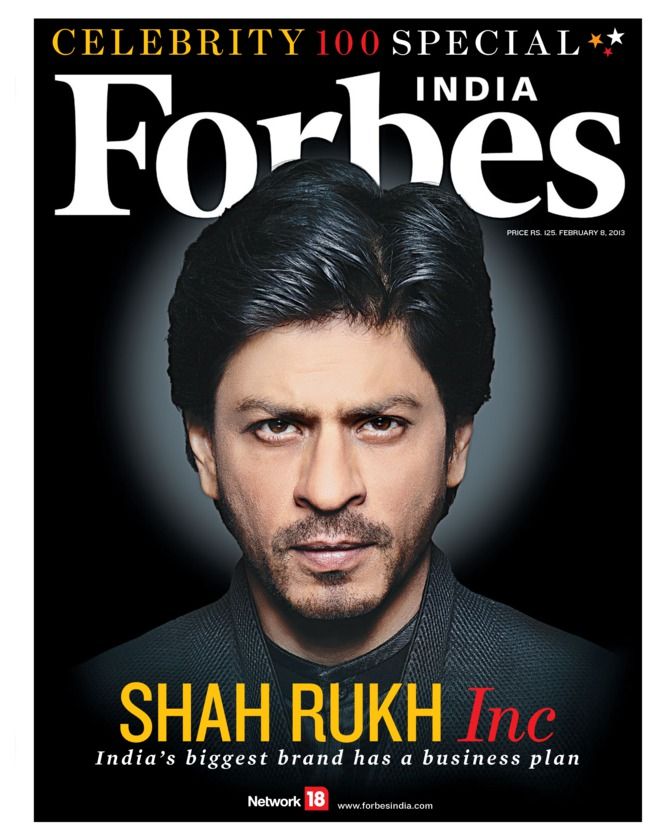
SHAH RUKH INC

[Archivio]

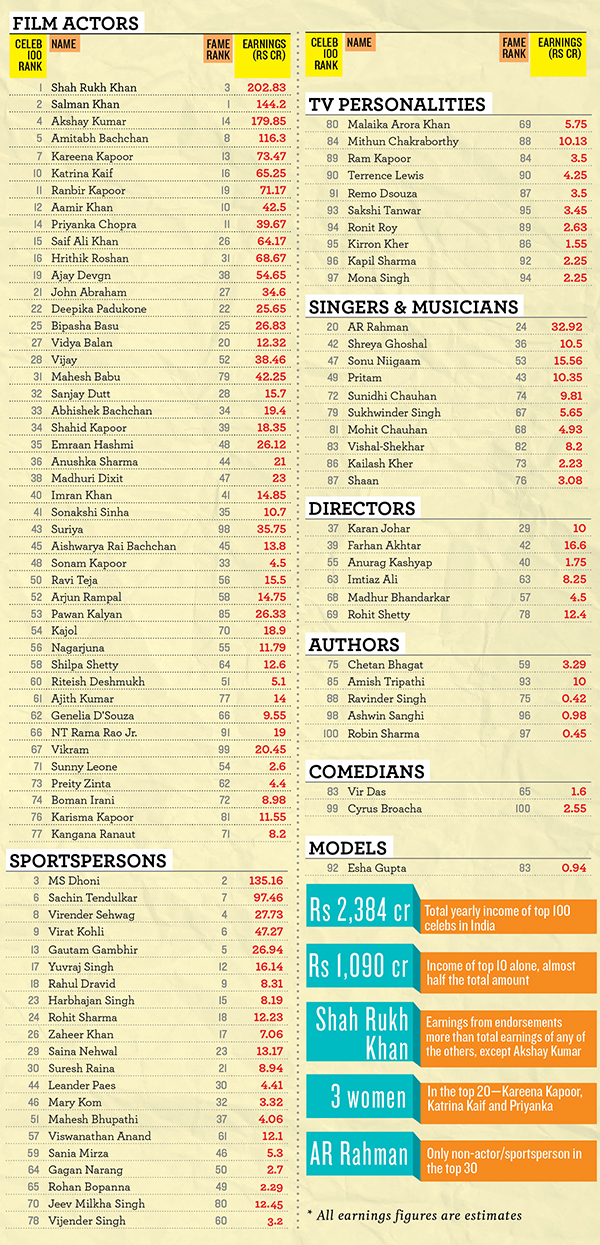
Vi propongo un estratto da una lunghissima intervista, suddivisa in due articoli, concessa da Shah Rukh Khan a Forbes India, in occasione del numero speciale dell'8 febbraio 2013 dedicato alle 100 celebrità più famose del subcontinente. Vi anticipo che la superstar cita ben due volte il nostro Paese (il Re ci ama). Per quanto riguarda la classifica, SRK si aggiudica il primo posto, Salman Khan si posiziona saldamente al secondo (clicca qui), Akshay Kumar è quarto, Amitabh Bachchan quinto, Kareena Kapoor settima, Katrina Kaif decima. Aamir Khan deve accontentarsi del dodicesimo posto, Hrithik Roshan del sedicesimo, Aishwarya Rai del quarantacinquesimo. Primo fra i registi, Karan Johar al trentasettesimo.

SHAH RUKH INC, Charles Assisi, Deepak Ajwani, Sohini Mitter:

'He ambled in trailing charm and cigarette smoke. An assistant placed a glass of whiskey in his hand. And we began to talk. Or rather, he did.
“I can do a line in a minute. I can memorise 20 pages and deliver it. I go for these rehearsals because in the space of work I am in, my performance, somewhere, besides the lines and production, I should be able to do something to improve the experience of someone watching it. That is the essential aspect of business I am in, or why I am in it, mashallah the business has prospered, I have the best of people and I have fantastic people, but we never discuss monies in this office.”
Huh?
We had been warned: By people who have seen him from close quarters - “He’s a master of the rehearsed ad-lib”; “He can speak and speak and say nothing, and you’ll only realise that two days later”; “He will duck all questions on Red Chillies Entertainment” - by those who said we were wasting time talking business with him - “The man has no clue what he’s doing” (a big-name producer); “He’s lost it in his head” (a distributor) - and of course, we knew he’d be late - “With him, I just kill my ego and wait” (a director known for his punctuality, and whom most actors would kill to work for) - and so we spent a day waiting for the call from his office - “He’s busy, you’ll have to get here on a two-hour notice” - which didn’t come, and then another day, and then we’d got the call, and scrambled to his home, where we had waited... Five... Mind... Numbing... Hours.

And then his publicist (...) told us he was coming. But: “Be gentle with him please. He’s sick and running 101 degrees.” And then, yes, he ambled in, and smiled, and we suspended disbelief and forgot our irritation and were enthralled listeners. At some point, though, self-preservation kicked in. Perhaps it was the realisation that we were hearing things we’d heard before. Some we recognised, word for word, from quotes we’d read in a story on him in Outlook 13 years ago. He was feeding us pre-digested faff. Charmingly, convincingly, with all the smooth delivery and sincerity of a used-car salesman on crack cocaine. But faff.
We gently reminded him we’d heard all this before. As gently as possible, we told him many people think he’s all gas. He didn’t blink. “They’re completely right. I don’t take offense to that.” Did we hear a switch click? The tone was the same, but he seemed to be going off-script. “I don’t need to do all this. I have enough money to last a lifetime. But you’ve got to have passion. You’ve got to be like Walt Disney. (...) I’m focussed, and I know why I’m doing what I am doing.”
For the rest of the evening, platitudes were in short supply. We got logic, even if coated in self-deprecation, plans rather than sound-bites. About building a sustainable business, using lessons learned from the superstars of the corporate world. He claims he doesn’t understand business. But 72 hours after leaving his gravity field, the effects of his charm have worn off and it is possible to look dispassionately at what is obvious: SRK knows exactly what he is doing.


Stick to what you know
Red Chillies Entertainment, (RCE, the banner he runs his various companies under), he believes, has the potential to generate a few hundred million dollars a year, much like a Hollywood major. And it will outlast him. “Else I would have called it Shah Rukh Khan Productions. Everybody in the business names their companies after themselves. Not me. I wouldn’t put my face on my company. I’d say this guy fights too much, smokes in public and does all the wrong things.” From his idols he has learned this: Focus ruthlessly on what you know, to the exclusion of everything else. And entertainment is what he does know, understand and get excited about. If he has got into businesses that don’t play to that strength, he gets out. Like when he started an equipment-leasing division. “It wasn’t entertainment.” He sold it to an assistant who had interned on his sets. And “I don’t understand or watch these saas-bahu [suocera-nuora] kind of soaps. It’s worked well for Ekta Kapoor. She is a close friend and has done a great job. I can’t.” So Red Chillies Idiot Box, a firm he started to create television software, is now defunct.
Sport, however, is entertainment. “Sport brings kids in. It makes business sense to keep the young happy.” (...) Then there is his VFX (visual effects) business. (...) “I like to think big. I don’t think short-term. The short term doesn’t scare me. I have the guts because of repeated failures in the past. If Ra.One hadn’t succeeded, I would have gone on and made Ra.One II until I made it a calling card for VFX in this country. The bottom line is that all of these are entertainment. I’ve been entertainer of the year for 20 years. VFX is entertainment. Film production is entertainment. And cricket is entertainment. I am not as diversified as people think I am.”


Slick is good
Ten years down the line, SRK believes, Indian film-makers will be toast. Hollywood will take over, like they did in Japan, Korea, Europe and other parts of the world. By way of examples, he talks of Christopher Nolan’s Inception and James Cameron’s Titanic. Back in 1997, when Titanic was released in India, it grossed Rs 6 crore. But when Inception was released two years ago, it grossed Rs 12 crore from South India alone. In Hollywood, that’s peanuts. But they’re playing to a plan and every big studio, whether it’s Fox, Sony, Columbia, or a you-name-them, wants a piece of India. To drive the point home, he talks of how Fox Studios first tied up to release My Name is Khan across India. The idea wasn’t to make money, but to break the gates down. “Because I am Shah Rukh Khan, every Indian outlet opened their doors to Fox. I called up the ten-twelve people who represent all theatre owners in India, and they agreed.” That was the opening they needed. Fox is now the largest distributor in India and use the channels they built with My Name is Khan to push Hollywood content into India. (...) But, as more people flock to cinemas, Hollywood’s finesse will eventually win them over. India may make the most movies in the world, but “With all due respect, the production values are s***. Why will my kids watch that kind of crap when Hollywood offers something slicker?” (...)


If need be, plead (...)
He is (...) the best public relations ambassador RCE could have. “I was the first to go on the road, do television shows, go to malls and market films in those big, stupid, silly, over-the-top ways that people do today.” Usually, he says, “I never go out and ask for business.” But for the VFX part, he does. “I have to convince people to trust RCE. I get access because I am Shah Rukh Khan. I went out, met Rakesh Roshan and told him ‘Sir, let me work on Krrish.’ He likes me and knows I will do the best job possible because I have this technical keeda [itch].” There’s more. “Hollywood collaborations are happening as well. What we refuse to do is low-end work. We want to work on the core effects. In Ra.One, that special sound effect you hear requires intricate software. These are things we build. Once you have it, you can rent it out. (...) We live in fortunate times. The American economy is in a bad shape. It allows us to get the top VFX guys from America and we employ them on short-term bonds. For Krrish, the top people have come down. We employ them for short periods, give them the best possible lifestyles, and ask them to teach our kids how to do it.” (...)


Use yourself
He is intensely aware of how powerful he is as a brand, and isn’t bashful about using his weight. And he doesn’t think quarter-on-quarter. (...) “So when we were doing Ra.One, I was told we have superb sound, but theatres can’t reproduce it and owners won’t cough up the money to invest in the systems. So I personally went to Dolby and asked them if they can put 7.1 Dolby surround sound in theatres. They said they would if I added my branding to it. I called up theatre owners and told them, ‘Listen guys, I’m Shah Rukh Khan and I’m getting you this hardware from Dolby. Just put it up for me.’ They agreed right away. It added to the viewers’ experience without them even realising it. The graphics cards that were used to make Ra.One, each one is horribly expensive. Nvidia, the company that manufactures those cards, gave me 300 of them in return for my brand name. It’s a win-win proposition for everybody.” (...)


RCE is making profits now, but the Hollywood-sized scale Khan wants for it is still some time away. Can it get there? What could get in its way? Shah Rukh Khan is RCE’s biggest strength and potentially, its biggest weakness. He is promoter, ambassador, mascot, rainmaker, inspiration and fund-raiser, and to fit it all in, he drives himself at a pace that would prostrate ordinary people. Sure, that’s not unusual for business barons, but they are not also called upon to simultaneously spend many hours a day on film sets leaping, dancing and projecting charisma at a billion people. He’s 47 now, and the abuse he has put his body through will begin to take its toll. Will his superstar status last? That’s unpredictable, given the vagaries of the industry, but at a conservative estimate, he could hold his place at the top for four or five years. Is that enough time to take Red Chillies Entertainment to the top of the food chain? Yes, business empires have scaled up in less. But there’s this: Many actors, around the world, have started businesses, with ambitious, visionary plans. Not one has ever truly made a genuine success of it. King Khan won’t be just fighting himself; he’ll have to beat history. And we have the best seats in the house'.


I PRAY TO GOD THAT I NEVER BECOME A BUSINESSMAN, Charles Assisi, Deepak Ajwani, Sohini Mitter:

'Becoming India’s biggest showman
To be really honest, I don’t know how all of this has happened. (...) When you ask me to be honest, I don’t know how it all happened. I do a lot of things. This business has given me the opportunity to meet some of the biggest world leaders. I am personal friends with some of them. And the only ability I have learnt is to say I don’t know and I want to pass that on to my son.

Equating failure with poverty
I come from Delhi. (...) I lost my father when I was 15. I lost my mother. I had a sister who was not well. I equated failure to be poverty. I have come from there. I am scared of poverty. I have succeeded because I am scared of failure, which for me is poverty. I believe in dignity of labour also. (...) Where I came from, I had no money to eat. (...) I come from a very realistic place. My parents died in debt. I remember, during the promotions of Kabhi Haan Kabhi Naa in Gurgaon, someone from the audience yelled at me saying that my mother owes him five lakhs. My mother was no more then. Here I was, being a star, and I was being told she owed somebody Rs 5 lakh. I don’t want that to happen to my son. (...) I have so many awards. But I am still scared for me or my son 40 years from now. That’s why I don’t want to ever take a loan. (...) I just want to give a good education to my kids and tell them listen, we don’t owe anybody any money. (...)


SRK: Actor or entrepreneur?
I’m only an actor. I pray to God that I never become a businessman. What turns me on is working on a line or singing a song or being able to create a moment in front of the camera. It does not turn me on cracking a deal. (...) I like to get more into the creativity of film making which is writing. That is the starting point. I want to graduate inwards. I will get it wrong more often than I get it right. But the idea is that I do it for the creative part of it, for the excellence and tech creativity of it. I have never done it because of money. I’m all right losing money but I live to the purpose of the business which is to give happiness. (...)

Diversify but get the core right
Everything else follows. Film production is related to my core. It’s in the same business as I’m in. VFX is only going to enhance them. Action, production and VFX are at my core. These are the things I like. I even draw the sets sometimes. I write my fight scenes. These are extensions. I really like kids. Business wise too, I feel the biggest gap India has is in the sector of children. Our entertainment (...) gives no opportunities to them. Sports are also related to that. Because sports allow kids to come in, it becomes entertaining and commercially viable. It makes great business sense to keep the young happy.


Entertainment, Entertainment, Entertainment
The bottomline is that all of these are entertainment. And that’s my business. I’ve been the entertainer of the year for 20 years. VFX is entertainment. Film production is entertainment. Cricket is entertainment. And television is entertainment. So if you really look at it, it’s under the masthead of entertainment. So I am not that diversified [as you think].

Sports is passion
I remember when we were doing Chak De! India we went out to rent the Jawaharlal Nehru stadium to practise. We couldn’t get the National Stadium all the time. The officials told me it was booked for weddings. And they asked me why are you making a movie on hockey? I told them what are you doing? This stadium is meant for sports in this country. So, as a person, who has come to a position of choice, who is doing well, who wants the best for his kids, and I have a passion for sports, in fact my life’s dream is to make a stadium. People keep telling me why did you get into IPL? But how stupid is it? In a country with 1 billion people, only 11 kids can go on playing cricket for the next five years. Just think about it. What are the chances of your child or my child making it to a cricket team? So we need to build more platforms. I am not saying this [IPL] is the greatest thing. As things are developing, I feel very sad we don’t have a good football team. Ours is the only developing country that doesn’t have a good football team. From Chile to Uruguay to god-bless-them Nepal, they’re all fantastic. It’s a cheap game. (...)


Corporatisation changing the industry landscape (...)
Corporates are allowing us to market films in places as diverse as Surinam and Italy. That was amiss earlier. And now that they have come, the marriage between the two, that is the creative set of producers and the business side of studios in the last 5-6 years have turned out some good stuff. Another five years and things will grow a lot more. (...)

Star system
I remember Quentin Tarantino telling me this in Cannes 5-6 years ago; that the star system is what is going to sustain the film industry. And we are genuinely lucky to have a system like that already in place. Where there is no star system, there will be no film industry. (...)

Tap India’s youth
We [Indians] are looking at the wrong market. We should be trying to capture our own market. We should have one theatre for 10,000 people. And let’s make cinema to attract this young India that is emerging. But younger people are going to have younger thoughts and younger ideas. So if I don’t give them the best film, they will go. I can see my 15-year old son succumbing to Hollywood. We need to cater to the youngsters. If we don’t do it, before we know it, we won’t be making 200 films anymore. It will be 150, and then a time will come when we will have just 50 [films] to show and the others will be watching Hollywood films. It is already happening in the urban India. If we make it, it has to be kickass. We have to take cues from the West and that is the long term business thought I have. (...)


Image, PR and endorsements
I have an amazingly pretty face. I am a fantastic poster boy, no doubt about it. I started endorsements. (...) I endorse everything. My image doesn’t matter. What I become, the work I do is my image. I am not trying to be someone else. (...) He is a good boy, he is a family man, he is a superstar, and he is an intelligent guy. None of these things, I decided. Whatever my image is, that’s what I am. When people say I am intelligent, it is because I am educated and I am proud of it. I remember when I came in, a very big producer told me let’s claim you’re uneducated. (...) Why should it feel good to say that this guy came from the streets of Delhi and became a hero? I make educated decisions, good or bad or ugly. I keep saying this again and again. I am employee of this image and the image is who I am. I work for this image. But some days, you don’t like your boss. Some days you like to sit down with your boss and say Sir, everything is good about you. But what you said that day is stupid. I don’t work for an image. I have great PR without wanting to be so. I sell films. I sell the goods you want me to. Is it good for my image? Who am I to question a 100 year-old company? You haven’t questioned it, why question me? (...) It’s not as good or as bad when they say I am fantastic; truth is I am not as fantastic. When they say I am bad, I am not as bad. It’s all somewhere in the middle. So long as your family knows that. My son and daughter will grow up to know the right things. Are they going to live off the image their father created? That would be stupid. (...)

Future of children
The easiest thing for me to do is to launch my son as an actor. He is good-looking, and has the backing. But I really want him to be a sportsman because it is an important aspect in this country. (...) That’s a great life. You’re a star son; you should live a great life. Live in Italy somewhere, or Barcelona, have a good time. Go around with some good babes, and get paid for playing. But I would like my daughter to be an actress. I think she is talented and has a lot of interest and acts very well. I personally feel a lot of my stardom is because of the women who have worked with me and they haven’t got their due. It is my duty to make sure, that I pass on the mantle to my girl because that would make a statement that it is alright to be a girl and an actress and it is cool to be a woman'.

(Fotografie scattate da Dabboo Ratnani)