Visualizzazione post con etichetta R VIKRAMADITYA MOTWANE. Mostra tutti i post

09 novembre 2023

SAIF ALI KHAN: WHEN MY FATHER DIED, PATAUDI PALACE GOT RENTED


[Archivio]

Vi propongo una piacevolissima (e lunghissima) intervista concessa da Saif Ali Khan a Mayank Shekhar, pubblicata da Mid-Day il 7 novembre 2019. Il testo include il video dell'intervista integrale. Saif Ali Khan: When my father died, Pataudi Palace got rented:

'You get called the 'Nawab', which inheritance-wise, you are [of Pataudi]. But the fact is you're actually a self-made actor, having taken nothing from parents, ever since you moved to Bombay, at 20!
Yes, thank you. (...) People have a certain fixed notion. For that matter, even [with] Pataudi [palace], when my father [Mansur Ali Khan Pataudi] died, it got rented to Neemrana Hotels. Aman [Nath] and Francis [Wacziarg] used to run [the hotel]. Francis passed away. He'd said that if I wanted [the palace] back, I could let him know. I said: I want it back. They held a conference, and said, okay, you have to give us lots of money! (...) Which I then consequently earned. So, even the house I'm supposed to have inherited has been earned back through money from films. You can't live off the past. At least we can't in our family, because there was nothing. There is history, culture, beautiful photographs; and, of course, some land. It has been a privileged upbringing. But there's been no inheritance.
You moved to a rented apartment in Bombay, is that how it worked?
I was born and even raised in Bombay. My father lived with my mother in her [Carmichael Road] flat; I went to Cathedral, spent time in Bombay Gym - in a world more influenced by my father's, than films. He had just finished playing cricket. His last Test series was when I was four/five. My mother [actor Sharmila Tagore] says he was bunking his responsibilities. His mother was looking after things in Bhopal and Pataudi. She'd got old. So we moved to Delhi to live with her. It was a nice, big old house in Delhi, which she had been given for her lifetime, in return for land, property and other kinds of deals that these old [royal] families had made with the Indian government.
That'd be 1971 [when privy purses were abolished], right?
1971, exactly. So, that's why we moved to Delhi. I had fun. That was the generation of designers like Rohit Bal, Rohit Khosla, Ashish Soni... These were the first people I came across, doing something off-beat, in terms of art, culture. Which might have planted a seed [within me] to go and act in films!


You did start off with an ad.
My father sent me to an ad agency to get a job, because I was partying a lot.
Where were you partying?
In Ghunghroo [discotheque at Delhi's Maurya Sheraton]. It was fantastic. My father put me on a bus to an ad agency in Sunder Nagar. One of my jobs was to make religious calendars for Birlas. The only creative [call] was whether we should put Lord Vishnu in October, or November. I soon lost interest!
And the Gwalior ad happened?
Which, again, had to do with my father. My parents were shooting a Gwalior ad together. Honestly the way my upbringing was, the kind of life I'd had, or lack of confidence - I wasn't a cinematic figure, in terms of being shot in photos. I was effeminate, coy, shy, unsure, worst qualities for a...
A leading man?
As an actor in Bombay, yes. But not bad for a western, academic school-boy. That was a different culture altogether. So some quick learning was required.


And then you moved to Bombay. Where did you first rent a place?
In Lokhandwala; a building called Red Rose One. It was a small flat with cane furniture. The producer's daughter had very kindly done it up for me. Until one night I came home with friends, and couldn't open the bedroom door. She had locked it. I think she had a plan. There was a big gap between the door and carpet. I peeped from under, and could see her lying like a whale on my bed. And I thought I'm not going in there. So we went out again!
You began your career pretty much by yourself, and it was, I hear, a disastrous start! Take us through it?
So I went to a really academic, school - the oldest in England - Winchester. The idea [of being there] was obvious. You go to Oxford [or a similar place] thereafter. That hadn't worked out. I was in the black books of my parents, what with Delhi, partying and Ghungroo. I was getting scared. Because there was nothing I was interested in. After the Gwalior ad, when [director] Aanand Mahendroo mentioned a film [to me], bells started ringing. The thought of moving to Bombay sounded so exciting. I remember having that shower in Delhi, in that old house, which had funny water [plumbing], it wouldn't work half the time, and I'd fiddle with it, too hot or too cold...
Saif, you're digressing.
Sorry. Chipkalis [lizards] on the ceiling. Okay, stop! I remember that shower and being excited about a kind of life I could see - coming to Bombay, struggling, little rented flat, films, meeting people, collaborating... It is the only job that, from 18, when I started considering it seriously, I've always been passionate about.
Were you not a movie buff?
Yeah, but a western, as an American, movie-buff. When I was young and my mother [Sharmila Tagore] was an actor, I'd see her crying on screen. It's not something I enjoyed. Hindi films in the '70s were also overtly emotional.


So, Aanand Mahendroo...
He offers me this movie, and comes to Ghungroo. I tell my friends, "Hey guys, this is my director..." He has a couple of vodkas. The same guys tell me, "Bro, your director friend is in the bathroom [throwing up]!" I should've realised we were in a bit of trouble. We came to Bombay. Sattee Shourie was our producer. Then somebody told me a story about an ambitious film she had made called Farishtay [1991] with Vinod Khanna. There were panthers chasing him in a shot in that film. She ran out of money during shoot. In the same scene, when he [Khanna] comes around the corner, there are no panthers. Because no money. So, she got some dogs, and painted them black. This is after she had been kidnapped by a cab-union driver!
That was your first producer!
Yes, she used to pay me Rs 1,000 a week. And I'd have to kiss her 10 times on the cheek. Anyway, she had a fight with the director, and I got saved. Because the film got shelved. Then, Rahul Rawail cast me in his film.
And that was a disaster too?
Kamal Sadanah was in the movie. So he [Rawail] threw out Kamal, and took me - for no fault of Kamal's. And then found out that I was worse, and threw me out. And took him!
Apparently you showed up drunk on set, slept off...
You've done your research. But no, that's not true. Nobody turns up drunk on set. I was just not subservient, sitting around all day. There could've been some attitude problem, which I myself wasn't seeing. I [probably] didn't understand how serious things are. You might come across as really cocky, because you think it's really funny, when it's not.
Did you make friends easily in Bombay though?
I did. Many of them are producers now. Some of them are in LA. I remember Dileep Singh Rathore [Hollywood production manager for Blood Diamond, The Dark Knight Rises] and I used to do acting classes together. And we'd get asked to take our shirts off; another guy would do push-ups with his shirt off. All the things [work-place sensitisation] happening lately is good. This crap's been going on forever. Luckily, we were like, no bro, we're not doing this.


And then you finally debuted with Yash Chopra.
It is personal and I don't want to dwell much on it - I also ran away from home, and got married at 20. And I've to give Amrita [Singh], my ex-wife, credit for being the only person who taught me to take it all [work/show-business] seriously. She said you can't hit the target while laughing at it. That's when Parampara happened. Yashji called to say he was looking for a fourth lead, or something. I was like, great; yeah, anything. I'll do it. It's like investment in stock - if Yash Chopra is taking him in Parampara, [the industry believes] let's invest in this. For me, it was as simple as, this has to work. There's nothing else. That focus was required. And taught to me, and I inculcated.
If we watch retro Lehren [video-magazine] interviews from back then, it seems like you, now, and that guy are two different people!
I sometimes find myself doing the same stuff. Maybe I haven't changed! But it's an age, and exposure thing. Your upbringing, the culture you're given, and the academic grounding that teaches you to be humble, understated... They come flooding back later. Not when you were trying to fit in - giving gaalis, drinking Bacardi, being one of the boys in the '90s; and then you question: Do I want to be known like that? Or should I be comfortable about how I express? It's true for people. I've read characters in plays that are rebellious, and then embrace everything they rebelled against.
I meant more in terms of the duality between who you were as a person, and what you did [in terms of movies] in the '90s.
For sure. Because you had to fit into a certain mould in the '90s. There wasn't that much room for experimentation. Aamir Khan said he'll do max five films a year, when others were doing 15! Shakti Kapoor said he felt insecure when he didn't have 17 films on floor!


You still had some hits to keep you going though.
This is an organic kind of an industry. Like crude oil, you distil off at different temperatures. So people find their own level. And you need a certain amount of success to survive. So Parampara, the great Yashji film, didn't work. It was his 'safe' film after Lamhe didn't run. Aamir, who did Parampara, got offered Darr. I was the fourth lead. And got offered Yeh Dillagi, a smaller film, with Akshay Kumar also in it. But my role was fun, music was great, so I scored something there.
As a person, did it occur to you that you're not exactly that 'Ole Ole' fellow [from Yeh Dillagi]?
In fact that merge [of sensibilities] is happening now. Which is a sign of some civilisation. Earlier, what you do for a living had nothing to do with what you are [as a person]. The minute we're on set, we are equal; and just part of this thing, and it doesn't matter what... (...) A lot of these films in that time, had great music. That kind of helped [us] survive. You could be an audio hero. I think, I kind of was - quite presentable doing a lot of songs. As for performance, even a big star said, what is acting? Just say your lines in a sincere fashion! Which is how it remained for the longest. There was also the 'Mr Bachchan' hangover.


Dil Chahta Hai [DCH], in that sense, is obviously Saif 2.0.
I would have to say it is people like [director] Farhan [Akhtar] and Aamir Khan, who were effecting change, and I benefitted. I wasn't sure if I wanted to do DCH. I was the third lead, while playing hero in multiple films. Aamir asked me about films I was hero in. I named them. He said this film [DCH] is about three times the size of all those put together - Can you get on the page, it is good cinema, you have to do it. (...) When LOC, or a two-hero film happened, I'd think of Bud Spencer and Terence Hill. In my head there's nothing wrong with it. I've always been happy to compete with the other guy as well. I'm like - you might be the biggest star; but I am going to give you a run for your money. The idea of a buddy-movie was also being liked at the point.
After DCH, there appears to have emerged a certain confidence. How many Bollywood stars have attempted an English film? You did Being Cyrus [2006].
Also, Kaalakaandi [2018]. With Being Cyrus, there was the question of the English sounding natural. American is the language of our English. [Director] Homi [Adajania] wanted me to sound a little Indian. We had to get it right. This is what's happening today - guys who basically speak Hindi are better actors. Language is the thing. (...) Well that was the time when things were coming together. I was at the right place, and also looking like the right guy - it was no longer that funny haircut. Films like Omkara and interesting stuff with Yash Raj were coming together.
And you were killing it with the dialect in Omkara. Tough?
Kind of. But despite perception and projection, I am not actually English, you know! I have grown up in Pataudi, which is in Haryana. I have heard that dialect all my life.


Saif 3.0: You turn producer with Love Aaj Kal. I'm told [director] Imtiaz Ali offered you Rockstar first. True?
Yes, that's right! Of all the ideas, Love Aaj Kal just sounded a bit more commercial, although not the way he wanted to make it. He had quite a grim ending in mind, where this flaky guy finally returns to find out that his girl is eight-months' pregnant. We had to plead with him, until when we were on set in London, he said alright, we can have a happy ending!
Which makes sense, because by then you were the quintessential rom-com leading man; Bollywood's own Hugh Grant, as it were.
Yeah [Hugh Grant], I've heard Karan Johar say that as well. Don't know where it came from. I remember Aditya Chopra telling me that he's got Shah Rukh Khan, who's the king of box-office. That there's this thing called the 'multiplex hero' coming up. And that he's trying to get a handle on it. And he thinks that I could be that multiplex hero, because I'm a little different. Cast correctly, I should hit that genre. So he started making Hum Tum, Salaam|Namaste.
Rom-coms seem to have died altogether. In Hollywood, it's all Marvel anyway. And here...
My wife [Kareena Kapoor] told me that that genre has changed into [films like] Badhaai Ho. Don't know if true. Think she means the lead character, trying to figure out life in New York etc., is passé. Also, confusion, being unsure, a bit of a mess, is the hallmark of the rom-com hero. Because there is no villain. Villain is your flaky self. Which, maybe, doesn't fit well, when you're supposedly more grown-up. Maybe she [Kareena] just doesn't want to see me like that!
Still with [producer] Saif 3.0, you did a zombie-comedy [Go Goa Gone] in Bollywood -spoof/subversion of a genre, while we hadn't had a proper zombie film!
It seemed like a good, entertaining idea. Frankly I don't think I'm a great producer. What I love might not be everybody's cup of tea. A great producer can tell: Okay, this is a joke, as in an amazing, four-line anecdote; not a film. Or this is a film. Or this is a short-story/book. He can sort out different mediums. Within films, he should also be able to tell at what budget that story should be made. Don't think I have that ability.
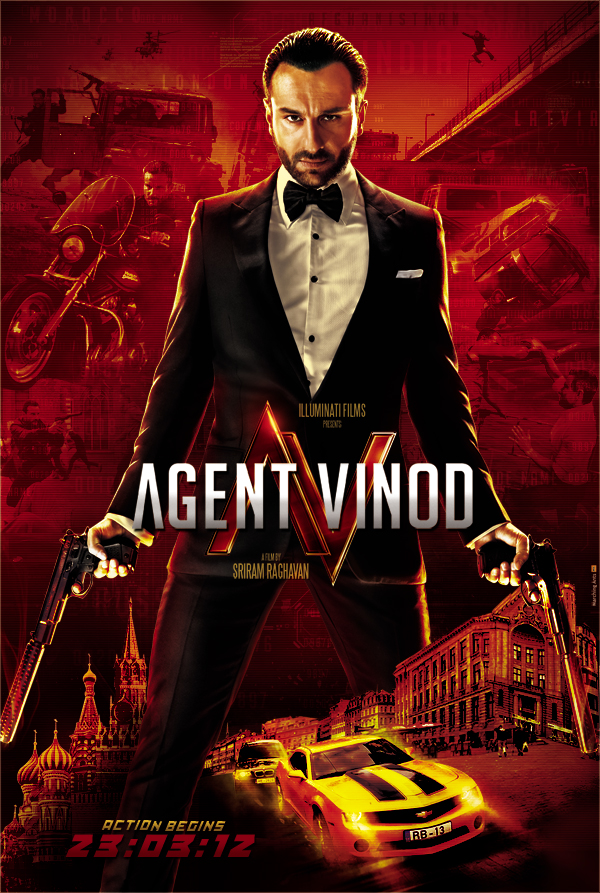

[Referring to Sriram Raghavan's] Agent Vinod, that you wanted to make?
I made a mistake. I thought Jack Bauer from 24; so why not an Indian Agent Vinod? Apart from a complicated script, we missed out on the character's 'Indianness'. This guy was looking bit too western - dinner-jacket, suaveness. He should've been wearing chashma, holding a ball-pen...
Did you decide to shelve the film during its making?
No, again, Dinesh Vijan was [co-]producing. He is good at balancing stuff. What had happened was that we were shooting at a heritage site - action-sequence, with machine guns and all. We needed to blow up stuff. So we said, okay, there are a couple of beautiful, medieval temple structures...
No!
Of course not! We built replicas 100 yards away. The people there went nuts, suggesting that we were blowing up the complex. They stopped our shoot. We had to reschedule, scrap what we were doing, etc. But we managed.


Curious to know, why did you name your company Illuminati? Anything to do with the conspiracy-theory about a society of elites that secretly rules the world?
No. There was something about illumination and light. There's also the fact about Illuminati being a group of people, including Isaac Newton etc, who questioned authority of Church and talked about importance of secular knowledge. But, ultimately, 'Illuminati' is to illuminate. And that is what a film projector does. Johnny Depp had a production company called Infinitum Nihil - 'nothing is impossible'. And I used to look up to him. Now he's been replaced by Tom Hardy.
Why did you and [your co-producer] Vijan part ways?
Because Dinesh Vijan is on his way to becoming a big film-producer. I wanted someone to run my production company. Which is fair. That's why people usually leave. I don't want to make films for 20 other people. I see myself as more of an actor.
In Cocktail, you did offer the lead role to other people.
We did. I only stepped into Cocktail, because Ranbir [Kapoor] and Imran [Khan] didn't want to do it. So I said, okay, I'll do it. They should remember that.


Stepping into Saif 4.0: Your entire career put together would be the polar opposite of the subdued Sartaj Singh from Sacred Games [on Netflix]. Conscious call?
It's got a lot to do with [director/show-runner] Vikram Motwane. On Day One, we were in Madh Island. Distance wise, this was painful for me, before the ferry, I realised... (...) I was doing an investigation scene. And he [Motwane] said, cut, and just told me to bring my energy levels down: "You're too hyper!" It was a different kind of communication from anything I had done before - the feeling of trusting the camera, and not showing what you feel. It was the first piece of film I had ever worked on with that thehraav.
You've been talking about unlearning, reading acting books etc, something you didn't do before.
But before that, a little bit of background. Which is about the way we were brought up in the movies. I don't know about Dilip Kumar Saab, and Amitabh Bachchan. But after the '60s and '70s, there was a creative slump, where the attitude with cool guys was: We don't talk about acting, work... Who learns lines? It was like how we used to laugh at nerdy kids in school. People used to wonder why Aamir is taking things seriously - there was just this whole attitude of 'unseriousness'. There was a glamour and starry vibe. It certainly wasn't about prepping for work, which has changed.
You were the first Bollywood star to green-light a web series. And you said no to Homeland, is that true?
Well, I was asked to read for Homeland, which I did, and then asked to come down to LA or New Zealand to read some more. I could have pursued it more aggressively. But I was busy here. I remember [daughter] Sara [Ali Khan] helping me a lot, people getting excited. But it wasn't a great part. It wasn't the main lead. The part went to an Etonian [Damien Lewis]. Now you can't have a Winchester boy playing [second fiddle to an Etonian]!
Would Sacred Games be the first time your school-friends watched your work?
Yes, good point. And they are quite academic, and say things like, it's really interesting that a Muslim guy plays Sardar, and in this kind of world, that's good contribution!


(Audience) Pacing of Sacred Games 2 came under question. What did you make of it?
I didn't like the second season as much as I liked the first, which was the newest and most interesting thing I had ever seen on TV, from any country. It was a mafia show with a disturbed cop. But it [Season 2] became a bit esoteric and slow, with the treatment of the guru with Gaitonde.
'I did not like Sacred Games Season 2,' reads like a headline!
But, you know, I didn't. We were in England. It was my birthday [when the season dropped]. Five of us had rented a country-cottage, including a South American book publisher friend of mine, who also speaks a bit of Hindi, loves different cultures. We opened a bottle of Champagne, got Netflix on...
That was your premiere.
Yes. We didn't even tell Kareena. And we sat. After a while I said, okay, I'll watch this on my own later. That didn't happen with Season 1. I shouldn't probably say this.


(Audience) In [Raghavan's] Ek Hasina Thi [EHT], you play the most believable f***boy. How did you pull it off?"
I was just happy to play something cooler, and darker. (...)
What happened in the second half of EHT, though. You think it went a little berserk?
It did. Sriram and I have gone berserk a couple of times [laughs]. And then he does Andhadhun [without me]! I don't mean to sell Sriram out, but he paints himself into a corner, and then tries to write himself out of it. Which is great. But might not always work, although the good stuff about EHT outweighed...
The first half was killer.
Yeah.
(Audience) You've often gravitated towards morally corrupt characters. Does that give you more room?
I'm just interested in those situations, more than glory of God. Hrithik, for example, suits a Ram-like character.
What role did you play in Hum Saath - Saath Hain?
Krishna - he's a naughty little version. Salman was Ram. I found it exhausting. One of the most tiring things is to be so happy and positive all the time. And Sooraj-ji [Barjatya] used to say, "Do it your way. But smile!"


How different is it to work with, say, Abbas-Mustan, from Sooraj Barjatya?It took me a while to figure out Abbas-Mustan. Mustan Bhai would give instructions. (...) Then there's Hussain Bhai, the third brother, who is unsung - one of the best editors. He probably contributed the most to films like Race. They'd start shoot at 10 am, wrap at 5 pm. Love these guys, easiest shoot ever.
They never shoot nights.
They just can't. Then Akshaye Khanna told me that I was behaving like a star with them. That I'm not hugging them enough. That I should hang out, and give them more love! I went to their room at Hilton, in South Africa. There was a white sheet on the floor they were sitting on, and having whiskey and peanuts. They asked me to join in. I sat there for a bit. At some point, they told me I don't have to do this [socialising], if I don't want to - just turn up on set, do my bit. That was great relief. We got along really well after. With Sooraj-ji, I just remember the sheer number of people coming to see him on set, touching his feet - from top heroine to struggling actresses.
Just to say hi on set?
In the most charming way! I remember Rekhaji coming to see him, and she's senior. That's power. And distributors would throw themselves at their feet on set, asking when's the film out, that there's a drought in theatres. They [Barjatyas] were the princes of the film industry. I remember Salman telling Sooraj-ji [about HSSH], "Do you think you'll give a hat-trick? It's quite rare." And I'm like, God, who talks to him like that! So, Abbas-Mustan and Rajshris are different sides of a coin.
Can't imagine Barjatyas on the floor, with booze and chakna.
Definitely, around the table, eating together. No, drinking, that's impossible!


Last question: You've been vocal about issues all along. But when the #MeToo movement happened, it seemed like you didn't say much, or anything; especially given that the head of the company managing you was accused.
But I said so much about #MeToo. Never heard? It's disgusting to make a workplace hostile. Whatever is happening is really good. I don't think there's any smoke without fire. But sometimes they [survivors] have to come forward. You have to. And we have to support these women. [At the same time] a guy's career can be destroyed, without any proof. So there are two things. You've got to be a little sure, before you destroy somebody, in any way. Also, whether it is a sign of our culture - we take down one or two juicy targets, that nobody really minds plucking out. Nobody touches the big boys! I don't know how civilised that is'.

07 maggio 2023

VIKRAMADITYA MOTWANE: VIKRAM, ET AL

Vikramaditya Motwane e Mayank Shekhar

Vi segnalo la lunga intervista concessa da Vikramaditya Motwane a Mayank Shekhar, pubblicata da Mid-Day il 27 aprile 2023. L'articolo include il video. Sit With Hitlist: Vikram, et al:

'His latest series, on Amazon Prime Video, Jubilee, is (...) actually a mammoth exercise in world-building, without the filmmaker getting overawed by it - sticking to drama and storytelling still. While so classical in its production design and shot-taking, it isn’t placed wholly inside a filmy bubble either. (...) It isn’t full of the usual exaggerations that naturally come with surveying showbiz either. (...) Jubilee captures the real world around it, equally. Whether that be the bloody Partition, or the Cold War. Once you buy into this world - and it takes a while, perhaps fourth episode onwards - we know no other Indian series that progressively gets better with every minute. It may even age better with time! Also, it’s to do with the dialogue. (...) Motwane says, “We wanted the language to be accessible. The language may not be completely correct to the period. But it’s not incorrect. (...) Motwane recalls the idea really took off in 2016: “What if we did our own definitive story of the Indian film industry, from the ’40s and ’50s onwards - the behind-the-scenes, the producers, directors, actors, press, all that sort of stuff coming together. This could be a season, or multiple seasons.” (...) 

If Jubilee does go through multiple seasons, leading up to Bombay cinema, late ’90s onwards as well, there will be few filmmakers more qualified to relive the times than Motwane. On one end is Bhansali, who he was the chief handyman for. (...) At the other end is filmmaker Anurag Kashyap. (...) There aren’t more separate filmy worlds that you could belong to simultaneously in Bombay! Bhansali and Motwane’s mother once ran an advertising production house together. He first met Kashyap on the sets of Deepa Mehta’s Water, where his job as the “wrangler” was to ensure the procrastinator Kashyap, as all writers are, delivers dialogues on time - not an easy task! “Anurag’s wife, [editor] Aarti [Bajaj], his ex-wife now, was with me at XIC [Xavier Institute of Communications], when we were doing a film production course in 1994-95. Anurag had done the same course a year before that. He says I met him then. I have no recollection of this.”


Also, few directors own a CV as varied as Motwane’s - so far as filmmaking departments go. What all has he been credited for? Let’s start: Sound design? “Yes, for Devdas, and Paanch.” Choreography? “Directed songs for Paanch. For Water as well. Well, choreography is a broad term. Because there was no dancing in Water. Deepa wanted me to help her with songs, because she felt I had a better music sense.” Acquired from Bhansali, one’s guessing. Okay, cinematography? “Short films.” (...) How about acting? “Acting in cameos in certain places, which I am not very proud of.” Like, Kashyap’s No Smoking (2007)? “Yeah, everybody sees me in No Smoking!” What’s left, production design? “No, I don’t like that part.” 

Yet, in terms of capturing the fuller gamut of Bollywood, his most uncanny credit might well be as the writer of a film by director Vivek Agnihotri, titled Dhan Dhana Dhan Goal (2007). No, seriously, how did that happen? “So, UTV was producing this film. Vivek had approached them. He said he had this story idea about football. He wanted a really good writer. They called up Anurag, who said he doesn’t know anything about football. But he knows this guy, who knows everything about football. So, they approached me. I have loved this game since I was eight years old. I said, let me write you an original script instead.” What, they gave him a DVD to rip? “Something like that!” Something like that, as in? “So, well, I wrote the script. But the film that got made was not exactly the way that Anurag and me, to put it mildly, kind of wanted. I liked the time though. Beggars can’t be choosers. We got paid for the work, and that was more important than anything else. I still believe the original script of mine is one of the best things I have written.”


Motwane’s first script to be made into a film (...) was the near-masterpiece, coming-of-age, Udaan (2010), that went straight to Cannes in the prestigious Un Certain Regard section: (...) “That was really trippy!”. It’s set in Jamshedpur, (...) about a boy who finishes school with ambitions in arts and poetry, but is forced into the mundane, by a disciplinarian father, who brooks no dissent. It’s almost the opposite of Motwane’s own life, since he was actually driven into the media world, because his mother needed help with a TV show she was producing for teenagers. He was a teenager then, chilling all day in the Mithibai College canteen. What did he even know of a strict boarding-school or small-town life, let alone the Tata Steel township, Jamshedpur, to get it so right with Udaan, we wonder. Motwane says Udaan was originally set in Nashik, in his head, because that’s a similarly industrial, small-town he knew, since his father owns an audio-equipment factory there. “They live in nice little bungalows. The town is very organised. So, I wrote it as a generic place, in fact. Because I knew that world. I could not write in Nashik. It’d be too close to home. And I didn’t want it to be that. So, I wrote it like a Ghaziabad or Faridabad kinda set-up - outskirts of Delhi, where the family lives. The boy sneaks out, comes into Delhi-proper, to party and stuff.” 

And then he handed the script to director Imtiaz Ali: “Imtiaz read the script and he’s like, ‘You know what, just take a train, go stay with my family in Jamshedpur. Have a look. I am reading this, and I can see those streets.’ I was going to cast Imtiaz’s younger brother, Sajid, in the lead, at that time. This was 2005. “Sajid and I hopped on to a train, went to Jamshedpur, spent four to five days with his family, saw the place - this was perfect! I moved the film to Jamshedpur. The film finally got made in 2009, which is also great, because by then, the viewership had changed; audiences had changed. In 2005, multiplexes were still not what they were by 2010, when we did the film with UTV, with a 225-screen release, which is a big deal for a small film.” Kashyap produced Udaan. (...) This also means the original lead actor, Imtiaz’s brother Sajid, would have passed his teenage by then. Young Rajat Barmecha was brought in for the (...) protagonist. The homework Motwane gave him was “the literature I’d read growing up, movies I’d watched.” (...)


The directorial career that Motwane scripted for himself after Udaan is indisputably marked by a range that’s hard to match - going from a period piece (Lootera) to super-hero (Bhavesh Joshi Superhero), a one-man survivor drama, set in a building, suggesting the dystopia of cities (Trapped), to the ultimate Mumbai-mafia sweeping-epic (Sacred Games), that he was the showrunner for - first Indian to hold that title. (...) The leaps are so wide that it piques your interest to know what inspired each film, since none suggest self-expression alone. Firstly, where the heck did AK vs AK (2020) come from - a meta movie that firstly defies genre, about a director and actor playing themselves. The director turns rogue, kidnaps the actor’s daughter, to film in real-time, what happens next! Wut? 

“It’s just such a great one-line idea. Which is what excites you most. As a young filmmaker, you fight the fact that the idea of your film should be encapsulated into one, single line. As you grow older, you realise that one, single line is what drives you forward. Writer Avinash Sampath, who’s now become a good friend of mine, sent the script to us. He’d written it for Aamir [Khan] first. I was sure Aamir is never gonna do it, so let’s not even try! There is Akshay Kumar, who we did approach, and it was a very interesting meeting - I mean, he didn’t sort of outrightly say, ‘Get out of my office,’ but it was close enough! For a while, I was making it with Shahid [Kapoor], which kind of happened, and then it didn’t. The [actor] AKs kept changing. The [director] AK, that is Anurag Kashyap, was a constant. He’s a fantastic actor.” Well, Kashyap says he sucks at acting! “I think he is fab. In fact, everybody on the AK set was talking about Anil Kapoor. I think Anurag, especially in the last scene, is incredible. You actually tear up, when shit happens to him.”


Okay, how about Lootera? It’s practically a Bengali film! “Practically. And that [part is all Satyajit] Ray. I wanted to do a thriller, with a love story in it, as opposed to a tragic love story. Our first trailer got it right. And then there became a problem with the pitching to the audience. People were expecting to watch this epic love story. And they probably went, ‘Hang on a second, this is not that!’” (...) 
Consider Motwane’s take on Bhavesh Joshi Superhero (2018). While he loves the film the way it is, immensely, he says, “I’ve never said this publicly, but I think Bhavesh should have been a woman. As in, Siku’s character should have been female. [Firstly] the world thinks there’s a guy, who turns out to be a girl. When she unmasks, you go, ‘What the f***. Also, then the film is not about a friend, saving a friend, in terms of the Ashish Verma character. He is actually deeply in love [with the female superhero], but has never been able to tell [her that]. The conflict is way deeper. The layers get more interesting too.”

As for reasons for smoothly jumping styles and genres, where each Motwane movie is unrecognisable from the other - unlike a subtle or strong voice/style that laces through most auteurs; think Bhansali, Kashyap - the impetus is quite simple. “It’s the excitement of trying something new. So, Jubilee is exciting, because it is something I have never done before - a classical style of storytelling, 10 playback songs, and all that stuff - the fact of telling a specific story, in the form that is most suited to it. I feel that the film is always the boss. I am not.” Motwane says his forthcoming film is titled Control. It’s a ‘computer-generated’ movie, flitting between screens, centred on an Instagram influencer: “Again, it is a cyber thriller, it is new. I get excited by it. And you learn. Every film is an audition for the next one, having learnt from the last one!” 


That said, surely, if one looks deep enough, they’ll be able to spot a personal thread. (...) His grandfather (...) once produced a film: “It was called Andolan, in 1949, with young Kishore Kumar in the lead. It was a film about the freedom struggle. It didn’t do well, which is why nobody in the family talks about it. Because I think the family lost a lot of money on it.” You also see the Sindhi refugee camp in Jubilee. Given his own Sindhi lineage, we wonder if there is a personal history to it as well? “So, my family didn’t have to make their way during Partition. We were already here from the 1930s. The business was already set up. But for a while, my family house in Khar was a refugee camp. I have seen photographs. People were also demarcated into tents in garden-area or permanent structures, depending on the social status of the refugees.” Motwane says he learnt of his family’s film lineage, only much after he became a filmmaker: “Nobody tells me anything! Now, I’m the family archivist.” He’s named his production company, Andolan, after his grandfather’s maiden and only production. AK vs AK and Jubilee are Andolan productions. 

Of course, the more famous production company he’s been associated with is Phantom Films, which shut down, following allegations of negligence, dealing with a sexual harassment case against one of the partners, Vikas Bahl, in 2017. Prior to that, it was a company rolling out quality films after another. (...) “It was an unfortunate end to what was a good journey.” (...) Is there anything that Motwane thinks they could have done differently over the workplace sexual harassment issue? “Externally, we could have [handled it better]. But again, this is in hindsight. If you’re going through something you haven’t before, you may not know how to handle it. From a professional, empathetic and personal point of view - I am saying all three - we could have done better.” (...)


Motwane and [Abhay] Deol were buddies in school: “He used to invite us over to his house to watch movies.” Isn’t that a close enough Bollywood connection for someone who claims to have grown up far removed from showbiz in general, with no practical understanding or ambition to enter films as such? “But it’s a movie star’s house, ya. That way, Abhishek Bachchan used to be in my school [Jamnabai Narsee] for a couple of years. His cousin Namrata is a close friend. I have been to Abhishek’s birthday parties in Madh Island, where [Amitabh] Bachchan made an appearance. This is peak-Bachchan, in 1984. You are seeing the hero of your dreams, standing in front of you! He’d come off the set, wearing boots. We hero-worshipped him, and I’d gone to Dharmendra’s house to watch movies. There used to be a badminton court. Maybe it’s still there. We were like, wow, Dharmendra plays baddy here!”. As for Abhay: “It’s when he returned from LA that we became close. Because when he came back, we shared an interest in the same kind of music and movies. We were hanging together, and writing some stuff together. We worked together on [the script of] Dev. D, and on a couple of things before that. I was actually in the room, when Imtiaz [Ali] narrated to him Socha Na Tha [his debut film]. So, yeah, that historical moment happened in my presence! We have tried a couple of times [to work together] and then it just has never happened, and then we have sort of given up.” (...)

Saif Ali Khan (...) wholly trashed the second season of Sacred Games altogether - speaking about how a friend and him had popped a champagne to catch it together at home. A little later, they just shut off the frickin’ TV. Rather harsh! “But that’s Saif. You can’t hold a grudge against things he says. He speaks his mind. That is exactly the way he is. I totally love him for that. You can say things back to him, and he will take it. He respects that. We respect him.” That said, Sacred Games season one (S01), that Motwane put together for Netflix, (...) was incredibly received. While Netflix seldom shares its viewership numbers, they were quick to point out that two out of three viewers of Sacred Games came from outside India - making it truly the first Indian global show. What one noticed was the sheer audacity of the characters. Again, the world-building. And just the use of uninhibited, uncensored visuals, language, grime, grit, and the madness of Nawazuddin Siddiqui’s Gaitonde, opposite the vulnerability of Saif’s Ali Khan’s Sartaj. 


And then, whatever happened to Sacred Games in the second season - the thriller lost its sheen, veering into spaces so separate from the first. For all the criticism its way, it was hardly the ghastly season it was made out to be. Just not close enough to the first. Motwane admits, “I think what happened with Sacred Games is that on S01, we had the luxury of time. Once Netflix said, okay, fine, we are going to do it - we got about a year to write the stuff, before starting shoot. I just wanted to do it without any assistance. I wanted to create a writers’ room. (...) What happened on S02 was that we had to turn it around in 12 months! So, while I was almost in the middle of shooting [S01], there is already the idea [that you have to start to work] on what to do with S02. While I was on post-production, the writing was actually happening. By the time I’m free to be able to get far deeper into [the writing of] S02, it’s too late for me to make my presence felt. In the way that I wanted to make it felt. Which is not to say [there’s] anything wrong with the writing. It’s just that, okay, it’s not mine. It has gone in a different way from what I would have done.” 
Time, Motwane says, is what he had the luxury of, with Jubilee (2023; seven years). As with Udaan, of course (2010; five years)'.

20 aprile 2023

FESTIVAL DI CANNES 2023


La 76esima edizione del Festival di Cannes si svolgerà dal 16 al 27 maggio 2023. Kennedy, di Anurag Kashyap, con Rahul Bhat e Sunny Leone, sarà proiettato fuori concorso nella sezione Séance de minuit (trailer). Agra, di Kanu Behl, è in concorso alla Quinzaine des Cinéastes, evento collaterale al festival.
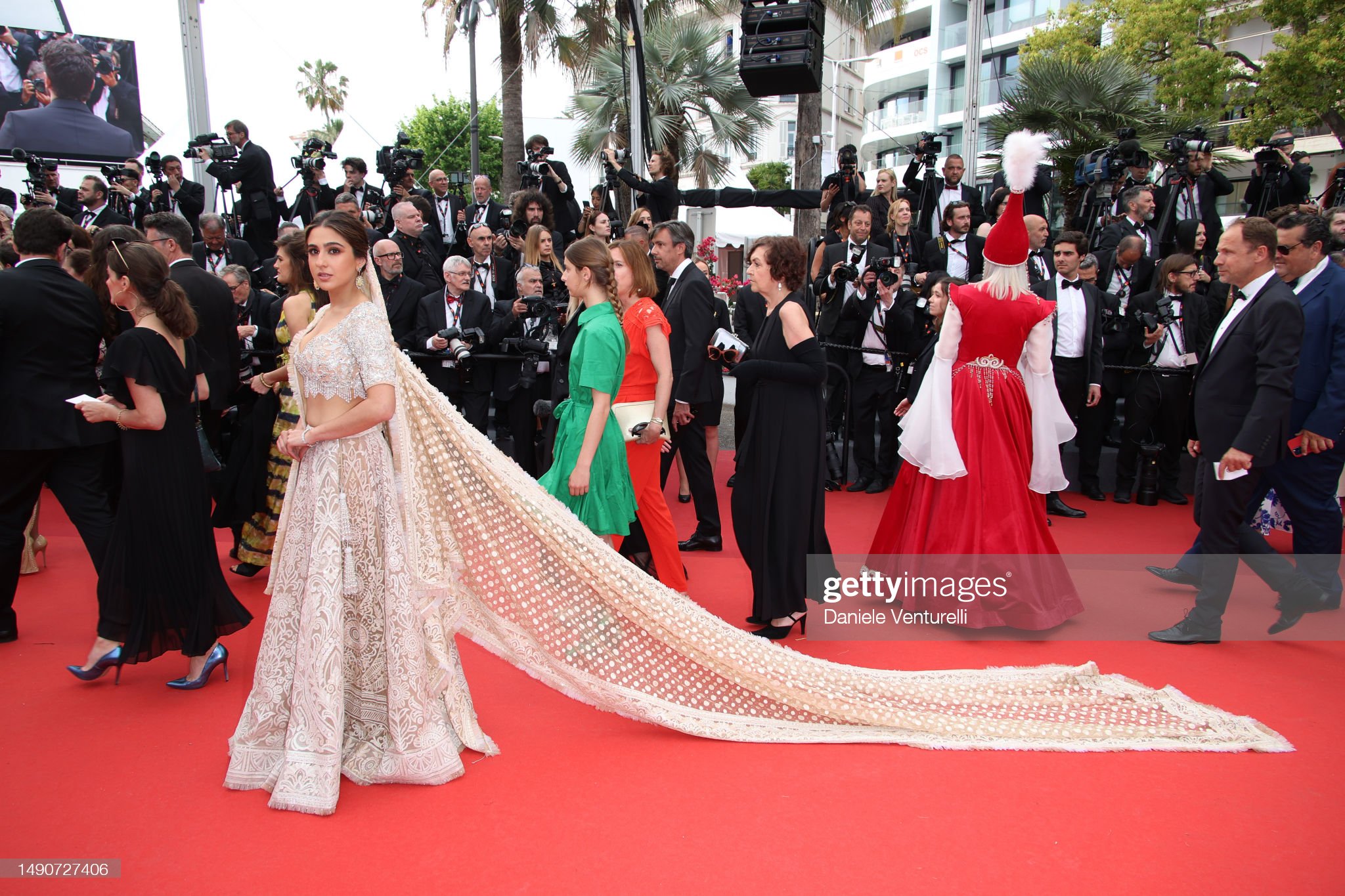
Come ogni anno, oltre ad Aishwarya Rai, sono numerose le celebrità indiane attese alla manifestazione, fra cui Anushka Sharma, Sara Ali Khan, Aditi Rao Hydari, Vikramaditya Motwane e Madhur Bhandarkar.
Vedi anche Aishwarya Rai al Festival di Cannes 2023, 20 maggio 2023


RASSEGNA STAMPA/VIDEO (aggiornata al 26 maggio 2023)

- Video Film Companion: intervista concessa da Anurag Kashyap
- Video: proiezione Kennedy
- Video: proiezione Kennedy
- Video: proiezione Agra
- Video: il cast di Agra a Cannes

- Living on a thin line: Kanu Behl on Agra, Uday Bhatia, Mint, 16 maggio 2023:
'You’ve been working on ‘Agra’ for a while. Was it the kind of project that demanded time, or was getting it made particularly challenging?
There were two major difficulties. One I knew the moment I started: where will you get funding for a film like this in India? The other, more interesting roadblock is an unconscious one I woke up to in the middle of writing, to deal with the fear of making a film like this myself. After Titli released in India in 2015, I truly got into Agra. I had the germ of the idea. I wrote a couple of drafts where I was a little scared - I was probably not writing what I really wanted to. After about a year of writing, and two or three drastically different drafts, I was at the Three Rivers residency in Italy. My mentor was Molly Stensgaard, who edits for Lars von Trier. On the fourth or fifth day, she asked me, why are you making this film? I was a little taken aback, and said I want to do a piece about repression and sexuality in India. She asked, then why are you not doing it? That really made me take a step back, ask myself what I was truly feeling and what was the impulse for not making the film. That proved to be a key breakthrough. Around October-November 2016 is when the film really started taking shape and I started writing something closer to what the film is now. By early 2017, we had the first draft. We got Cinémas du monde (a French grant for foreign feature films) just after that, so 40% of the funding was in place. I always knew the other 60% would be the problem. I went around town but no one wanted to look at it. Two years went by like this. It was in 2019 that I finally found collaborators who were on the same page. I shot the film in June-July 2019. Then everything shut down because of the pandemic. And we took some time with post [production], because it's a difficult film with a difficult character operating on a very thin line. I wanted to take time to edit the film.

What was the germ of the idea?
I would say it was more a very strong feeling within me that I'd carried for a few years - growing up, in my adolescent years, going to college in Delhi, and some of the early years in Kolkata. I was wondering why people don’t choose to address sexuality, why there isn’t more conversation in our cinema about that. That combined with my own feeling about sexuality and how I had been able or unable to express it in those years. A lot of what you see in the film is real-life stories I've seen happen around me.


‘Agra’ is definitely recognisable as a Kanu Behl film, but where ‘Titli’ was a slow burn, this one goes straight to 11.
For me it’s about being able to serve the film you're doing as truthfully as possible. Titli was a coming-of-age story. This is almost the opposite of that. When I was writing Agra, I was wary of doing something that othered the character. I wanted to do this piece about sexual repression but I had not experienced the intensity and chaos of the life of a boy who desperately wants some physical connection. He doesn’t know how to express himself but he’s looking for a moment of truth. I decided I'd have to create that experience for myself. And that comes with the problem of staying safe, for yourself and the people around you. I went into a lot of sex chat rooms, sometimes posing as women, sometimes as men, to see how people were expressing their secret lives. The more time I spent in these rooms, I noticed that the complete white noise you start to feel if you're desiring that sort of connection and not getting it for a very long time, it’s amped up to 11. The more I started breathing in that noise, the film started emerging from there. So the amping up is my attempt to take you to that place.

You favour a bold, almost overwhelming sound design. There are these factory-like sounds that really make a particular scene with Guru [il protagonista].
Apart from the factory noise in that scene, there's a really high-pitched sound. It’s the little thing that goes in your teeth when you're in the chair at the dentist's. The idea was just to create a string of really dissonant spaces. With the drones we try and give you a sense of the white noise that he's feeling - especially when Mala [his girlfriend] appears, you hear the noise. Slowly the drones start blending into his internal pain. In a critical scene with Guru and Chhavi [his cousin], the drone you hear is literally like he's not able to take the noise within himself anymore. In the final act of the film, there are a lot of sharp sounds you find in the construction space.

There's very little music. Did you feel a score might intrude?
Absolutely, because there's no music in his life. Very early on when I was writing, I knew this. The montage at the end - that's my Bollywood song. But that little calm or peace is also acerbic. I wanted to use score as a counterpoint to action in the second half.

Did you rehearse a lot?
No, there was little rehearsal, just a lot of character-building work. It's more about taking the character that you're playing from day one in their lives to the point where they start the film, so you know them as intimately as possible, so that when we're shooting the actor is the best person to decide what that person is feeling. That character needs to be lived fully by the actor. Most of the stuff in the workshops is designed towards arriving at the point where you start the film'.


- ‘Agra’ isn’t for the faint-hearted - and director Kanu Behl won’t have it any other way, Nandini Ramnath, Scroll, 25 maggio 2023. Intervista concessa da Kanu Behl:
'In Agra, Guru’s [il protagonista] fractured mind is mapped on to the architecture of his home, which becomes a bargaining chip between him and his family members. The film traverses inhabited spaces as well as the inner recesses of Guru’s increasingly fragile mind, resulting in scenes ranging from the disturbing to the explicit. (...)
Q. It’s not always clear which year Agra is taking place in.
A. There’s a curious thing with my films. I don’t like to commit to a particular time and space. I wanted it to feel like it could be taking any place anytime. It could easily be a few years earlier. It’s deliberate - I think it gives the story a bit of a fable-like quality.


Q. The title gives the impression that the film is about insanity. There are surreal moments that seem to be taking place in Guru’s head. Yet, is Agra more about the crisis of Indian masculinity rather than madness?
A. The film was about being able to very honestly look at this troubled guy who was not able to express himself. It was sort of a lament, a call for help, for some sort of honesty in our closest, most private moments. Guru is seeking truth in a sexual union in its true meaning. Within moments where you are supposed to have an honest interaction, he finds various cracks of desire where other transactional desires come up. He arrives at that moment where no one is really trying to talk about the truth of the sexual repression that he feels and that they all are dealing with. They are trying to label him as the crazy guy, whereas from his point of view, they’re all crazy. It’s a reverse coming of age, where he realises, all these relationships are transactional, so I will show how transactions are to be done. You can’t keep devolving your house or physical space through a woman. That’s cheating, a gaze on ourselves as men. Guru wants to rebel against that. He says that in the world that we live in, there is some sort of an amputation that is involved with this need for the almost phallic, vertical rise-up of space.
Q. Much of the film is playing out inside Guru’s head. The space he inhabits too reflects his struggles.
A. I don’t quite know how to completely talk about the film purely in a socio-political-cultural context. For me, there were these human undercurrents. In addition, I was looking at the idea of physical spaces, this need, a very personal need of every Indian family, to make a house. I’ve seen this need play out in my family and a lot of families around us. Everybody wants to make a house, but what is weird is that the people living in those houses are not quite a family in as many ways as they would want to be. Yet when they make a house together, all their small transactional dreams are invested in that house. That I found curious - the act of making this house; how, when you are crammed into a house with so many people, your sexuality gets affected. (...)


Q. The narrative is fragmented, whether in the human experiences, the layout of the house, or the manner in which scenes have been designed and filmed. There are explosions and lulls.
A. When I started thinking about this film, I wondered if I could understand the levels of Guru’s repression. I was not intimately aware of who this person was. I had felt sexual repression myself, let’s say to a degree of 40 or 50 or maybe 60%. But I knew that I was talking about 100%. I didn’t want to do a false piece, a piece from the outside. I decided to put myself in situations where I first understood exactly what Guru was feeling. I had to find ways to be very safe about it. For example, I spent six-eight months in sex chat rooms. I tried to actively put myself in a place where I was not writing a film, I was just being me. I subsumed myself into that chaos to see what people were feeling. I was trying to hit those notes, which is what the fragmentation comes out of. The more I got to that place, I realised that if your desire, some black holes within your secret self, are not addressed in a certain way, it creates such a strong storm within you that you get fractured. You almost live a double life. The pathway between the public and the private gets destroyed. Sensing that time-and-space texture was important to reflect, the feeling of being inside Guru’s head. Otherwise it would be a safe film.
Q. Did you mesh real locations with sets?
A. The whole film is shot in Agra. (...) We wanted to incorporate as much phallic and vulvic sort of imagery as possible. The film’s texture is full of repressed sexuality. The biggest battles for us were the house and the internet cafe. We did a lot of work on the house. We’ve hidden a room at the back, we remade the bathroom, including the tiling. We were using a lot of blue, and we wanted the blue to spread everywhere. The terrace has been redesigned to feel bigger. That’s the last space of the house they are fighting for - it’s the main play area, it’s everybody’s desire. The internet cafe was a much bigger battle. I wanted it in the middle of a busy market. It’s difficult to find exactly the space you’re looking for. We built it from scratch. We found a hole in the wall with bricks and open sky. (...)


Q. There has been a pushback in arthouse cinema against the depiction of explicit sex. Your film has several such scenes, and you haven’t used an intimacy co-ordinator.
A. I don’t know how to answer that. I don’t know if you can respond to the film on the basis of whether you had an intimacy co-ordinator. A film is a film. Your first interaction with it is to have a conversation with what it’s trying to say. If your first reaction is, how did you shoot these sex scenes and did you have an intimacy co-ordinator or not, then you haven’t really seen the film. Do the actors feel comfortable within the discomfort you are trying to create? Do you feel part of a specific piece where you feel the discomfort of the characters? How and why can we engage in conversations about sexuality without looking at the sexual act itself? How do we hope to do a revelatory piece without going into the most secret things that we do? That would go into PSA [public service announcement] territory, where you are saying something from the outside. When you choose to be in the realm of the senses, you can’t say, why was it made this way? If you have made the choice to be in Agra, you have to be able to breathe in its time and space, however difficult it is for you, to see where it is trying to take you. My responsibility is to make the film in such a way that it is a conversation, not a sermon. The audience response tells me more about them than me. If they choose to walk away saying, he’s just showing us sex rather than seeing the humanity and the struggles, it’s their conversation with the film'.


Rahul Bhat


Kanu Behl

Da destra: Priyanka Bose, Kanu Behl e Mohit Agarwal


Anurag Kashyap e Vikramaditya Motwane

Sunny Leone - Prima mondiale di Rapito

Anushka Sharma


Aditi Rao Hydari


Esha Gupta

Sara Ali Khan


Michael Douglas all'India Pavilion

Mrunal Thakur

Vijay Varma

Madhur Bhandarkar e Michael Douglas

Shruti Haasan

Mouni Roy