Visualizzazione post con etichetta V SERIE. Mostra tutti i post

23 gennaio 2025

PRIYANKA CHOPRA, SAMANTHA PRABHU E MATILDA DE ANGELIS: EVENTO CITADEL


Il 24 settembre 2024 Prime Video aveva organizzato a Londra un evento speciale per presentare le serie Citadel: Diana e Citadel: Honey Bunny, spin-off italiano e indiano della serie principale Citadel. Ospiti d'onore le tre attrici protagoniste: Priyanka Chopra (Citadel), Matilda De Angelis (Diana), e Samantha Prabhu (Honey Bunny) accompagnata dai registi Raj & DK. Citadel: Diana (trailer) è disponibile sulla piattaforma streaming Prime Video dal 10 ottobre 2024, Citadel: Honey Bunny (trailer) dal 7 novembre 2024. Video ufficiale di celebrazione delle tre serie, con dichiarazioni del cast - inclusa Matilda.
Il primo ottobre 2024, sempre nella capitale britannica, Priyanka e Matilda avevano inoltre partecipato all'evento Prime Video Presents: Trailblazers. Priyanka in ottobre era a Londra per le riprese della seconda stagione di Citadel. 
Vedi anche: Priyanka Chopra a Roma: evento Citadel, 23 aprile 2023


Vi segnalo l'articolo Citadel-Diana's Matilda De Angelis: ‘Watched Priyanka after I had shot for my Citadel’, di Mayank Shekhar, pubblicato da Mid-Day l'11 ottobre 2024:

'“I was over for the London première of Citadel and watched Priyanka Chopra for the first time,” says Italian lead actor, Matilda De Angelis, from Citadel Diana. (...) By then, Matilda says, she had already shot for her own show: “So, I couldn’t take anything from Priyanka’s performance in Citadel [into mine]. But I just thought to myself - please, let me be, at least, as good as her!” In the series, Matilda plays spy Diana. That’s pronounced ‘Dee-a-naa’, the Italian way. As against ‘Die-a-naa’ for the late princess, from London - where Mid-Day exclusively met Matilda, along with her showrunner, executive producer, Gina Gardini. (...)


The final frame of Citadel (2023) lets out that there will be Diana. One wonders, if the Indian version was planned alongside. Gina says, “We started at the same time, five-and-a-half years ago. The fantastic part of the experience was the [Indian and Italian] showrunners, writers, would get together every two weeks, to spend two hours on Zoom, to check where we were at [in the writing process].” Which is different from a common writers’ room “that involves 27 people, over 10 months, breaking down episodes. Our mission from the Russos and to Raj & DK [creators from India] was the shows have to stand on their own. The idea isn’t [to develop] interconnected stories, like Marvel. There are, however, several winks in both shows - subtle easter eggs for super-fans, where Diana’s world is in Honey Bunny, and Citadel itself.” That Italy and India got picked first for expanding the Citadel spy-verse, appears natural to Gina: “Histories of cinema in both countries go back a hundred years, with strong cultural identities. Our family values are similar. Also, despite genres, we try and tell deeply emotional stories. This isn’t just true for Diana and Honey Bunny, but the overarching Citadel as well.”


While Matilda would like to be favourably compared to Priyanka in her Italian Citadel, what she has in common with the dually hyphenated (Bollywood-Hollywood) star is she’s also a singer. To drill in the fact of how big Matilda is, back home, the Italian press in London - rightly mesmerised by her performance in the show’s first episode première - told Mid-Day, what beats everything else is, she’s hosted Sanremo! Matilda laughs, “Can you imagine? I did 20 movies, but the time I conducted that one show, everybody got to know me, what am I doing [with myself]!” And what’s Sanremo? “It’s our Super Bowl.” Only, that instead of sport/American football, it involves Italy’s top musicians competing annually, as if on Indian Idol, that the whole nation is collectively hooked to. Matilda doesn’t sing in Citadel. For her favourite musical movie-moment, she points us to “the sequence of singing and acting in the film, Robbing Mussolini - really proud of that scene” .'

Video Mid-Day

Priyanka Chopra, Samantha Prabhu, Matilda De Angelis, Raj & DK


Evento Prime Video Presents: Trailblazers


08 dicembre 2023

IL RAGAZZO GIUSTO - LA SERIE


[Archivio]

Nell'autunno del 2020 Netflix propose - anche in italiano - la serie BBC in sei episodi Il ragazzo giusto, tratta dall'omonimo romanzo di Vikram Seth, diretta da Mira Nair e con un cast ricchissimo: Tabu, Vijay Raaz, Vijay Varma, Shahana Goswami, Ram Kapoor, Ishaan Khatter, Vivaan Shah, Ranvir Shorey, Randeep Hooda, Kulbhushan Kharbanda, Vinay Pathak, Vivek Gomber e Manoj Pahwa. Trailer. Vi segnalo di seguito un paio di interviste concesse dalla regista in quel periodo. 


'How much is A Suitable Boy itself a homecoming for you? How lived in does it feel to you?
Very lived in. I read the novel in 1993 soon after it came out. I read it twice. I didn’t want to leave my best friend at the end of it - it was that kind of a feeling. Vikram [Seth] had so extraordinarily captured that Nehruvian India [at] the moment we were trying to create [a] new country after freedom from the British. And yet we were so anglicised and spoke and dreamt in English. He coupled all that with a very astute eye on the politics of that time. So prescient in some ways. But, besides that, the wit and the sensuality, the great depths and layers of friendship between the families - the Khans, the Mehras, the Chatterjees, the Kapoors. It’s a world I do know, but I [have] also longed for. My parents married in 1951, the year of A Suitable Boy’s story. They travelled from Punjab to Orissa where he [Nair’s father] was an administrative officer [IAS officer], setting up the new capital of Bhubaneswar. That’s where I grew up, in those bungalows, with hardly any roads and a new airport, when I was eight years old. The idealism of that time has always attracted me.

The society that you are talking of - what hits home is a longing and a sense of nostalgia: what we were and where we have come.  Do you also see parallels with the situation now? 
I only came back to A Suitable Boy. I haven’t been holding a torch for it for the last 25 years, hoping to make it. Not at all. I moved on to my own work. Only when I heard that it was being made perhaps [that] I said, anyone but a gora [White] to make it, man! I need to make it [laughs]. Even the story of Babri Masjid is in it. The stories in it, the prescience of Vikram’s vision - the seeds were planted then. But there was the great beauty of the syncretic culture where we come from. The same cloth [from which they are cut], Hindu and Muslim, whether it be language or poetry or music. (...) That was actually the biggest magnet for me. (...) This is (...) the reason why I just had to make it. And make it with such great artistes who [are] deeply imbued [with] what I am talking about in terms of that syncretic culture. Tabu was the first one cast in my head and fortunately she loved it. It’s all about finding that spirit in who you choose and who you bring to the party, and I swear the greatest satisfaction of making A Suitable Boy was this great cornucopia of actors. And pretty much everyone said yes. (...) We cast for over 18 months, [from] all over India - 110 characters and they are all great. And, of course, I have old friends. Many of them started with me so they can’t say no to me. Even Vijay Raaz, who is now a big star, did two scenes for me, memorable scenes. Or Manoj Pahwa. These are  extraordinary actors who just came and lit up the screen. That was the real joy; to see Shahana Goswami completely sparkle without any inhibition and with great skill.

You have adapted many other literary works for the screen. What is it that made this fun or [conversely] a nightmare?  
I came to it when it had already been adapted by Andrew Davies, who is a master distiller of great big tomes like War and Peace, Les Misérables. He has craftsmanship on his side in such a fantastic way and also a great sense of humour and also the television structure of the cliffhanger, and there are so many in our book. It was there but it had to be culled out. At that time, it was eight hours [duration] and, frankly, the financing for an eight-hour, all-Asian drama in the Western world is always going to be challenging. I used to joke and say, it’s The Crown in brown, as magnificent, with as much sweep as [that] series, but the budget was some 10% of it. I don’t have the statistics, but it is always the case. You don’t have what you need when you are not a gora [White]. I am used to it and I always show it. I always give it to them: “Don’t see my struggle baby. But this is as good as anything out there”. (...) Having said that, we had to distil it further into six episodes of six hours. At that point I was deeply involved and basically added two things. One was to make the political interweave with the personal, [to say]  that it would not just be a marriage story - who will she marry,  who is the boy? It’s not only that. But it is much more interwoven with the politics of then, which is [also] the politics of now. That balance is what I tried to bring back in. Also, in the process, bringing back certain characters that had not been given the time of day. Like Mrs. Mahesh Kapoor, (...) who is the unspoken cornerstone, the foundation of this political family and is really the glue that holds this family together. Restoring some weight to some characters. And sadly, as is often the case, killing some characters, [by] just not having them. Secondly, I insisted on the language. It’s a beautiful novel in English that people spoke at that time. [But] if Saeeda bai would sing in Urdu, then why wouldn’t she talk in Urdu? Or the villagers. That was the discussion at every level. Vikram, thankfully, supported me, thanked me for “translating it back”, as he put it. For BBC it was quite radical to have their first big drama show in Urdu, Awadhi and Hindustani, mixed with English. But I could do this much and not more. I tried to juice it and do it as skilfully as I could and as naturally to the character as possible. There were other things. Music is my oxygen and it’s a huge part of everything that weaves these worlds together.

Even the incidental music ties in with the larger narrative very well. 
This is a very different style for the BBC: “Is it a Bollywood thing? What are these musical interludes? Can’t we just have some kind of a singing over there?” I would say, this is not Bollywood style; this is what I do, and this is why I am doing this. Basically, it was a vocabulary that was not familiar to them. But I must say they came around and they love it for what it is. And then I worked directly and closely with Vikram to get the balance and the nuance and the love and the complications, but most of all the friendship - the depth of it - correct between the Hindu and the Muslim characters. I did not want to fall into any traps of today. I wanted to make sure that we really got (...) what I wanted to say, which is syncretism. The structure of it was given to me and I carefully worked within.

The society as seen in A Suitable Boy is syncretic, but also at a point in time when the threads are beginning to unravel. Is there a sense of regret on how far we have come as a culture, country, society?  
Regret is like giving in to defeat. I am confronted by it - we all are - in such a direct, transparent fashion, whether it be renaming things, or pretending things just didn’t exist and, of course, the more targeted attacks we see every day. We cannot be defeated [by] this. We have to persevere, and we have to remember who we actually are. It’s within ourselves'.


- Going down Mira Road, Mayank Shekhar, Mid-Day, 21 novembre 2020 (il testo include il video dell'intervista integrale):

'Mira Nair's journey as an Odisha-born/bred filmmaker in America will seem greater to you, if you consider the first thing she did, landing up as an under-grad student at Harvard in the mid '70s. She went over to her course-mate from Bombay, Sooni Taraporevala, desperately to check on who the other Indians around were. There were only two - studying film. One of them, a gentleman named Anand Mahindra; the industrialist, whose surname carries the massive fleet of automobiles on Indian roads. "Anand was a really talented filmmaker. He's still an artist in his soul. I'll never forget the wonderful thesis-film he made, following a holy man up a mountain," Mira remembers. Screenwriter Sooni and Mira of course became great friends and colleagues thereafter - collaborating on notable productions like Salaam Bombay! (1988), Mississippi Masala (1991), and The Namesake (2006). Anand was the "big brother, who'd encourage everyone to move back to India [once done with studies]." As he did, taking over his family empire.

Speaking of famous associations from unrelated fields, a picture that once got widely circulated online was of Mira as Cleopatra and Shashi Tharoor as Mark Antony, in an inter-college Shakespearean production from the '70s. Mira was a student at Delhi University's Miranda House then; Shashi Tharoor, the undisputed star of St. Stephen's College. She's been asked about this picture on occasion during interviews. And I gauge from her responses before - it doesn't seem like she liked the college-kid Shashi Tharoor much! Did he throw big words at her? "Oh no, I just didn't like kissing him [in the play]. Back then, you know how it was - even if you got slightly physically close to someone, people would start cat-calling. It was ridiculous." As for the Tharoorosaurus bit, "Well, we used to tease Shashi [who hadn't lived or been abroad yet] about where he had got that accent from. (...) But he's always been a sport. He used to take it well!" (...)

Mira remains still one of the most critically acclaimed filmmakers - for a majority of her filmography. (...) Mira is formally trained in cinema verite - art/technique, mostly associated with documentary filmmaking, intended to convey realism. (...) The main muse for Mira's realistic lens was in fact the city of Bombay itself. (...) "Now they can call me a New York-based filmmaker in Bombay, but the fact is that not many saw Salaam Bombay, right under their noses. It was a life around us. When you live in it all the time, you can't see it well - having numbed yourself to it." This seamless transition from documentary filmmaking to fiction - something that writers of non-fiction find harder to be equally adept at - Mira admits, has helped define her work. And you can still sense strong stamps of it, even in later movies. (...) "Cinema of truth [cinema verite] sounds a little pretentious. It is very real, in the sense that you don't script everything. You just have to be humble enough to enter the world. Just be there. Of course your presence is shaping [the moment] to some extent. But it is also about being an observer to the situation, and eliciting things from [actors] - as they feel them, rather than you telling them what to say."

What this has also led to since her celebrated debut feature is - film after film, an established practice of casting 'real' people, as it were, or non-professional actors, alongside trained actors/stars, in the same frame. And watching this unique alchemy come to life on screen. For instance, Mira discovered Sarita Choudhury, who played Denzel Washington's love interest in Mississippi Masala, biking on a street in Cambridge once. She found Tillotama Shome (Alice in Monsoon Wedding) in the corridors of Delhi's Lady Shri Ram College. Even better, she picked up Kamini Khanna for a typically Delhi-Punjabi Shashi Aunty in the same film - spotting her on the walking track of a South Delhi park. Does she think everyone is essentially an actor then? "Not at all! It's about several things, but mostly instinct. I can tell immediately if the camera will love you or not. Or sometimes it doesn't matter if the camera won't love you, but can I use that in a way? Like [Pedro] Almodovar and his ladies are fantastic. And they so destroy the notion of what's beautiful before a camera. But the roles need that. So it depends on the role, of course."

While casting for Monsoon Wedding, she recalls, a newbie Vijay Raaz's face had caught her eye: "He'd walked in from the train station to (...) Churchgate. I don't know how I even remembered his name. Paresh Rawal, whom I admired a lot, had approached me for (...) Dube's part. We had a workshop in Delhi, which Paresh couldn't join. So then I had to take Tillotama [Alice] back to Bombay to rehearse with Paresh [Dube]. Naseer bhai [Naseeruddin Shah] had given us space above his flat for rehearsal. The door opened, and my eyes fell out. Paresh had gained 30 to 40 pounds. He looked like Alice's father, and this was supposed to be a love-story with him! (...) He said, 'I'll just lose [weight].' But we were shooting in literally four days! I just thought of the bald man with long ears and the widest mouth in the world, Vijay Raaz, and called him. I had not auditioned him, but I loved his look." The role expanded as Raaz came on board, killing it along the way. (This conversation between Mid-Day and Nair took place a day before Raaz was summarily arrested and subsequently bailed over a molestation charge on a movie set.) He's had a solid career since. 

Several Indian actors in the Bombay film industry similarly owe their first frame on the big screen to Mira. Right from Nana Patekar and Irrfan in Salaam Bombay!. Late Irrfan, she always felt, was cut from a different cloth from Bombay's leading men in the '80s and '90s. He delivered, arguably, his finest work with Mira in The Namesake (2006). Or Randeep Hooda and Ram Kapoor, for that matter. They were debutants in Monsoon Wedding; bona fide stars now. Why, even Kamini Khanna! She's played multiple versions of Shashi Aunty in every other Bollywood movie. This contribution to the Bombay film industry in particular, I suspect, isn't acknowledged enough about the New York and Kampala-based filmmaker.

Even more than a keen head-hunter, Mira is an all-encompassing aesthete, wholly invested in cinematography, literature, production design, colours, costumes, the craft of moulding actors/characters... (...) Given the résumé and musical references seeped into her work, besides an army of previous recruits from among top Bombay actors, I'm almost amazed that in all these years, Bollywood folk haven't ever attempted to co-opt Mira with a grand scheme/project? "I am not looking for that either. But I have really lovely friendships. Yash Johar and I were very close. (...) I really respect Aditya Chopra's mind. I had taken him on an idea - not for me to do, but for us to work together on. But, no, I don't think so. I think they think correctly - that I just make my own movies!" (...)

A film that would've brought (...) [Mira] back to Bombay - her early muse, and that too with Johnny Depp - was the adaptation of Gregory David Roberts' Shantaram. Regrets - that the film fell through? "I only regretted that I gave one-and-a-half years of my life to it. And we really had a good thing going. Not, otherwise. They were starting it again, and I was not interested!" Mira also famously let go of directing the fourth Harry Potter film, for the sake of The Namesake. She declined The Devil Wears Prada, going by the same measure of what interests her - and what she can do, better than similar directors on hire. (...) Exuding power, all right, in an industry that when she entered it - doing theatre in New York during day, waiting tables at night - there were barely any coloured people around, let alone desis, or women. (...) Mira first got on the road, splitting rent for an editing suite at a basement collective for offbeat artistes in New York. This is after she had shot Salaam Bombay!. Which she knew the West had no similar reference point for. Spike Lee, same age, also editing his film, would pay the other half of the rent!'. 

09 novembre 2023

SAIF ALI KHAN: WHEN MY FATHER DIED, PATAUDI PALACE GOT RENTED


[Archivio]

Vi propongo una piacevolissima (e lunghissima) intervista concessa da Saif Ali Khan a Mayank Shekhar, pubblicata da Mid-Day il 7 novembre 2019. Il testo include il video dell'intervista integrale. Saif Ali Khan: When my father died, Pataudi Palace got rented:

'You get called the 'Nawab', which inheritance-wise, you are [of Pataudi]. But the fact is you're actually a self-made actor, having taken nothing from parents, ever since you moved to Bombay, at 20!
Yes, thank you. (...) People have a certain fixed notion. For that matter, even [with] Pataudi [palace], when my father [Mansur Ali Khan Pataudi] died, it got rented to Neemrana Hotels. Aman [Nath] and Francis [Wacziarg] used to run [the hotel]. Francis passed away. He'd said that if I wanted [the palace] back, I could let him know. I said: I want it back. They held a conference, and said, okay, you have to give us lots of money! (...) Which I then consequently earned. So, even the house I'm supposed to have inherited has been earned back through money from films. You can't live off the past. At least we can't in our family, because there was nothing. There is history, culture, beautiful photographs; and, of course, some land. It has been a privileged upbringing. But there's been no inheritance.
You moved to a rented apartment in Bombay, is that how it worked?
I was born and even raised in Bombay. My father lived with my mother in her [Carmichael Road] flat; I went to Cathedral, spent time in Bombay Gym - in a world more influenced by my father's, than films. He had just finished playing cricket. His last Test series was when I was four/five. My mother [actor Sharmila Tagore] says he was bunking his responsibilities. His mother was looking after things in Bhopal and Pataudi. She'd got old. So we moved to Delhi to live with her. It was a nice, big old house in Delhi, which she had been given for her lifetime, in return for land, property and other kinds of deals that these old [royal] families had made with the Indian government.
That'd be 1971 [when privy purses were abolished], right?
1971, exactly. So, that's why we moved to Delhi. I had fun. That was the generation of designers like Rohit Bal, Rohit Khosla, Ashish Soni... These were the first people I came across, doing something off-beat, in terms of art, culture. Which might have planted a seed [within me] to go and act in films!


You did start off with an ad.
My father sent me to an ad agency to get a job, because I was partying a lot.
Where were you partying?
In Ghunghroo [discotheque at Delhi's Maurya Sheraton]. It was fantastic. My father put me on a bus to an ad agency in Sunder Nagar. One of my jobs was to make religious calendars for Birlas. The only creative [call] was whether we should put Lord Vishnu in October, or November. I soon lost interest!
And the Gwalior ad happened?
Which, again, had to do with my father. My parents were shooting a Gwalior ad together. Honestly the way my upbringing was, the kind of life I'd had, or lack of confidence - I wasn't a cinematic figure, in terms of being shot in photos. I was effeminate, coy, shy, unsure, worst qualities for a...
A leading man?
As an actor in Bombay, yes. But not bad for a western, academic school-boy. That was a different culture altogether. So some quick learning was required.


And then you moved to Bombay. Where did you first rent a place?
In Lokhandwala; a building called Red Rose One. It was a small flat with cane furniture. The producer's daughter had very kindly done it up for me. Until one night I came home with friends, and couldn't open the bedroom door. She had locked it. I think she had a plan. There was a big gap between the door and carpet. I peeped from under, and could see her lying like a whale on my bed. And I thought I'm not going in there. So we went out again!
You began your career pretty much by yourself, and it was, I hear, a disastrous start! Take us through it?
So I went to a really academic, school - the oldest in England - Winchester. The idea [of being there] was obvious. You go to Oxford [or a similar place] thereafter. That hadn't worked out. I was in the black books of my parents, what with Delhi, partying and Ghungroo. I was getting scared. Because there was nothing I was interested in. After the Gwalior ad, when [director] Aanand Mahendroo mentioned a film [to me], bells started ringing. The thought of moving to Bombay sounded so exciting. I remember having that shower in Delhi, in that old house, which had funny water [plumbing], it wouldn't work half the time, and I'd fiddle with it, too hot or too cold...
Saif, you're digressing.
Sorry. Chipkalis [lizards] on the ceiling. Okay, stop! I remember that shower and being excited about a kind of life I could see - coming to Bombay, struggling, little rented flat, films, meeting people, collaborating... It is the only job that, from 18, when I started considering it seriously, I've always been passionate about.
Were you not a movie buff?
Yeah, but a western, as an American, movie-buff. When I was young and my mother [Sharmila Tagore] was an actor, I'd see her crying on screen. It's not something I enjoyed. Hindi films in the '70s were also overtly emotional.


So, Aanand Mahendroo...
He offers me this movie, and comes to Ghungroo. I tell my friends, "Hey guys, this is my director..." He has a couple of vodkas. The same guys tell me, "Bro, your director friend is in the bathroom [throwing up]!" I should've realised we were in a bit of trouble. We came to Bombay. Sattee Shourie was our producer. Then somebody told me a story about an ambitious film she had made called Farishtay [1991] with Vinod Khanna. There were panthers chasing him in a shot in that film. She ran out of money during shoot. In the same scene, when he [Khanna] comes around the corner, there are no panthers. Because no money. So, she got some dogs, and painted them black. This is after she had been kidnapped by a cab-union driver!
That was your first producer!
Yes, she used to pay me Rs 1,000 a week. And I'd have to kiss her 10 times on the cheek. Anyway, she had a fight with the director, and I got saved. Because the film got shelved. Then, Rahul Rawail cast me in his film.
And that was a disaster too?
Kamal Sadanah was in the movie. So he [Rawail] threw out Kamal, and took me - for no fault of Kamal's. And then found out that I was worse, and threw me out. And took him!
Apparently you showed up drunk on set, slept off...
You've done your research. But no, that's not true. Nobody turns up drunk on set. I was just not subservient, sitting around all day. There could've been some attitude problem, which I myself wasn't seeing. I [probably] didn't understand how serious things are. You might come across as really cocky, because you think it's really funny, when it's not.
Did you make friends easily in Bombay though?
I did. Many of them are producers now. Some of them are in LA. I remember Dileep Singh Rathore [Hollywood production manager for Blood Diamond, The Dark Knight Rises] and I used to do acting classes together. And we'd get asked to take our shirts off; another guy would do push-ups with his shirt off. All the things [work-place sensitisation] happening lately is good. This crap's been going on forever. Luckily, we were like, no bro, we're not doing this.


And then you finally debuted with Yash Chopra.
It is personal and I don't want to dwell much on it - I also ran away from home, and got married at 20. And I've to give Amrita [Singh], my ex-wife, credit for being the only person who taught me to take it all [work/show-business] seriously. She said you can't hit the target while laughing at it. That's when Parampara happened. Yashji called to say he was looking for a fourth lead, or something. I was like, great; yeah, anything. I'll do it. It's like investment in stock - if Yash Chopra is taking him in Parampara, [the industry believes] let's invest in this. For me, it was as simple as, this has to work. There's nothing else. That focus was required. And taught to me, and I inculcated.
If we watch retro Lehren [video-magazine] interviews from back then, it seems like you, now, and that guy are two different people!
I sometimes find myself doing the same stuff. Maybe I haven't changed! But it's an age, and exposure thing. Your upbringing, the culture you're given, and the academic grounding that teaches you to be humble, understated... They come flooding back later. Not when you were trying to fit in - giving gaalis, drinking Bacardi, being one of the boys in the '90s; and then you question: Do I want to be known like that? Or should I be comfortable about how I express? It's true for people. I've read characters in plays that are rebellious, and then embrace everything they rebelled against.
I meant more in terms of the duality between who you were as a person, and what you did [in terms of movies] in the '90s.
For sure. Because you had to fit into a certain mould in the '90s. There wasn't that much room for experimentation. Aamir Khan said he'll do max five films a year, when others were doing 15! Shakti Kapoor said he felt insecure when he didn't have 17 films on floor!


You still had some hits to keep you going though.
This is an organic kind of an industry. Like crude oil, you distil off at different temperatures. So people find their own level. And you need a certain amount of success to survive. So Parampara, the great Yashji film, didn't work. It was his 'safe' film after Lamhe didn't run. Aamir, who did Parampara, got offered Darr. I was the fourth lead. And got offered Yeh Dillagi, a smaller film, with Akshay Kumar also in it. But my role was fun, music was great, so I scored something there.
As a person, did it occur to you that you're not exactly that 'Ole Ole' fellow [from Yeh Dillagi]?
In fact that merge [of sensibilities] is happening now. Which is a sign of some civilisation. Earlier, what you do for a living had nothing to do with what you are [as a person]. The minute we're on set, we are equal; and just part of this thing, and it doesn't matter what... (...) A lot of these films in that time, had great music. That kind of helped [us] survive. You could be an audio hero. I think, I kind of was - quite presentable doing a lot of songs. As for performance, even a big star said, what is acting? Just say your lines in a sincere fashion! Which is how it remained for the longest. There was also the 'Mr Bachchan' hangover.


Dil Chahta Hai [DCH], in that sense, is obviously Saif 2.0.
I would have to say it is people like [director] Farhan [Akhtar] and Aamir Khan, who were effecting change, and I benefitted. I wasn't sure if I wanted to do DCH. I was the third lead, while playing hero in multiple films. Aamir asked me about films I was hero in. I named them. He said this film [DCH] is about three times the size of all those put together - Can you get on the page, it is good cinema, you have to do it. (...) When LOC, or a two-hero film happened, I'd think of Bud Spencer and Terence Hill. In my head there's nothing wrong with it. I've always been happy to compete with the other guy as well. I'm like - you might be the biggest star; but I am going to give you a run for your money. The idea of a buddy-movie was also being liked at the point.
After DCH, there appears to have emerged a certain confidence. How many Bollywood stars have attempted an English film? You did Being Cyrus [2006].
Also, Kaalakaandi [2018]. With Being Cyrus, there was the question of the English sounding natural. American is the language of our English. [Director] Homi [Adajania] wanted me to sound a little Indian. We had to get it right. This is what's happening today - guys who basically speak Hindi are better actors. Language is the thing. (...) Well that was the time when things were coming together. I was at the right place, and also looking like the right guy - it was no longer that funny haircut. Films like Omkara and interesting stuff with Yash Raj were coming together.
And you were killing it with the dialect in Omkara. Tough?
Kind of. But despite perception and projection, I am not actually English, you know! I have grown up in Pataudi, which is in Haryana. I have heard that dialect all my life.


Saif 3.0: You turn producer with Love Aaj Kal. I'm told [director] Imtiaz Ali offered you Rockstar first. True?
Yes, that's right! Of all the ideas, Love Aaj Kal just sounded a bit more commercial, although not the way he wanted to make it. He had quite a grim ending in mind, where this flaky guy finally returns to find out that his girl is eight-months' pregnant. We had to plead with him, until when we were on set in London, he said alright, we can have a happy ending!
Which makes sense, because by then you were the quintessential rom-com leading man; Bollywood's own Hugh Grant, as it were.
Yeah [Hugh Grant], I've heard Karan Johar say that as well. Don't know where it came from. I remember Aditya Chopra telling me that he's got Shah Rukh Khan, who's the king of box-office. That there's this thing called the 'multiplex hero' coming up. And that he's trying to get a handle on it. And he thinks that I could be that multiplex hero, because I'm a little different. Cast correctly, I should hit that genre. So he started making Hum Tum, Salaam|Namaste.
Rom-coms seem to have died altogether. In Hollywood, it's all Marvel anyway. And here...
My wife [Kareena Kapoor] told me that that genre has changed into [films like] Badhaai Ho. Don't know if true. Think she means the lead character, trying to figure out life in New York etc., is passé. Also, confusion, being unsure, a bit of a mess, is the hallmark of the rom-com hero. Because there is no villain. Villain is your flaky self. Which, maybe, doesn't fit well, when you're supposedly more grown-up. Maybe she [Kareena] just doesn't want to see me like that!
Still with [producer] Saif 3.0, you did a zombie-comedy [Go Goa Gone] in Bollywood -spoof/subversion of a genre, while we hadn't had a proper zombie film!
It seemed like a good, entertaining idea. Frankly I don't think I'm a great producer. What I love might not be everybody's cup of tea. A great producer can tell: Okay, this is a joke, as in an amazing, four-line anecdote; not a film. Or this is a film. Or this is a short-story/book. He can sort out different mediums. Within films, he should also be able to tell at what budget that story should be made. Don't think I have that ability.


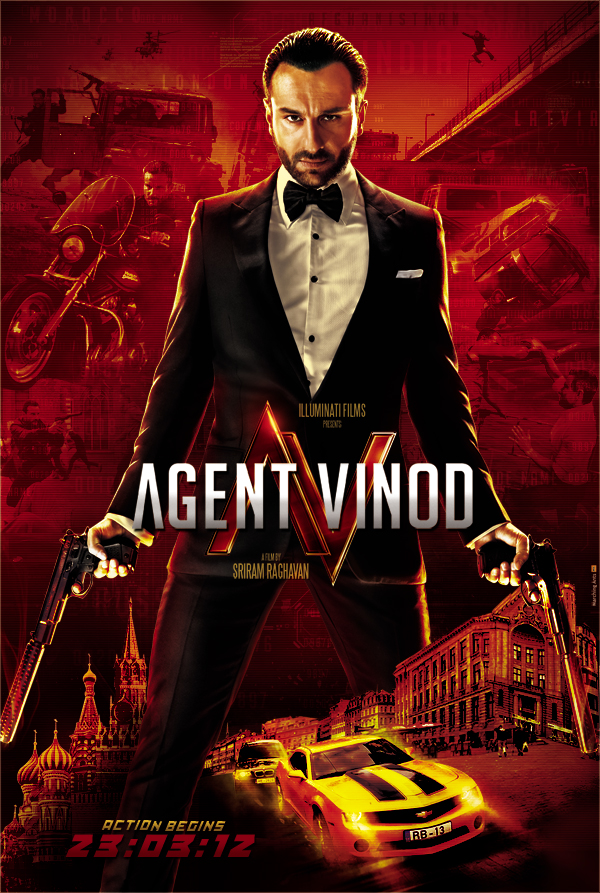
[Referring to Sriram Raghavan's] Agent Vinod, that you wanted to make?
I made a mistake. I thought Jack Bauer from 24; so why not an Indian Agent Vinod? Apart from a complicated script, we missed out on the character's 'Indianness'. This guy was looking bit too western - dinner-jacket, suaveness. He should've been wearing chashma, holding a ball-pen...
Did you decide to shelve the film during its making?
No, again, Dinesh Vijan was [co-]producing. He is good at balancing stuff. What had happened was that we were shooting at a heritage site - action-sequence, with machine guns and all. We needed to blow up stuff. So we said, okay, there are a couple of beautiful, medieval temple structures...
No!
Of course not! We built replicas 100 yards away. The people there went nuts, suggesting that we were blowing up the complex. They stopped our shoot. We had to reschedule, scrap what we were doing, etc. But we managed.


Curious to know, why did you name your company Illuminati? Anything to do with the conspiracy-theory about a society of elites that secretly rules the world?
No. There was something about illumination and light. There's also the fact about Illuminati being a group of people, including Isaac Newton etc, who questioned authority of Church and talked about importance of secular knowledge. But, ultimately, 'Illuminati' is to illuminate. And that is what a film projector does. Johnny Depp had a production company called Infinitum Nihil - 'nothing is impossible'. And I used to look up to him. Now he's been replaced by Tom Hardy.
Why did you and [your co-producer] Vijan part ways?
Because Dinesh Vijan is on his way to becoming a big film-producer. I wanted someone to run my production company. Which is fair. That's why people usually leave. I don't want to make films for 20 other people. I see myself as more of an actor.
In Cocktail, you did offer the lead role to other people.
We did. I only stepped into Cocktail, because Ranbir [Kapoor] and Imran [Khan] didn't want to do it. So I said, okay, I'll do it. They should remember that.


Stepping into Saif 4.0: Your entire career put together would be the polar opposite of the subdued Sartaj Singh from Sacred Games [on Netflix]. Conscious call?
It's got a lot to do with [director/show-runner] Vikram Motwane. On Day One, we were in Madh Island. Distance wise, this was painful for me, before the ferry, I realised... (...) I was doing an investigation scene. And he [Motwane] said, cut, and just told me to bring my energy levels down: "You're too hyper!" It was a different kind of communication from anything I had done before - the feeling of trusting the camera, and not showing what you feel. It was the first piece of film I had ever worked on with that thehraav.
You've been talking about unlearning, reading acting books etc, something you didn't do before.
But before that, a little bit of background. Which is about the way we were brought up in the movies. I don't know about Dilip Kumar Saab, and Amitabh Bachchan. But after the '60s and '70s, there was a creative slump, where the attitude with cool guys was: We don't talk about acting, work... Who learns lines? It was like how we used to laugh at nerdy kids in school. People used to wonder why Aamir is taking things seriously - there was just this whole attitude of 'unseriousness'. There was a glamour and starry vibe. It certainly wasn't about prepping for work, which has changed.
You were the first Bollywood star to green-light a web series. And you said no to Homeland, is that true?
Well, I was asked to read for Homeland, which I did, and then asked to come down to LA or New Zealand to read some more. I could have pursued it more aggressively. But I was busy here. I remember [daughter] Sara [Ali Khan] helping me a lot, people getting excited. But it wasn't a great part. It wasn't the main lead. The part went to an Etonian [Damien Lewis]. Now you can't have a Winchester boy playing [second fiddle to an Etonian]!
Would Sacred Games be the first time your school-friends watched your work?
Yes, good point. And they are quite academic, and say things like, it's really interesting that a Muslim guy plays Sardar, and in this kind of world, that's good contribution!


(Audience) Pacing of Sacred Games 2 came under question. What did you make of it?
I didn't like the second season as much as I liked the first, which was the newest and most interesting thing I had ever seen on TV, from any country. It was a mafia show with a disturbed cop. But it [Season 2] became a bit esoteric and slow, with the treatment of the guru with Gaitonde.
'I did not like Sacred Games Season 2,' reads like a headline!
But, you know, I didn't. We were in England. It was my birthday [when the season dropped]. Five of us had rented a country-cottage, including a South American book publisher friend of mine, who also speaks a bit of Hindi, loves different cultures. We opened a bottle of Champagne, got Netflix on...
That was your premiere.
Yes. We didn't even tell Kareena. And we sat. After a while I said, okay, I'll watch this on my own later. That didn't happen with Season 1. I shouldn't probably say this.


(Audience) In [Raghavan's] Ek Hasina Thi [EHT], you play the most believable f***boy. How did you pull it off?"
I was just happy to play something cooler, and darker. (...)
What happened in the second half of EHT, though. You think it went a little berserk?
It did. Sriram and I have gone berserk a couple of times [laughs]. And then he does Andhadhun [without me]! I don't mean to sell Sriram out, but he paints himself into a corner, and then tries to write himself out of it. Which is great. But might not always work, although the good stuff about EHT outweighed...
The first half was killer.
Yeah.
(Audience) You've often gravitated towards morally corrupt characters. Does that give you more room?
I'm just interested in those situations, more than glory of God. Hrithik, for example, suits a Ram-like character.
What role did you play in Hum Saath - Saath Hain?
Krishna - he's a naughty little version. Salman was Ram. I found it exhausting. One of the most tiring things is to be so happy and positive all the time. And Sooraj-ji [Barjatya] used to say, "Do it your way. But smile!"


How different is it to work with, say, Abbas-Mustan, from Sooraj Barjatya?It took me a while to figure out Abbas-Mustan. Mustan Bhai would give instructions. (...) Then there's Hussain Bhai, the third brother, who is unsung - one of the best editors. He probably contributed the most to films like Race. They'd start shoot at 10 am, wrap at 5 pm. Love these guys, easiest shoot ever.
They never shoot nights.
They just can't. Then Akshaye Khanna told me that I was behaving like a star with them. That I'm not hugging them enough. That I should hang out, and give them more love! I went to their room at Hilton, in South Africa. There was a white sheet on the floor they were sitting on, and having whiskey and peanuts. They asked me to join in. I sat there for a bit. At some point, they told me I don't have to do this [socialising], if I don't want to - just turn up on set, do my bit. That was great relief. We got along really well after. With Sooraj-ji, I just remember the sheer number of people coming to see him on set, touching his feet - from top heroine to struggling actresses.
Just to say hi on set?
In the most charming way! I remember Rekhaji coming to see him, and she's senior. That's power. And distributors would throw themselves at their feet on set, asking when's the film out, that there's a drought in theatres. They [Barjatyas] were the princes of the film industry. I remember Salman telling Sooraj-ji [about HSSH], "Do you think you'll give a hat-trick? It's quite rare." And I'm like, God, who talks to him like that! So, Abbas-Mustan and Rajshris are different sides of a coin.
Can't imagine Barjatyas on the floor, with booze and chakna.
Definitely, around the table, eating together. No, drinking, that's impossible!


Last question: You've been vocal about issues all along. But when the #MeToo movement happened, it seemed like you didn't say much, or anything; especially given that the head of the company managing you was accused.
But I said so much about #MeToo. Never heard? It's disgusting to make a workplace hostile. Whatever is happening is really good. I don't think there's any smoke without fire. But sometimes they [survivors] have to come forward. You have to. And we have to support these women. [At the same time] a guy's career can be destroyed, without any proof. So there are two things. You've got to be a little sure, before you destroy somebody, in any way. Also, whether it is a sign of our culture - we take down one or two juicy targets, that nobody really minds plucking out. Nobody touches the big boys! I don't know how civilised that is'.

07 maggio 2023

VIKRAMADITYA MOTWANE: VIKRAM, ET AL

Vikramaditya Motwane e Mayank Shekhar

Vi segnalo la lunga intervista concessa da Vikramaditya Motwane a Mayank Shekhar, pubblicata da Mid-Day il 27 aprile 2023. L'articolo include il video. Sit With Hitlist: Vikram, et al:

'His latest series, on Amazon Prime Video, Jubilee, is (...) actually a mammoth exercise in world-building, without the filmmaker getting overawed by it - sticking to drama and storytelling still. While so classical in its production design and shot-taking, it isn’t placed wholly inside a filmy bubble either. (...) It isn’t full of the usual exaggerations that naturally come with surveying showbiz either. (...) Jubilee captures the real world around it, equally. Whether that be the bloody Partition, or the Cold War. Once you buy into this world - and it takes a while, perhaps fourth episode onwards - we know no other Indian series that progressively gets better with every minute. It may even age better with time! Also, it’s to do with the dialogue. (...) Motwane says, “We wanted the language to be accessible. The language may not be completely correct to the period. But it’s not incorrect. (...) Motwane recalls the idea really took off in 2016: “What if we did our own definitive story of the Indian film industry, from the ’40s and ’50s onwards - the behind-the-scenes, the producers, directors, actors, press, all that sort of stuff coming together. This could be a season, or multiple seasons.” (...) 

If Jubilee does go through multiple seasons, leading up to Bombay cinema, late ’90s onwards as well, there will be few filmmakers more qualified to relive the times than Motwane. On one end is Bhansali, who he was the chief handyman for. (...) At the other end is filmmaker Anurag Kashyap. (...) There aren’t more separate filmy worlds that you could belong to simultaneously in Bombay! Bhansali and Motwane’s mother once ran an advertising production house together. He first met Kashyap on the sets of Deepa Mehta’s Water, where his job as the “wrangler” was to ensure the procrastinator Kashyap, as all writers are, delivers dialogues on time - not an easy task! “Anurag’s wife, [editor] Aarti [Bajaj], his ex-wife now, was with me at XIC [Xavier Institute of Communications], when we were doing a film production course in 1994-95. Anurag had done the same course a year before that. He says I met him then. I have no recollection of this.”


Also, few directors own a CV as varied as Motwane’s - so far as filmmaking departments go. What all has he been credited for? Let’s start: Sound design? “Yes, for Devdas, and Paanch.” Choreography? “Directed songs for Paanch. For Water as well. Well, choreography is a broad term. Because there was no dancing in Water. Deepa wanted me to help her with songs, because she felt I had a better music sense.” Acquired from Bhansali, one’s guessing. Okay, cinematography? “Short films.” (...) How about acting? “Acting in cameos in certain places, which I am not very proud of.” Like, Kashyap’s No Smoking (2007)? “Yeah, everybody sees me in No Smoking!” What’s left, production design? “No, I don’t like that part.” 

Yet, in terms of capturing the fuller gamut of Bollywood, his most uncanny credit might well be as the writer of a film by director Vivek Agnihotri, titled Dhan Dhana Dhan Goal (2007). No, seriously, how did that happen? “So, UTV was producing this film. Vivek had approached them. He said he had this story idea about football. He wanted a really good writer. They called up Anurag, who said he doesn’t know anything about football. But he knows this guy, who knows everything about football. So, they approached me. I have loved this game since I was eight years old. I said, let me write you an original script instead.” What, they gave him a DVD to rip? “Something like that!” Something like that, as in? “So, well, I wrote the script. But the film that got made was not exactly the way that Anurag and me, to put it mildly, kind of wanted. I liked the time though. Beggars can’t be choosers. We got paid for the work, and that was more important than anything else. I still believe the original script of mine is one of the best things I have written.”


Motwane’s first script to be made into a film (...) was the near-masterpiece, coming-of-age, Udaan (2010), that went straight to Cannes in the prestigious Un Certain Regard section: (...) “That was really trippy!”. It’s set in Jamshedpur, (...) about a boy who finishes school with ambitions in arts and poetry, but is forced into the mundane, by a disciplinarian father, who brooks no dissent. It’s almost the opposite of Motwane’s own life, since he was actually driven into the media world, because his mother needed help with a TV show she was producing for teenagers. He was a teenager then, chilling all day in the Mithibai College canteen. What did he even know of a strict boarding-school or small-town life, let alone the Tata Steel township, Jamshedpur, to get it so right with Udaan, we wonder. Motwane says Udaan was originally set in Nashik, in his head, because that’s a similarly industrial, small-town he knew, since his father owns an audio-equipment factory there. “They live in nice little bungalows. The town is very organised. So, I wrote it as a generic place, in fact. Because I knew that world. I could not write in Nashik. It’d be too close to home. And I didn’t want it to be that. So, I wrote it like a Ghaziabad or Faridabad kinda set-up - outskirts of Delhi, where the family lives. The boy sneaks out, comes into Delhi-proper, to party and stuff.” 

And then he handed the script to director Imtiaz Ali: “Imtiaz read the script and he’s like, ‘You know what, just take a train, go stay with my family in Jamshedpur. Have a look. I am reading this, and I can see those streets.’ I was going to cast Imtiaz’s younger brother, Sajid, in the lead, at that time. This was 2005. “Sajid and I hopped on to a train, went to Jamshedpur, spent four to five days with his family, saw the place - this was perfect! I moved the film to Jamshedpur. The film finally got made in 2009, which is also great, because by then, the viewership had changed; audiences had changed. In 2005, multiplexes were still not what they were by 2010, when we did the film with UTV, with a 225-screen release, which is a big deal for a small film.” Kashyap produced Udaan. (...) This also means the original lead actor, Imtiaz’s brother Sajid, would have passed his teenage by then. Young Rajat Barmecha was brought in for the (...) protagonist. The homework Motwane gave him was “the literature I’d read growing up, movies I’d watched.” (...)


The directorial career that Motwane scripted for himself after Udaan is indisputably marked by a range that’s hard to match - going from a period piece (Lootera) to super-hero (Bhavesh Joshi Superhero), a one-man survivor drama, set in a building, suggesting the dystopia of cities (Trapped), to the ultimate Mumbai-mafia sweeping-epic (Sacred Games), that he was the showrunner for - first Indian to hold that title. (...) The leaps are so wide that it piques your interest to know what inspired each film, since none suggest self-expression alone. Firstly, where the heck did AK vs AK (2020) come from - a meta movie that firstly defies genre, about a director and actor playing themselves. The director turns rogue, kidnaps the actor’s daughter, to film in real-time, what happens next! Wut? 

“It’s just such a great one-line idea. Which is what excites you most. As a young filmmaker, you fight the fact that the idea of your film should be encapsulated into one, single line. As you grow older, you realise that one, single line is what drives you forward. Writer Avinash Sampath, who’s now become a good friend of mine, sent the script to us. He’d written it for Aamir [Khan] first. I was sure Aamir is never gonna do it, so let’s not even try! There is Akshay Kumar, who we did approach, and it was a very interesting meeting - I mean, he didn’t sort of outrightly say, ‘Get out of my office,’ but it was close enough! For a while, I was making it with Shahid [Kapoor], which kind of happened, and then it didn’t. The [actor] AKs kept changing. The [director] AK, that is Anurag Kashyap, was a constant. He’s a fantastic actor.” Well, Kashyap says he sucks at acting! “I think he is fab. In fact, everybody on the AK set was talking about Anil Kapoor. I think Anurag, especially in the last scene, is incredible. You actually tear up, when shit happens to him.”


Okay, how about Lootera? It’s practically a Bengali film! “Practically. And that [part is all Satyajit] Ray. I wanted to do a thriller, with a love story in it, as opposed to a tragic love story. Our first trailer got it right. And then there became a problem with the pitching to the audience. People were expecting to watch this epic love story. And they probably went, ‘Hang on a second, this is not that!’” (...) 
Consider Motwane’s take on Bhavesh Joshi Superhero (2018). While he loves the film the way it is, immensely, he says, “I’ve never said this publicly, but I think Bhavesh should have been a woman. As in, Siku’s character should have been female. [Firstly] the world thinks there’s a guy, who turns out to be a girl. When she unmasks, you go, ‘What the f***. Also, then the film is not about a friend, saving a friend, in terms of the Ashish Verma character. He is actually deeply in love [with the female superhero], but has never been able to tell [her that]. The conflict is way deeper. The layers get more interesting too.”

As for reasons for smoothly jumping styles and genres, where each Motwane movie is unrecognisable from the other - unlike a subtle or strong voice/style that laces through most auteurs; think Bhansali, Kashyap - the impetus is quite simple. “It’s the excitement of trying something new. So, Jubilee is exciting, because it is something I have never done before - a classical style of storytelling, 10 playback songs, and all that stuff - the fact of telling a specific story, in the form that is most suited to it. I feel that the film is always the boss. I am not.” Motwane says his forthcoming film is titled Control. It’s a ‘computer-generated’ movie, flitting between screens, centred on an Instagram influencer: “Again, it is a cyber thriller, it is new. I get excited by it. And you learn. Every film is an audition for the next one, having learnt from the last one!” 


That said, surely, if one looks deep enough, they’ll be able to spot a personal thread. (...) His grandfather (...) once produced a film: “It was called Andolan, in 1949, with young Kishore Kumar in the lead. It was a film about the freedom struggle. It didn’t do well, which is why nobody in the family talks about it. Because I think the family lost a lot of money on it.” You also see the Sindhi refugee camp in Jubilee. Given his own Sindhi lineage, we wonder if there is a personal history to it as well? “So, my family didn’t have to make their way during Partition. We were already here from the 1930s. The business was already set up. But for a while, my family house in Khar was a refugee camp. I have seen photographs. People were also demarcated into tents in garden-area or permanent structures, depending on the social status of the refugees.” Motwane says he learnt of his family’s film lineage, only much after he became a filmmaker: “Nobody tells me anything! Now, I’m the family archivist.” He’s named his production company, Andolan, after his grandfather’s maiden and only production. AK vs AK and Jubilee are Andolan productions. 

Of course, the more famous production company he’s been associated with is Phantom Films, which shut down, following allegations of negligence, dealing with a sexual harassment case against one of the partners, Vikas Bahl, in 2017. Prior to that, it was a company rolling out quality films after another. (...) “It was an unfortunate end to what was a good journey.” (...) Is there anything that Motwane thinks they could have done differently over the workplace sexual harassment issue? “Externally, we could have [handled it better]. But again, this is in hindsight. If you’re going through something you haven’t before, you may not know how to handle it. From a professional, empathetic and personal point of view - I am saying all three - we could have done better.” (...)


Motwane and [Abhay] Deol were buddies in school: “He used to invite us over to his house to watch movies.” Isn’t that a close enough Bollywood connection for someone who claims to have grown up far removed from showbiz in general, with no practical understanding or ambition to enter films as such? “But it’s a movie star’s house, ya. That way, Abhishek Bachchan used to be in my school [Jamnabai Narsee] for a couple of years. His cousin Namrata is a close friend. I have been to Abhishek’s birthday parties in Madh Island, where [Amitabh] Bachchan made an appearance. This is peak-Bachchan, in 1984. You are seeing the hero of your dreams, standing in front of you! He’d come off the set, wearing boots. We hero-worshipped him, and I’d gone to Dharmendra’s house to watch movies. There used to be a badminton court. Maybe it’s still there. We were like, wow, Dharmendra plays baddy here!”. As for Abhay: “It’s when he returned from LA that we became close. Because when he came back, we shared an interest in the same kind of music and movies. We were hanging together, and writing some stuff together. We worked together on [the script of] Dev. D, and on a couple of things before that. I was actually in the room, when Imtiaz [Ali] narrated to him Socha Na Tha [his debut film]. So, yeah, that historical moment happened in my presence! We have tried a couple of times [to work together] and then it just has never happened, and then we have sort of given up.” (...)

Saif Ali Khan (...) wholly trashed the second season of Sacred Games altogether - speaking about how a friend and him had popped a champagne to catch it together at home. A little later, they just shut off the frickin’ TV. Rather harsh! “But that’s Saif. You can’t hold a grudge against things he says. He speaks his mind. That is exactly the way he is. I totally love him for that. You can say things back to him, and he will take it. He respects that. We respect him.” That said, Sacred Games season one (S01), that Motwane put together for Netflix, (...) was incredibly received. While Netflix seldom shares its viewership numbers, they were quick to point out that two out of three viewers of Sacred Games came from outside India - making it truly the first Indian global show. What one noticed was the sheer audacity of the characters. Again, the world-building. And just the use of uninhibited, uncensored visuals, language, grime, grit, and the madness of Nawazuddin Siddiqui’s Gaitonde, opposite the vulnerability of Saif’s Ali Khan’s Sartaj. 


And then, whatever happened to Sacred Games in the second season - the thriller lost its sheen, veering into spaces so separate from the first. For all the criticism its way, it was hardly the ghastly season it was made out to be. Just not close enough to the first. Motwane admits, “I think what happened with Sacred Games is that on S01, we had the luxury of time. Once Netflix said, okay, fine, we are going to do it - we got about a year to write the stuff, before starting shoot. I just wanted to do it without any assistance. I wanted to create a writers’ room. (...) What happened on S02 was that we had to turn it around in 12 months! So, while I was almost in the middle of shooting [S01], there is already the idea [that you have to start to work] on what to do with S02. While I was on post-production, the writing was actually happening. By the time I’m free to be able to get far deeper into [the writing of] S02, it’s too late for me to make my presence felt. In the way that I wanted to make it felt. Which is not to say [there’s] anything wrong with the writing. It’s just that, okay, it’s not mine. It has gone in a different way from what I would have done.” 
Time, Motwane says, is what he had the luxury of, with Jubilee (2023; seven years). As with Udaan, of course (2010; five years)'.